
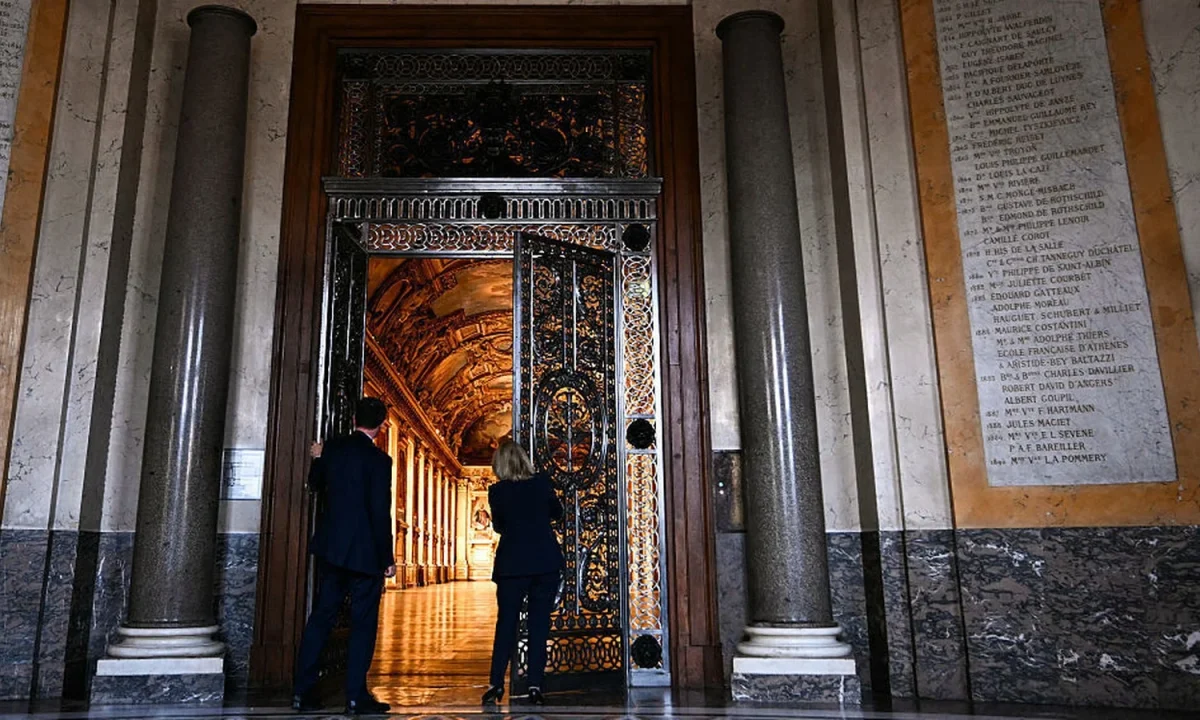
The Louvre gallery breached in a brazen daylight jewel heist last year has reopened to visitors, drawing curious tourists even as its priceless displays remain absent.
The Apollo Gallery, among the most opulent rooms in the world’s most visited museum, had long been celebrated as the home of the French crown jewels.
Its reputation changed after thieves stole eight items worth around $100 million (€87.67m) during last October’s raid, turning the vaulted hall into the backdrop for one of the most audacious burglaries in recent memory.
“For me it’s an honour to be here on the first day, in the morning,” said Jenny Lee, a 34-year-old tourist guide.
French police have arrested four suspected robbers, but the missing treasures remain unaccounted for despite extensive searches across the Paris region and contact with investigators in Belgium, Italy and elsewhere.
Officials have removed the jewels that remained in the Apollo Gallery and plan to exhibit them in a secure, windowless room in the future.
During the raid, the thieves used a truck-mounted lift to reach the gallery’s balcony, then deployed powerful disc cutters to slice through windows and glass display cases.
A museum-commissioned audit in 2019 had warned of security weaknesses created by the gallery’s balcony and road-side position, but no action was taken on its findings.
Iron window guards were installed on the outside of the Apollo Gallery last December
The theft shocked observers around the world, humiliated France and exposed multiple security failures, including the Louvre’s outdated CCTV system.
It also plunged the institution into turmoil, prompting employee protests and the resignation of Laurence des Cars, the museum’s first woman president.
Christophe Leribault, an art historian and former head of the Versailles Palace, replaced her in February.
Police detained the four men suspected of carrying out the robbery in the following weeks. All came from the Paris region and had criminal backgrounds.
Several have acknowledged participating in the heist, but insist they followed instructions from an alleged mastermind and did not realize they were breaking into the Louvre.
Fearing retaliation, they have declined to identify the supposed ringleader, although investigators reportedly question whether such a person exists.
Another possibility under consideration is that the group devised the operation independently and carried it out for financial gain.
The Louvre, whose treasures include the Mona Lisa, received around nine million visitors last year—far beyond the capacity it was designed to handle and a continuing source of overcrowding.