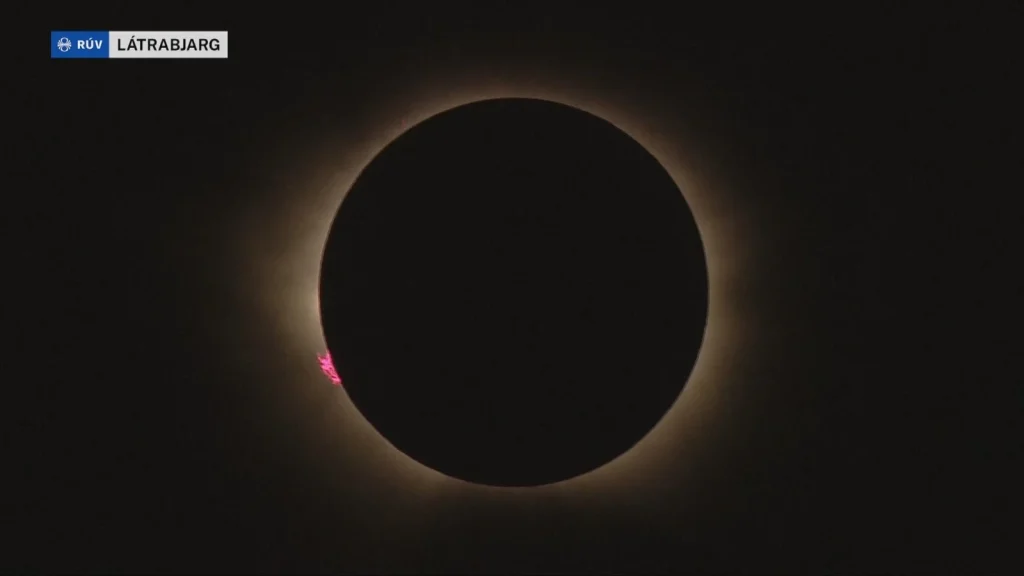
Western Iceland plunged into darkness as a total solar eclipse swept across the country’s coast, giving crowds a fleeting view of one of nature’s most dramatic spectacles.
A gap in the cloud cover offered locals and visitors a chance to watch the moon pass directly in front of the sun.
- Advertisement -
Live pictures from Reykjavik showed an overcast sky above the capital, but the crowd gathered outside Hallgrimskirkja church erupted in cheers when the light suddenly disappeared.
Millions of people in Iceland and northern Spain turned out to witness Western Europe’s first total solar eclipse in 27 years.
Spanish officials, however, urged people not to travel into areas where a heatwave had heightened the threat of wildfires.
Up to six million visitors were expected across predominantly rural parts of northern Spain and the Balearic Islands that lay along the eclipse’s path, according to Spain’s Secretary of State for Science, Juan Cruz.
“I hope that tonight will see the emergence of a wonderful generation of astrophysicists. It’s such a special moment.”
In Spain, the eclipse was followed almost immediately by sunset, adding to the drama of the event.
For centuries, the strange experience of daylight fading into twilight as animals fell silent beneath the moon’s shadow was viewed as an omen, a cosmic contest or evidence of divine power.
Spain is now presenting the eclipse as an opportunity to highlight lesser-known regions and steer visitors beyond its crowded coastal resorts. At the same time, authorities mounted a major police operation and public safety campaign aimed at preventing wildfires.
Interior Minister Fernando Grande-Marlaska said 25,000 officers had been assigned to maintain security at eclipse viewing sites, while almost 100 aircraft and helicopters were being deployed.
He encouraged the public to watch from the hundreds of official observation points and to respect restrictions imposed around some parks.
“Let’s not forget that the wildfire risk is very high, it’s extreme due to high temperatures,” he said.
A view of the eclipse from San Sebastian in Spain
Lola Guerreiro spent the night in the mountains near Arcos de las Salinas in eastern Spain, home to Galactica – Europe’s largest educational astronomy centre – and the Javalambre observatory. She had driven for seven hours from Extremadura to reach the site.
“Watching a total solar eclipse has been a dream of mine for many, many years, and I didn’t want to miss the chance to experience it, even though it meant a seven-hour journey,” she said.
Sergio, a 60-year-old Italian, travelled with his family in a camping van to Arija in northern Spain.
“I do feel a little emotional. Yes, because I know I won’t have another chance in my life to see an eclipse, a phenomenon like this,” he said.
The Iberian Peninsula had not experienced a total solar eclipse since 1912.
Another total eclipse is due to cross the region on 2 August 2027, followed by an annular eclipse in January 2028. Together, the events are known as the “Iberian Eclipse Trio.”
A view of special solar eclipse glasses held towards the sky in Antibes, France
In Reykjavik, specialist glasses that allow people to watch the eclipse safely had been sold out for days. Iceland, a Nordic country of roughly 400,000 people, was preparing to receive as many as 80,000 visitors.
Totality reached Iceland’s westernmost coast at about 5.44pm (6.44pm Irish time), covering the far west of the island in complete darkness for as long as 2 minutes and 13 seconds. Most towns and cities experienced shorter periods of darkness.
The moon’s shadow then continued moving eastwards.
Officials had warned of severe traffic congestion and advised spectators to arrive early.
Singer Björk was scheduled to perform a DJ set at an eclipse-themed event south of Reykjavik.
NASA planned to send a high-altitude WB-57 aircraft from Iceland to track the moon’s shadow. Teams funded by the US space agency also launched balloons to examine how the sudden drop in light and temperature affected the lower atmosphere.
The event attracted not only casual viewers but also dedicated “eclipse chasers” who travel around the world to reach the path of totality whenever an eclipse takes place.
Gordon Telepun, a retired plastic surgeon and amateur astronomer from the US who has photographed six total eclipses, said he planned to watch from Mallorca because Spain offered everything eclipse chasers were looking for.
The eclipse was also visible from Ireland.