US strikes on bridges and an airport in Iran have widened the conflict’s reach, prompting Tehran to retaliate against a power generation and desalination plant in Kuwait.
By targeting critical infrastructure, both countries have pushed the confrontation closer to a potentially more dangerous phase.
At sea, where renewed fighting has once again choked off Gulf energy supplies, US Marines boarded a tanker near the Strait of Hormuz.
Armed men seized another vessel off Yemen, deepening fears over security at the Middle East’s other major oil-shipping choke point near the mouth of the Red Sea.
US and Iranian footage shows US strikes
As signs of escalation mounted, benchmark Brent crude prices jumped more than 3% to nearly $87, their highest level since an interim agreement a month ago sought to bring the war to an end.
Shares fell worldwide, while Wall Street opened sharply lower.
US President Donald Trump has threatened sweeping air strikes against Iranian infrastructure and refused to rule out a ground assault on Iran’s coastline or islands.
US officials have said the attacks on southern Iran are intended partly to broaden the options available to Mr Trump.
But such action could drive Tehran to retaliate against essential infrastructure in vulnerable neighbouring Arab countries, or encourage its Yemeni allies to further disrupt global energy flows by attacking Red Sea shipping.
Bridges struck in Iran, plant damaged in Kuwait
In its latest operation, the US military’s Central Command listed “military logistics infrastructure” among the targets it said had been struck, marking the first time in more than a week that it had referred to infrastructure.
Iranian state media reported that at least five bridges in the south had been hit.
Seven people were reported killed in strikes on bridges at the southern port of Bandar Khamir, where the railway station was also attacked.
Farther east, away from the coast, an airport was reported struck in Iranshahr, in a province bordering Pakistan.
Reuters could not independently verify those accounts, which also included reports of other deadly strikes, among them an attack in the port of Bandar Abbas that killed a woman and wounded her child.
Iran responded by announcing attacks on Gulf countries hosting US airbases, including Bahrain, Qatar and Kuwait.
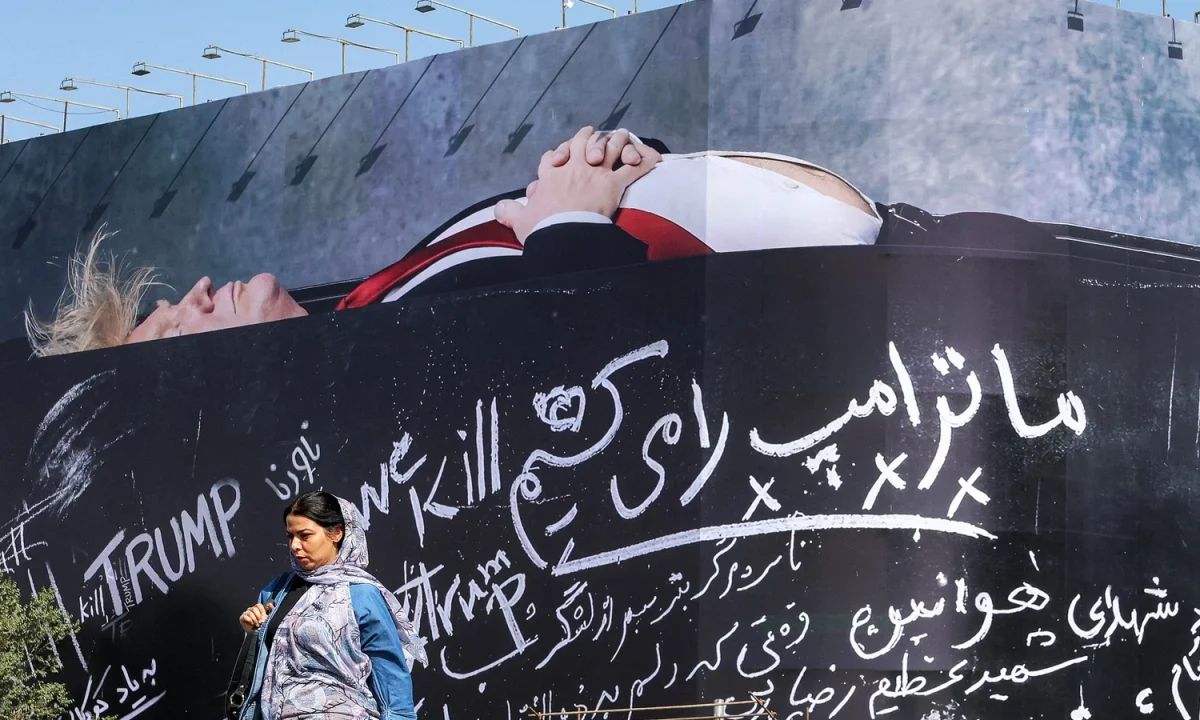
Traffic crosses a bridge below an anti-US mural in Tehran
Kuwaiti authorities said an Iranian attack had struck one of the country’s power generation and water desalination stations, damaging facilities, starting a fire and knocking a large number of electricity generation units out of service.
Firefighters contained the blaze as technical crews assessed the damage, secured the site and worked to restore electricity generation as quickly as possible, the Ministry of Electricity, Water and Renewable Energy said.
Wealthy Arab Gulf states rely heavily on facilities that generate power and turn seawater into fresh water, making life possible in their desert cities.
Iran’s strike on a Kuwaiti desalination plant on 30 March was viewed as a major escalation and helped propel the US towards declaring the war’s first ceasefire a week later.
Strait dispute intensifies
Iran said it had attacked US bases in Kuwait, Qatar and Bahrain, along with an American radar station in Oman.
Blasts were heard in Doha, the Qatari capital, where the interior ministry said shrapnel had wounded a child.
Tehran also said it had fired at Syria, apparently for the first time during the war, aiming at what it called a US special forces base in Tanf. Damascus and Washington say American troops left the site earlier this year.
A Syrian military source said the projectile landed near the base without causing damage or casualties. CENTCOM said no US personnel had been killed or captured.
The interim deal reached last month to end the conflict has unravelled since 7 July, when Iran attacked vessels in the Strait of Hormuz and the US answered with air strikes.
Tehran has since declared the strait closed, while Washington has reinstated its blockade of Iranian ports.
In the latest maritime operation, the US military said it boarded a tanker to enforce the blockade. It released images showing Marines rappelling from a helicopter onto the deck, where one was photographed posing in front of an Iranian flag.
Outside the Gulf, armed attackers boarded and captured a small chemical tanker off Yemen in the Gulf of Aden, near the entrance to the Red Sea.
A maritime security source said the seizure appeared linked to Somali piracy rather than an operation by Iran’s allies in Yemen, the Houthis.
Only three commodity vessels passed through the Strait of Hormuz yesterday
However, security sources in the Horn of Africa have previously voiced concern that the Houthis could assist, encourage or supply weapons to pirates operating in the region.
Although Iran and the US have traded strikes every day since last week, both sides have so far avoided moving beyond boundaries established earlier in the conflict, when civilian infrastructure and major economic assets were largely treated as off limits because of the danger of retaliation.
Iran has warned that it will strike civilian infrastructure across the Middle East if Mr Trump carries out his threats to attack Iranian infrastructure.
Tehran has also indicated it could press its Houthi allies in Yemen to shut another crucial waterway: the Bab al-Mandeb at the entrance to the Red Sea. Such a move could sever the main alternative route for Middle Eastern oil seeking to bypass the Gulf.
Sources have told Reuters that Iran has already directed the Houthis to take action if Washington targets the country’s infrastructure.
More Middle East Stories