
By Eltayeb Siddig, Nafisa Eltahir and Khalid AbdelazizTuesday June 23, 2026
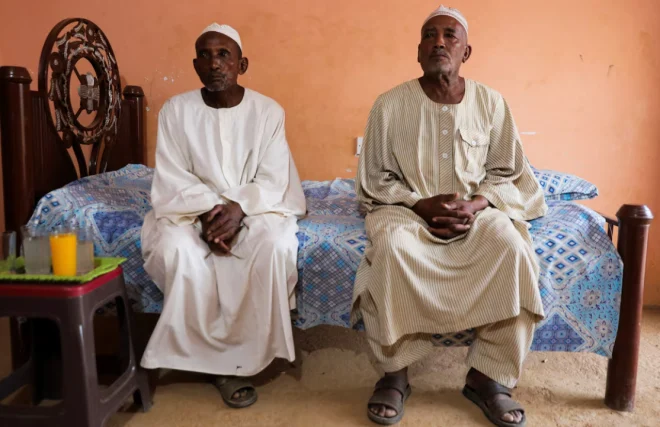
Parents of victims mass-murdered by the Rapid Support Forces (RSF) sit on a bed during an interview in the Salha area, south of Omdurman, Sudan, June 7, 2026. REUTERS/Stringer Purchase Licensing Rights
When Ali Rizkallah, a commander in Sudan’s Rapid Support Forces paramilitary group, arrived in Khartoum last month, he was greeted not as a former foe but as a convert. The army-backed authorities handed him a uniform and a rank in the force he had spent roughly three years fighting.
The public embrace was presented as a political win for the government, which has been celebrating a growing list of high-profile defections that are shifting allegiances in Sudan’s brutal war and strengthening the military’s hand in one of the century’s deadliest conflicts.
Yet the images of Rizkallah and other ex-RSF figures being received with ceremony, appearing at news conferences and, in some cases, physically embracing former adversaries, have stirred anger among many Sudanese. For victims and survivors, the spectacle raises a different question: whether those accused of abuses will slip beyond accountability.
‘I CAN’T FORGIVE THEM,’ SAYS DARFUR WOMAN
“These RSF soldiers, even if they seek God’s forgiveness, I can’t forgive them because of what I saw face to face,” Halima Ismail, a woman in western Darfur, told Reuters.
She said Rizkallah’s fighters fired into the air during an attack on a village where she had been taking shelter in 2024.
Since the RSF and the army split in April 2023 and plunged the country into war, Sudan’s civil conflict is believed to have killed hundreds of thousands of people, driven millions from their homes and deepened famine and disease across the country.
Darfur has seen some of the worst atrocities. It is an RSF stronghold and the region where Rizkallah, widely known as “al-Savannah,” served as a commander. The force was accused of abuses during its assault on al-Fashir last October, which Reuters later documented in a film.
Another senior commander in North Darfur, al-Nour Guba, defected to the army in April. Speaking to Reuters, Guba said he had not switched sides to avoid prosecution and insisted that any former RSF commanders implicated in crimes should face justice.
“If anyone from the Sudanese people has anything against us, I swear we are ready,” he said.
Savannah, who did not respond to requests for comment, has previously said he would surrender if accused of wrongdoing. Sudan’s army-affiliated government and the RSF, which has denied committing atrocities in Darfur, also did not respond to requests for comment.
CALLS FOR ACCOUNTABILITY
Now sheltering in Tawila, a village in Darfur, Ismail said she had been forced to flee repeatedly as RSF units raided communities around al-Fashir. She said she witnessed women being raped in front of her and was whipped by RSF fighters.
“You can see the scars on my arms, all the way down my legs,” she said.
During one attack by a unit under Rizkallah’s command, fighters fired their weapons into the air and forced her and her children to the ground, she said.
In neighboring Kordofan, resentment is equally raw. A trader in al-Nuhud said he intends to bring a private case against Rizkallah under Sudan’s sharia law system, accusing one of the commander’s units of looting peanuts and gum arabic from his warehouses.
“What happened is the responsibility of Savannah, the RSF, and the army that did not protect us,” the trader said, speaking anonymously for fear of being targeted.
Mohamed Salaheldin, a member of the executive board of Emergency Lawyers, an activist group, said such cases are unlikely to move forward in any meaningful way while the war continues.
“This issue can’t be dealt with piecemeal — it needs transitional justice,” he said.
That stands in contrast to the 243 cases tallied by Emergency Lawyers that have gone to trial against alleged collaborators, on accusations ranging from passing along intelligence to cooking for RSF fighters during the occupation. Some of those cases have ended in death sentences, although no executions have been carried out.
One young activist said he was angered by the sight of defectors being “welcomed” and “honoured” while he himself had been harassed and detained by both RSF and army-aligned authorities as he carried out aid work in his Khartoum neighborhood.
“When I see an RSF vehicle driving in front of me now I can’t even lift my head to look them in the face, let alone live with them like they’re heroes,” he said, speaking anonymously out of fear of further targeting.
ARMY SEEN EXPLOITING DIVISIONS
By encouraging defections, the army is seeking to exploit ethnic splits inside the RSF, said Emadeddin Badi, a senior fellow at the Global Initiative Against Transnational Organized Crime.
Many senior RSF commanders come from the Arab Rizeigat tribe, where tensions among clans have sharpened, particularly after an RSF raid earlier this year on the hometown of army-aligned Musa Hilal.
Hilal belongs to the Mahamid clan, as does Savannah. In his interview with Reuters, Guba pointed to these fault lines, saying the RSF was “based on a racist, tribal” system that specifically favored the family of RSF commander Mohamed Hamdan Dagalo, known as Hemedti.
The army is hoping similar fractures can echo the result seen in central El Gezira state, where the defection of RSF-aligned militia commander Abuagla Keikal helped turn the tide in 2024, Badi said.
“There’s a military rationale, but the social repercussions are probably underappreciated by the armed forces,” he added.
Writing by Nafisa Eltahir and Alexander Dziadosz; Editing by Andrew Heavens