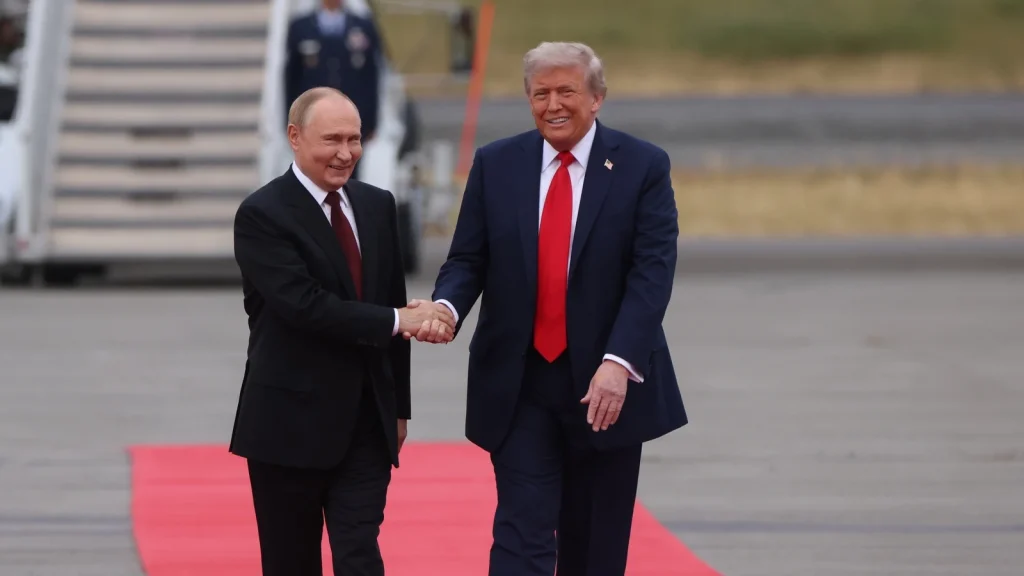
“There’s no deal until there’s a deal,” US President Donald Trump told reporters in Anchorage, Alaska’s largest city, on this day last year.
The remark was deliberately noncommittal, echoing the uncertainty that had hung over the summit—and the lengthy statement delivered minutes earlier by Russian President Vladimir Putin from the same podium.
- Advertisement -
Many observers had hoped the meeting at an air force base outside Anchorage would mark the first significant step towards ending the war in Ukraine.
Mr Trump had threatened to impose tougher sanctions on Russia unless Moscow agreed to a ceasefire.
In the days before the summit, analysts and officials debated a wide range of possible outcomes.
With neither Ukraine nor Europe represented in Alaska, concerns grew in Kyiv and across European capitals that Mr Trump and Mr Putin might strike an agreement behind Ukraine’s back, leaving Kyiv under pressure to accept an unacceptable peace.
For many Ukrainians, the decision to invite the Russian leader to the US felt like a betrayal. Few believed anything positive could emerge for their country.
Ultimately, the meeting delivered little tangible progress towards ending the war in Ukraine.
A year later, there is still no “deal” to stop the conflict, while the prospect of a peace agreement appears more distant than it did immediately after the Anchorage summit.
US President Donald Trump, Russian President Vladimir Putin and their delegations ahead of the summit in Anchorage
Before the meeting, the Trump administration had supported the position shared by Ukraine and its European allies: a ceasefire should come first, creating the conditions for negotiations on a durable peace settlement.
But shortly after meeting Mr Putin, Mr Trump announced a dramatic change in direction. In a post on his Truth Social account, he said he now favoured moving directly towards a peace agreement rather than pursuing an initial ceasefire.
Mr Putin had opposed—and continues to oppose—a ceasefire covering all fronts. Whatever the Russian leader told Mr Trump inside the Anchorage meeting room persuaded the US president to abandon the previous approach.
Ukraine and European leaders rejected the decision to drop the ceasefire demand. They viewed it as an American attempt to push Kyiv towards territorial concessions.
In the months that followed, the policy reversal instead strengthened European military backing for Ukraine and reinforced the shared European view that a ceasefire was the necessary starting point for meaningful peace negotiations.
Mr Putin offered no concessions in Anchorage. Most importantly, he maintained his demand for control of all of Donbas as the central condition for ending the war.
That left Ukrainian diplomats focused on securing US guarantees for their country’s security before they would even consider talks about the future status of Donbas.
The Trump administration has never clearly explained what those guarantees would involve.
The closest the US came to providing detail was last January, following a Coalition of the Willing summit in Paris, when US special envoy Steve Witkoff said the guarantees for Kyiv “would be the strongest anyone has ever seen”.
A Coalition of the Willing summit was held last month
Ukraine continues to seek those guarantees, but substantive discussions on the issue lost momentum after the US launched its war against Iran last February.
US officials also held their final trilateral discussions with Russian and Ukrainian representatives in Geneva in February, just 10 days before the US strikes on Iran began. Since then, the two sides have not held further talks.
Professor Pavel K Baev, a Russia foreign policy expert at the Oslo Research Peace Institute, said Mr Putin “overplayed his hand” at the Alaska summit.
“It wasn’t exactly a bluff that was called. It was more a demand too far, which even Trump recognised as impossible to meet,” Prof Baev told RTÉ News.
“I think that for Trump, Putin needed to make more concessions and not insist on territorial gains, which proved to be impossible on the battlefield and politically as well.
“Putin could have made a further step towards agreeing on a ceasefire at least. That was for Trump, I think, the key point, and Putin missed that opportunity to make a deal with Trump, who generally lost interest,” said Prof Baev.
Just three days after the Anchorage summit, the leaders of five European countries, along with European Commission President Ursula von der Leyen and NATO chief Mark Rutte, joined Ukrainian President Volodymyr Zelensky at the White House.
Their message was that Ukraine could not be shut out of negotiations to end the war. They also pressed for security guarantees for Kyiv.
For Ukraine, the clearest benefit of the Anchorage meeting was the way it prompted Europe to recognise that political and moral support alone would not be enough to help Kyiv.
Most European countries have increased military and financial assistance to Ukraine over the past year, helping to compensate for the Trump administration’s near-total withdrawal of military support.
Agreements between Ukraine and European governments on drone manufacturing and air defence cooperation have also become increasingly common.
As a result, Ukraine is less vulnerable to US pressure to end the war on Russia’s terms than it was during the early months of 2025, when Mr Trump and his officials appeared to regard Kyiv as the side responsible for making concessions.
The Americans didn’t deliver Ukraine on a platter for Putin as he had wished.
“Before Anchorage there was not such close cooperation between Europe and Kyiv on the path towards peace. Now, it is water-tight,” Volodymyr Dubovyk, Director of the Centre of International Studies at Odesa Mechnikov National University, told RTÉ News.
For months after the Alaska summit, the Trump administration continued to press Ukraine to treat the future of Donbas as the central question in ending the conflict.
Mr Zelensky and senior Ukrainian officials resisted that pressure, maintaining their demand for firm and clearly defined security guarantees.
Eventually, the pressure eased as the Trump administration accepted that Kyiv would not simply surrender Donbas.
Mr Dubovyk described the Alaska meeting as significant because the US and Russia “discovered that there was a limit to their pressure”.
“The Americans didn’t deliver Ukraine on a platter for Putin as he had wished,” he said.
For at least six months after the summit, Mr Putin, Foreign Minister Sergey Lavrov and other senior Russian officials continued to speak of the need to return to what they called the “spirit of Anchorage”.
The phrase reflected Moscow’s claim that Russian and US officials had reached an understanding in Alaska about how the war in Ukraine could be brought to an end.
US Secretary of State Marco Rubio, who attended the summit, has said no agreement was reached. There is also no written record of the discussions.
In recent months, however, Mr Putin has stopped using the phrase “spirit of Anchorage”. That may indicate that the Kremlin recognises the diplomatic framework has shifted—or simply that Washington is no longer interested in it.
Although the frontline has changed little over the past year, the air war has evolved sharply.
Over the past two months, Ukrainian deep strikes against oil depots and e-commerce warehouses inside Russia have contributed to petrol shortages and inflicted damage on the country’s important retail sector.
Ukraine now holds a stronger military and diplomatic position, even as Russia has responded with more ballistic missile attacks and devastating glide-bomb strikes on cities near the frontline.
Smoke rises from a warehouse owned by a Russian e-commerce giant near Saint Petersburg after being hit by Ukrainian drones on 24 July
Mr Putin’s uncompromising position in Alaska has made it extremely difficult for him to reverse course and accept the ceasefire option.
Doing so could be portrayed as weakness—something the Russian president is determined to avoid.
Prof Baev said Mr Putin’s room for manoeuvre is now “much narrower” than it was a year ago.
The summit also brought Ukraine and Europe closer together, although European governments remain divided over whether they should engage directly with Mr Putin and other Russian officials.
Some media outlets have reported that Mr Witkoff and Jared Kushner, a US envoy and Mr Trump’s son-in-law, plan to travel to Kyiv and Moscow later this month.
It would be the first time the two US envoys had visited Kyiv since the current Trump administration took office.
Few Ukrainians, however, expect a breakthrough in the near future, and there is no indication that Washington is preparing a revised peace proposal.
Mr Dubovyk said the reported visit by the two US envoys to Kyiv “looks like an attempt to return to what was there before, an imitation of peace talks”.
A year on, the Alaska summit looks both like a failure of US diplomacy and a strategic miscalculation by Mr Putin, who dismissed the ceasefire option outright. His forces have made only limited gains in Donbas over the past 12 months, and at a heavy cost.
At the same time, the meeting helped accelerate Europe’s diplomatic and military support for Ukraine—assistance that has proved vital to the country’s survival.