
By Farhan Jimale Thursday August 6, 2026
Farhan Jimale
“To deny people their human rights is to challenge their very humanity.” — Nelson Mandela.
In a world reshaped by war, humanitarian emergencies, economic instability, climate pressures and rapid technological change, one conclusion stands out: neither growth nor security alone can deliver lasting peace or democratic government. Societies also need institutions that defend human dignity, apply the rule of law and earn the confidence of the people.
Somalia’s democratic transition is unfolding against this unsettled international backdrop. Following decades of conflict, institutional breakdown and political change, the country is rebuilding its constitutional order and developing the institutions required for a peaceful democratic future. The creation of the National Independent Human Rights Commission is consequently much more than an administrative development. It represents a commitment to the principles on which democratic life rests: dignity, accountability, equality and justice.
Six months have elapsed since the Commission elected its leadership and officially began its work. In institutional terms, that is a brief period. Even so, it offers an opportunity to consider the groundwork already laid and the weight of the mandate entrusted to the Commission.
As one of the Commissioners, I have learned that institution-building is seldom defined by headline-making events. It is more often the result of deliberate choices, sustained dialogue and the patient establishment of integrity, independence and public trust. Those efforts can be difficult to see from outside, but they will ultimately determine whether the Commission can carry out its responsibilities and retain the confidence of the people it serves.
This is not a formal institutional report. It is a personal reflection on the value of independent national human rights institutions, the significance of Somalia’s first such body at a pivotal point in the country’s history, and what the Commission’s opening six months tell us about the work still ahead.
Why National Human Rights Institutions Matter?
Across the world, National Human Rights Institutions have become essential components of democratic governance. Their role is not limited to addressing abuses after they occur. They also help create a public culture in which rights are understood, respected and reflected in government policy and daily administration.
An effective National Human Rights Institution provides an independent link between citizens and the State. It creates channels for redress, promotes accountability, supports dialogue and helps restore faith in public institutions. At its core is the principle that government exists to serve the people, rather than people existing to serve government.
That role carries particular importance in Somalia.
After years of conflict and institutional weakness, restoring public confidence is one of the country’s most pressing national tasks. Citizens need institutions that act independently, fairly and transparently if trust in public life is to return. The creation of Somalia’s first National Independent Human Rights Commission is therefore a significant step in the country’s democratic development.
Its performance, however, will not rest on the Commission by itself. Protecting human rights is a national undertaking that requires genuine cooperation among Parliament, Government, the Judiciary, civil society, traditional elders, religious leaders, the private sector, development partners and, most importantly, Somali citizens.
A Constitutional Mandate and a National Responsibility
The Commission was not created solely through political ambition; its authority is rooted in Somalia’s constitutional and legal framework. Article 41 of the Provisional Constitution provides for an independent National Human Rights Commission. The National Independent Human Rights Commission Establishment Law (Law No. 16 of 2016) turns that constitutional commitment into an operational mandate by setting out the Commission’s powers and functions. The law authorises it to promote and protect human rights, monitor compliance with constitutional and international standards, receive and investigate complaints, examine systemic violations, visit detention facilities, issue recommendations and work with public institutions and civil society to advance respect for human rights. It also empowers the Commission to summon witnesses, seek relevant information, mediate complaints and recommend suitable remedies when violations are established.
But a law, on its own, cannot secure an institution’s effectiveness.
Legitimacy comes not only from the statute that creates an institution, but from the integrity with which it applies its authority. Independence must be visible in impartial decisions. Credibility must be built through consistency, openness and professionalism. Public trust, above all, develops gradually through principled engagement with the communities the institution is intended to serve.
Laying the Foundations
Our central task during the first six months has been to establish the foundations for the Commission’s long-term work. That has involved creating appropriate governance arrangements, setting ethical standards and improving decision-making procedures so that the institution operates consistently, accountably and with integrity.
We have also taken practical steps to establish the Commission’s presence, including opening its headquarters and putting in place the administrative systems needed to support its mandate. Such work may attract little public attention, but it is essential to creating an independent body that can act credibly and command confidence while carrying out its constitutional responsibilities. The Commission’s future work will depend on the strength of these early foundations.
Engagement with stakeholders has been another important part of this initial period. We have held discussions with government bodies, civil society organisations, development partners and private-sector representatives. These contacts are intended neither to dilute our independence nor to create dependence. They are meant to explain the Commission’s mandate, establish productive working relationships and develop a shared understanding of its role.
Those conversations have underscored one point in particular.
Independence is not isolation.
It means being able to engage openly with others while preserving impartiality, objectivity and fidelity to the law and the public interest.
Human Rights Begin in Everyday Life
Human rights are frequently addressed through constitutional language, international treaties and legal concepts. For most Somalis, however, they are encountered through the practical realities of daily life.
They are evident in whether parents can keep their children in school, whether a sick family member can receive medical care, whether clean water is within reach and whether households can live with a basic level of dignity.
Figures released recently by the Somali National Bureau of Statistics (SNBS) make that connection clear. The June 2026 Consumer Price Index recorded annual inflation of 8.1 per cent, with notable increases in areas closely tied to fundamental rights. Education costs rose by 14.0 per cent, including a 16.6 per cent increase in early childhood and primary education. Health costs climbed by 11.8 per cent, while outpatient services rose by 17.1 per cent. Housing, water, electricity, gas and other essential utilities increased by 10.3 per cent, and water prices alone rose by 16.5 per cent.
These figures are more than measures of economic change.
They describe the pressure placed on families as they weigh school fees, medical care and other necessities against limited household resources. They also show why economic policy and human rights cannot be treated as separate concerns.
The Commission does not set prices or design fiscal policy; those duties belong to other institutions. Its responsibility, however, includes ensuring that the human impact of economic conditions is not overlooked and that public decisions remain anchored in dignity, equality and non-discrimination.
When economic conditions become harder, protecting rights becomes more urgent, not less.
Looking Ahead
Having spent the first six months building the institution, the Commission’s next phase must turn that groundwork into tangible benefits for the public.
That will require more accessible complaint procedures, wider public knowledge of the Commission’s role, stronger collaboration with state institutions and civil society, and continued efforts to earn confidence through transparency, professionalism and independence.
The Commission’s success will not be judged by the number of meetings it convenes, reports it releases or statements it issues. It will be judged by whether ordinary Somalis come to believe that an independent institution will hear their concerns, protect their rights and pursue accountability fairly and without fear or favour.As a Commissioner, I remain optimistic.
Somalia’s democratic institutions remain young, but they are developing. Trust takes time to build. Rights protection demands courage. Strong institutions require sustained consistency over many years.
The National Independent Human Rights Commission is only beginning its journey. If it stays true to the principles that shaped its creation, including independence, impartiality, accountability and respect for human dignity, it can become one of Somalia’s lasting democratic institutions.
Human rights protection cannot be left to one Commission. It is a shared national obligation involving Government, Parliament, the judiciary, civil society, the private sector, development partners and every Somali citizen.
That collective commitment is the path toward a Somalia where justice commands trust, dignity is safeguarded and human rights are not simply promises written into law, but realities encountered by citizens in their everyday lives.
___________________________
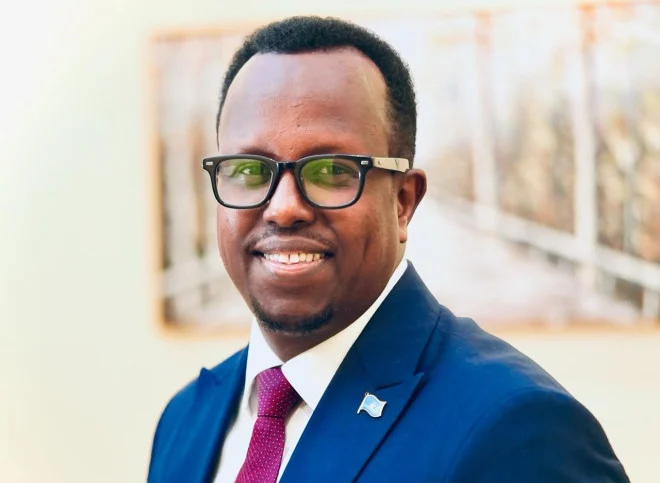
About the Author: Farhan Jimale is a Commissioner of the National Independent Human Rights Commission (NIHRC) of the Federal Republic of Somalia, an accomplished human rights advocate, strategic communications specialist, and former international journalist with more than three decades of experience spanning human rights, governance, public policy, media, and humanitarian affairs.
Before joining the Commission, he served as Government Spokesperson and Director of Communications and Public Relations at the Office of the Prime Minister of the Federal Republic of Somalia, following more than two decades with the BBC World Service and United Nations humanitarian agencies, where he led strategic communications, journalism, and public information initiatives across the Horn of Africa.
He holds a Master’s degree in Religion in Peace and Conflict from Uppsala University, Sweden, and a Master’s degree in International Relations from Queen Mary University of London, United Kingdom. He writes in his personal capacity on human rights, governance, and public policy, and can be reached at [email protected] or [email protected]. He can also be followed on LinkedIn https://www.linkedin.com/in/farhanjimale/ and X (Twitter) https://x.com/farhanjimale for professional insights and commentary.