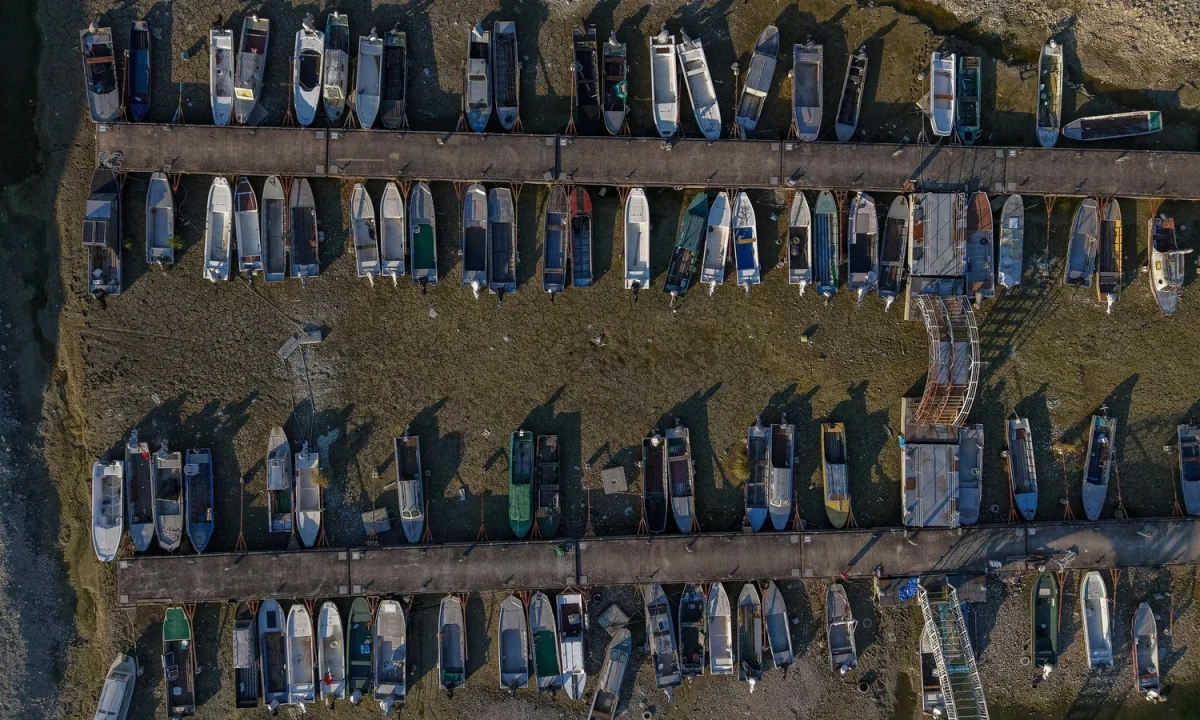
At the tourist port in the Romanian town of Corabia, the Danube has retreated so far that the waterfront is nearly empty, leaving only a handful of pleasure boats stranded among the algae.
Sandbars have formed across the river, blocking vessels from entering or leaving the port.
“Last year we could swim across but now the water only comes up to our chests,” said 71-year-old Doru, gesturing toward an island in the river.
“In two years, we’ll be able to just walk across,” added the fisherman, who gave only his first name.
From its headwaters in Germany’s Black Forest mountains to its outlet on the Black Sea, the Danube stretches 2,850km (1,770 miles) and carries the consequences of the drought through every country along its route.
In Slovakia and Hungary, then farther east in Romania and Bulgaria, vessels have been unable to sail fully laden and are being held up for long periods.
A fisherman casts his line in the shallow Danube waters near Vidin, Bulgaria
Hungary shut down its only nuclear power plant on Sunday because it depends on the Danube for cooling water. Romania also halted both reactors at the Cernavoda plant, the first time the two units had been closed simultaneously because of low river levels.
Serbia, meanwhile, has had to cut electricity production at its two largest hydroelectric facilities.
Scientists from the World Weather Attribution group said in a report published last week that human-caused climate change had intensified an already severe drought.
The Danube has fallen to a 30-year low in Romania and Slovakia, while Hungary is recording its lowest level ever.
‘There’s never been a drought like this before’ – fisherman
Near the Vidin-Calafat bridge linking Bulgaria and Romania, fishermen said the receding river had left them unable to work, with their boats stranded on shore.
“It’s never dried up this much before,” fisherman Rossen Dobrev said. “Now we can even walk all the way to Romania.”
“I’ve been a fisherman for 39 years and there’s never been a drought like this before,” said fellow fisherman Aleksandar Angelov with a sigh.
“The people in charge up there need to take action,” added the 59-year-old. “We don’t have any water here.”
Ferry services between Romania and Bulgaria have been temporarily suspended at two locations.
In Bulgaria, nearly 200 passengers were evacuated from a cruise ship after it ran aground on the Danube because the water had fallen so low.
Commercial traffic has also been disrupted.
“Cargo vessels are being forced to wait or sail with a reduced load,” a spokesperson for the Bulgarian government’s Danube agency said.
In Romania, sections of the river are already one metre (three feet) below the minimum level required for navigation.
“This is an exceptional situation… we’re surprised by this very, very low level,” said Adrian Maizel, from the administration responsible for monitoring Danube traffic.
“We are making efforts to maintain a navigable channel as much as possible – albeit a narrower one – so that navigation is not completely blocked,” he said, describing the administration’s dredging work.
Both Romania and Bulgaria recorded the unusually low readings significantly earlier than they did last year.
People cross sandbars revealed by the Danube’s falling waters near Apatin, Serbia
Farther north, in the Hungarian capital Budapest, the Danube has dropped to its lowest point since records began.
During the June heatwave, dozens of towns and cities along the river introduced water restrictions. By July, several cruise services had also been suspended.
At the Gabcikovo dam in Slovakia, even farther upstream, lock operations have slowed, creating longer queues and prompting captains to check whether their vessels can safely navigate the river.
Temperatures are expected to remain high, offering no immediate prospect of relief.
“I’ve lived here for 25 years and the water has never been this low,” said Romanian pensioner Mitica Nicolae as he fished in an irrigation canal near Corabia.
The 65-year-old, who listens to the public radio’s Danube water report each morning, said his catch had declined and warned that farm crops could also suffer.
Romania’s section of the river recently fell to its lowest level in three decades.
National authorities have restricted irrigation for farmers in the southeast, although those contacted by AFP said the measures had not affected them so far.
On a beach in southern Romania, just a few metres from the Danube’s edge, a boy dragged his bare feet through water that barely covered his ankles.
“It’s like quicksand,” he shouted to relatives watching from farther away.