By Elias BiryabaremaTuesday July 28, 2026
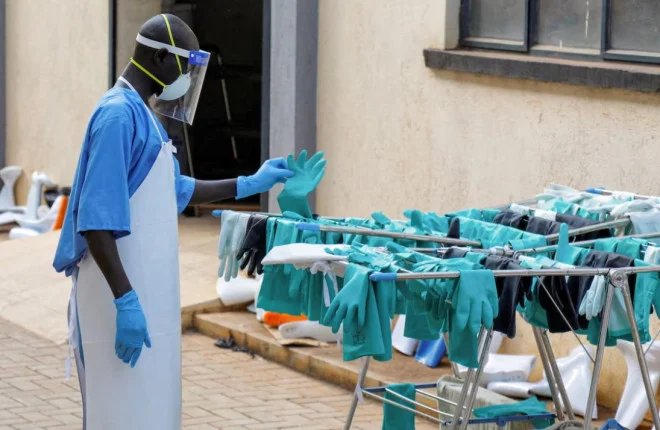
A Ugandan worker retrieves a rubber glove from an airing line during a visit by World Health Organisation (WHO) Director-General Tedros Adhanom Ghebreyesus to the Mulago National Referral Hospital Isolation Unit, as aid agencies step up efforts to contain a new Ebola outbreak involving the Bundibugyo Virus, in the Mulago suburb of Kampala, Uganda, June 8, 2026. REUTERS/ Abubaker… Purchase Licensing Rights
Uganda declared itself Ebola-free on Tuesday after its latest outbreak of the viral haemorrhagic disease infected 20 people and claimed two lives, the country’s health minister said.
The East African nation has faced repeated Ebola outbreaks since recording its first epidemic in 2000. Officials say that experience has helped Uganda develop the expertise needed to contain recent flare-ups quickly and limit transmission within communities.
Fifteen people infected during the latest outbreak, which was declared in mid-May, contracted the virus in neighbouring Democratic Republic of Congo, the centre of an epidemic where confirmed cases have surpassed 3,000.
Uganda’s last Ebola patient, a Congolese national, left hospital on June 22, less than 42 days before Tuesday’s declaration. The World Health Organization requires a 42-day waiting period before an outbreak can officially be declared over.
Health Minister Chris Baryomunsi said, however, that the declaration followed the “successful completion of the mandatory 42-day monitoring period which begun after the discharge of the last Ugandan national, a locally transmitted patient, on the 16 of June, 2026.”
Of the 20 confirmed infections, 18 patients recovered and were discharged. The two people who died from the virus were both from the Democratic Republic of Congo.
“Throughout this period the ministry of health maintained intensive surveillance nationwide and no new Ebola cases have been detected,” Baryomunsi said.
Officials say Uganda remains prone to recurring outbreaks because its numerous tropical forests are home to large populations of fruit bats, which are natural reservoirs for the virus.
Ebola spreads through contact with infected bodily fluids and tissue. Symptoms include headaches, muscle pain, vomiting blood and bleeding.
Reporting by Elias Biryabarema; Writing by Vincent Mumo Nzilani, Editing by Louise Heavens, Alexandra Hudson and Alex Richardson