
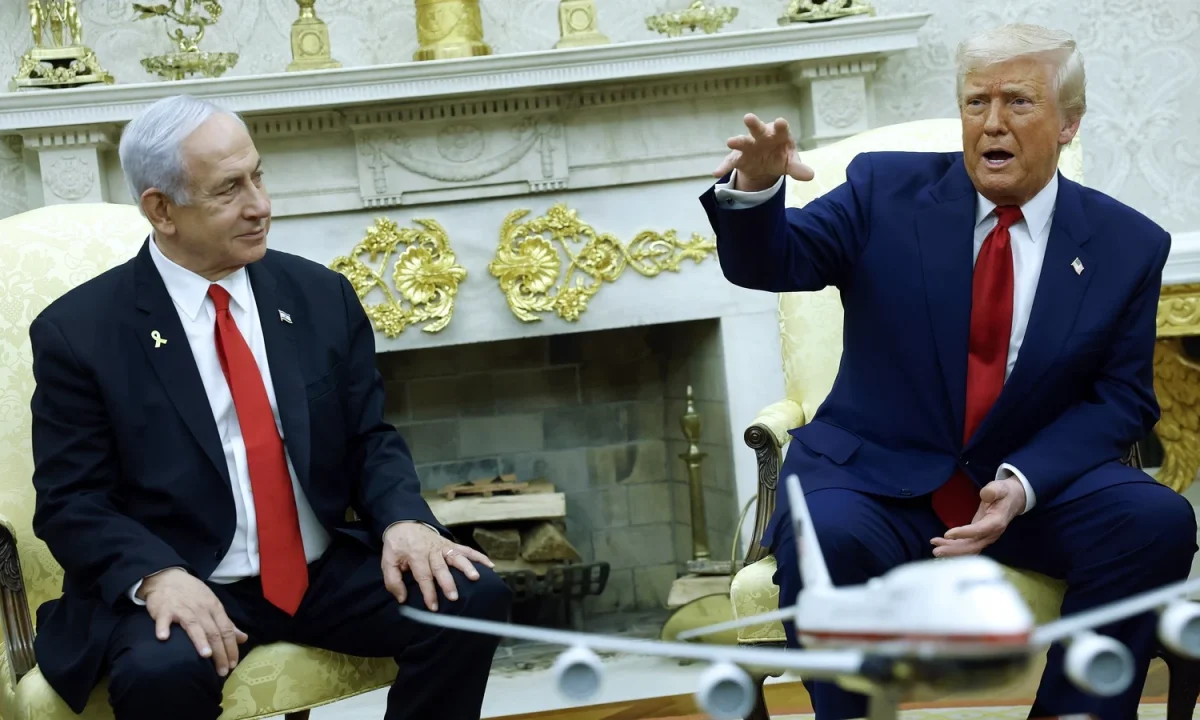
Israeli Prime Minister Benjamin Netanyahu is heading into a high-stakes White House meeting with US President Donald Trump, their first face-to-face encounter since the Iran war began and exposed rare public friction between the two allies.
The relationship between Mr Netanyahu and Mr Trump has looked uneasy at points in recent months, though both leaders have since moved to soften the appearance of a rift.
The war is expected to sit at the centre of their talks, after US-Israeli strikes on Iran in late February opened the conflict and Washington later signalled it wanted to leave room for negotiations.
Israel has stayed out of the latest fighting between the United States and Iran, which reignited earlier this month after a ceasefire agreed in April fell apart.
“This is a great privilege, but it is also a great responsibility,” Mr Netanyahu said before leaving Israel on Monday.
“We will discuss all the issues on the agenda, first and foremost Iran. Naturally, our goal is to safeguard our security and also to expand the circle of peace around us,” he added.
The two leaders’ ties appeared to hit their lowest point in April, during ceasefire negotiations, when Mr Trump directed profanity-laced outbursts at his Israeli ally.
Mr Trump later called Mr Netanyahu a “very difficult guy” in an interview.
Mr Netanyahu sought to play down the confrontation, describing the exchanges as “tactical disagreements” and insisting both men remained united on the war’s broader aims.
The leaders are also expected to review the rollout of a US-sponsored framework agreement signed by Israel and Lebanon last month, a deal whose implementation on the ground has proved difficult.
Gaza is also likely to feature in the discussions, with diplomatic efforts to restart reconstruction in the devastated Palestinian territory still stalled.
Nearly three years after the war between Israel and Hamas erupted, Gaza’s humanitarian crisis remains severe, while Israel continues to carry out regular strikes against people its military identifies as militants.
‘No rupture’ in ties
Yonatan Freeman, an international relations expert at the Hebrew University of Jerusalem, said the visit’s central purpose is to counter the perception that relations between the allies have cooled.
“I think that the main issue… is to show the world, to show Iran, and also even Lebanon and others as well specifically, that there is no break or any kind of major disagreement between the United States and Israel,” he said.
“There’s more in agreement between the two leaders than disagreement,” he added.
Mr Freeman said the gaps between Mr Trump and Mr Netanyahu appear to be about methods — the timetable, force and immediate objectives of military operations — rather than the ultimate goals of the war.
He also said Mr Trump would probably concentrate on his two main regional priorities, Iran and the expansion of the Abraham Accords, rather than Gaza, which he views as lower on the agenda.
Palestinians walk along a debris-laden street in the Tuffah area of Gaza City
The Abraham Accords, brokered by the United States during Mr Trump’s first term, brought formal diplomatic relations between Israel and the United Arab Emirates and Bahrain for the first time, with Morocco following later.
Other analysts, however, believe the talks could turn to the possibility of easing Israel’s military footprint in parts of the region, including Lebanon, Syria or Gaza.
Mr Netanyahu’s trip comes months before Israel’s national elections, in which he intends to seek another term.
Recent polling shows Mr Netanyahu trailing, with public anger still raw over his government’s failure to prevent Hamas’s 7 October 2023 attack on Israel, the assault that triggered the Gaza war.
Oman puts Strait of Hormuz mechanism to Iran
Oman has put forward a proposal to Iran for a joint regional mechanism to manage the Strait of Hormuz, funded through voluntary fees, a Gulf source said today.
The Omani plan, which has regional support, would mean Iran would not hold sole control over the crucial waterway, the source added.
The model draws on the Strait of Malacca, where users voluntarily contribute money to support navigation, environmental protection and search-and-rescue operations.
Iran’s foreign minister discussed issues related to the security of the Strait of Hormuz with his Saudi and Omani counterparts
The United States abruptly halted a campaign of air strikes against Iran over the weekend, lifting hopes that diplomacy could reopen shipping through the Strait of Hormuz, which carried a fifth of global energy supplies before the conflict.
President Donald Trump said yesterday that the United States was having “good talks” with Iran and that a deal was possible, while warning that US strikes would restart if negotiations failed.
Iranian Foreign Minister Abbas Araqchi discussed the Strait of Hormuz yesterday with his Omani and Saudi counterparts.
“He emphasised the need to strengthen cooperation and advance joint diplomatic efforts to establish stability in the region, and lift the insecurity imposed on the Strait of Hormuz due to the aggressive actions of the United States,” Iran’s foreign ministry said in a statement.
The call between Mr Araqchi and his Saudi counterpart, Faisalbin Farhan, followed Saudi Arabia’s announcement that it had shot down drones fired at the kingdom by Iran-affiliated groups in Iraq.
New Israel-Lebanon talks scheduled for August 4 – US official
The US State Department confirmed that Israel and Lebanon will hold their next round of talks in Rome from 4 August through 6 August, as Israel prepares to pull back from two “pilot zones” in southern Lebanon.
Italian Foreign Minister Antonio Tajani first disclosed the next round of US-mediated talks last week, before a State Department official, speaking on condition of anonymity, gave further details.
“In Rome, technical groups will focus on advancing the full implementation of the framework agreement,” the official told AFP, adding that the talks are expected to include “expanding the pilot zone process, resolving all outstanding border issues, and working on a comprehensive peace and security agreement.”
The Israel-Lebanon framework deal took shape after war broke out on 2 March between Israel and the Iran-backed militant group Hezbollah, against the backdrop of the wider Middle East conflict.
It seeks to end the war in Lebanon, disarm the Lebanese movement, deploy Lebanese troops in the south and set in motion a gradual Israeli withdrawal from the country through two “pilot zones.”
“The experience of the initial zones will help us perfect pilot-zone implementation so it can expand in a phased manner,” the US official added.
Lebanon’s army on Sunday criticised Israel’s continuing military operations in the country’s south, saying they were blocking its full deployment under the framework agreement.
Beirut has reported sporadic Israeli strikes and artillery fire in the south despite the lull in fighting.