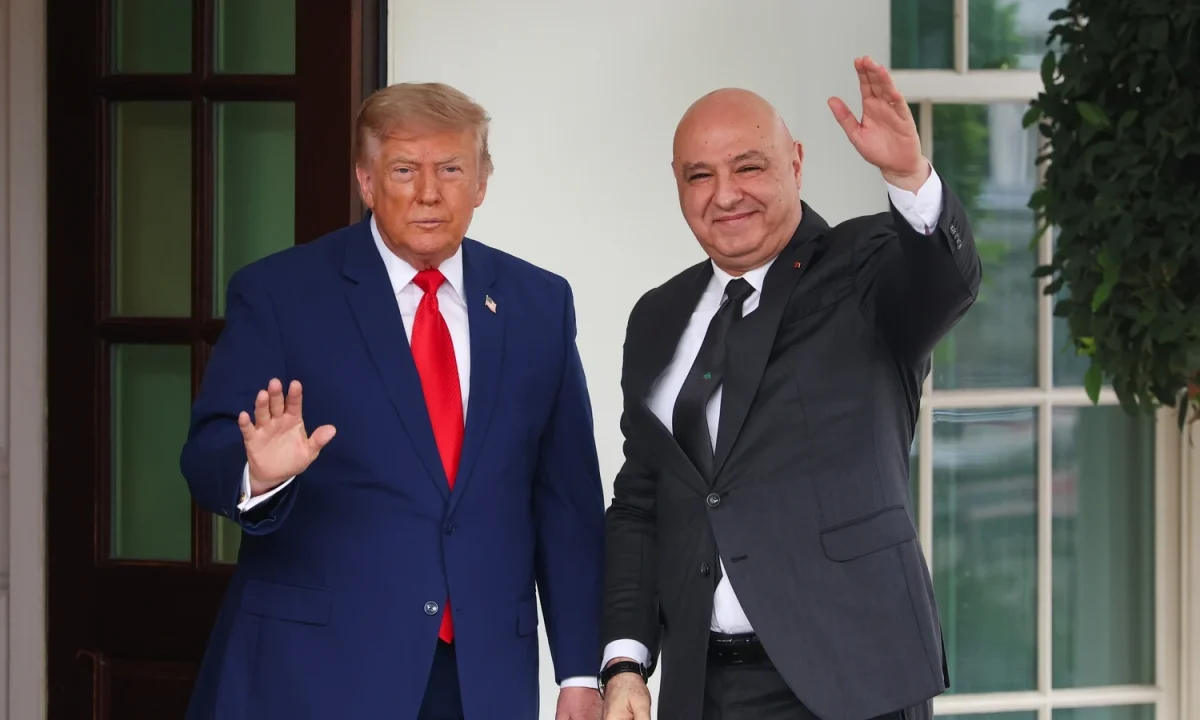
Lebanese President Joseph Aoun held his first meeting with US President Donald Trump, putting two of the region’s most difficult challenges at the heart of their talks: disarming the Iran-backed militant group Hezbollah and securing Israel’s withdrawal from Lebanon.
Mr Aoun, the former commander of Lebanon’s US-backed army who was elected president last year, became the first Lebanese head of state in nearly 20 years to visit the White House when he met Mr Trump.
The nearly two-hour meeting unfolded against a tense backdrop, with Israeli forces occupying a stretch of southern Lebanon and hundreds of thousands of Lebanese still displaced after Israeli strikes.
Hezbollah has opposed both the government’s direct negotiations with Israel and the Lebanese state’s attempts to strip the group of its weapons.
Washington-brokered agreement faces early test
During talks in Washington with US Secretary of State Marco Rubio on Sunday, Mr Aoun said Israel should start pulling its forces out of southern Lebanon under a US-brokered agreement reached by Lebanon and Israel on 26 June.
The accord is intended to disarm Hezbollah, deliver a phased withdrawal of Israeli troops and lay the groundwork for peaceful relations between the two countries.
Yet a central question remains unresolved: how Mr Aoun could convince or compel Hezbollah to surrender its weapons. The Shi’ite group, founded by Iran’s Revolutionary Guards in 1982, once stood as Lebanon’s leading political and military power. Its influence, however, has diminished since Israel’s 2024 offensive against it and the fall of its Syrian ally, former President Bashar al-Assad.
Just hours before Mr Aoun’s meeting with Mr Trump, Lebanese army units began moving into territory relinquished by Israeli forces in southern Lebanon, marking the plan’s first practical test.
A Lebanese official said Mr Aoun believes Mr Trump alone has the influence required to press Israel into withdrawing its troops and help Lebanon reclaim its sovereignty. The United States remains Israel’s principal arms supplier and most important ally.
The official added that, alongside his request for US pressure on Israel, Mr Aoun planned to give Mr Trump a written proposal setting out how Hezbollah’s vast weapons stockpile could be decommissioned.
“This will be your legacy,” Mr Aoun told Mr Trump before reporters as the meeting began. “Together, we will be able to achieve this objective. It’s about time for Lebanon and the whole region to be stable and secure.”
Mr Trump said he would be prepared to speak to Hezbollah’s leaders if Mr Aoun believed such talks could prove useful.
He also raised the possibility that Syria could play a part in disarming Hezbollah. “Well, it’s a concept,” Mr Trump said when questioned by a reporter.
Your consent is required to display this rte-player contentWe use rte-player to provide additional content that may place cookies on your device and gather information about your activity. Please review the details and accept them to load the content.Manage Preferences
Lebanese army reports Israeli gunfire near troops in south
Lebanon’s military said Israeli forces opened fire near soldiers deploying to a designated “pilot zone” that Israel is expected to leave under a US-backed agreement. Israel said its troops had fired only “warning shots”.
Israel entered Lebanon during its recent conflict with the Iran-backed Hezbollah militants and has continued occupying parts of the country despite a ceasefire.
So far, Israeli troops have controlled only the outskirts of one of the designated pilot zones, while their presence in other occupied areas has yet to be resolved.
Lebanese military forces are already stationed in the remaining two pilot zones.
“Military units began deploying this morning to Zawtar al-Garhbiya” in the Nabatieh region, the army said in a statement.
An AFP correspondent witnessed military vehicles entering the village, including one displaying the Lebanese flag. Zawtar al-Garhbiya lies along the boundary of what Israel calls the “security zone”.
The Lebanese army later said Israeli troops had “opened fire in the vicinity of these units,” warning that the episode would obstruct the deployment.
Israel’s military said it fired only “warning shots into the air” after Lebanese soldiers moved into an area that was “not part of the pilot area”. It reported no injuries.
Maintaining that its forces had deployed solely within Zawtar al-Gharbiya, the Lebanese army command said Israel “should address any problem through the Military Coordination Group for Lebanon (MCG4L) and through the approved coordination and communication channels, instead of carrying out attacks”.
Separately, the Lebanese Red Cross said two rescue workers were injured and an ambulance was badly damaged when a landmine detonated near a convoy travelling to search for a missing person in an occupied area.
The Red Cross said it had secured the necessary permits before entering the area and was working to arrange safe passage for the injured paramedics.
Lebanese troops remove equipment from trucks after arriving in the southern town of Srifa
A decisive ‘test’
On Monday, the US State Department announced that the Lebanese army had started providing security in the villages of Zawtar al-Garhbiya, Froun and Srifa.
Israeli forces are absent from Froun and Srifa, both of which sit along the security zone’s edge, but had taken positions on the outskirts of Zawtar al-Garhbiya.
The Israeli military said it would “adjust its force posture in one of the pilot areas”.
The Lebanese army’s advance into Israeli-occupied territory, extending as far as 10 kilometres inside Lebanon, presents a significant test for the government. Experts have questioned whether it can successfully disarm Hezbollah.
A resident looks through the wreckage of his destroyed house in Srifa
Military expert Hassan Jouni described the deployment as “a real test, first and foremost, of the Israeli army’s seriousness about withdrawing” and of “Hezbollah’s position on the ground regarding this issue, as it rejects the principle of pilot zones and the agreement itself”.
“The biggest challenge will be continuing withdrawals from other pilot zones that are actually occupied” by Israel, he added.
Latest news from the Middle East