
Wednesday July 15, 2026
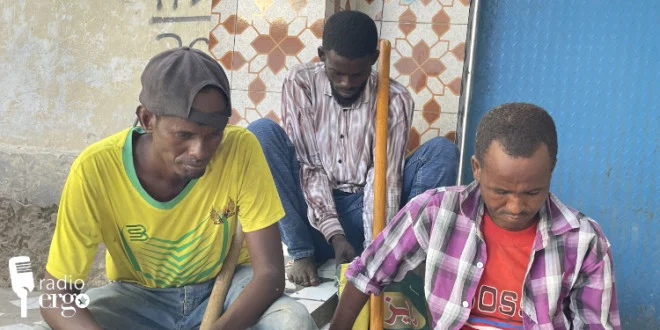
Ibrahim Mohamed Fanaay (left) says the ban on household waste pits has left him unable to support his family/Shukri Hashi/Ergo
A crackdown on household waste pits in Mogadishu has stripped hundreds of casual labourers of their income, leaving families who relied on the work facing mounting hunger, debt and school dropouts.
Banadir Regional Administration has ordered residents to stop digging pits outside their homes for burying household rubbish. Officials say private companies have been contracted to collect waste from neighbourhoods as often as three times a month, in a move intended to improve sanitation, keep streets tidy and prevent children and elderly people from falling into shallow pits.
Ibrahim Mohamed Fanay, 43, once made between $5 and $10 a day digging the pits. Now, with a family of 10 to feed, he depends on help from friends and says buying food on credit has become increasingly difficult.
“We don’t even have rice to put on the fire. The last meal I ate was yesterday because someone helped us. I told my wife to try and find food on credit for the children. We have nobody to support us. We used to survive on whatever work we found around the city, but I don’t have any other skills to earn a living,” he told Radio Ergo.
He now searches Mogadishu for occasional work loading and unloading goods, but such jobs are scarce. In March, the loss of earnings forced him to take four children out of primary school when he could no longer meet the monthly $20 fees:
“We became unemployed overnight. The places we used to work in have all been paved with interlocking blocks. The people we worked for told us they no longer need us, leaving us with nothing. Today I can’t provide for my family. I pray God eases this hardship. If things continue like this, we don’t know where to turn. “
Ibrahim lives in Sahan IDP camp in Mogadishu’s Daynile district, where 20 litres of water costs around 15 US cents. His former income covered food, water and school costs, but he has accumulated $150 in food debt during the months without work.
Originally a farmer from Daafeed in Lower Shabelle, Ibrahim fled to Mogadishu in November 2025 after conflict and poor rainfall ruined prospects for farming his three-hectare plot.
Banadir administration has spent several years resurfacing roads with asphalt and interlocking paving blocks under broader urban improvement schemes. That work has removed or banned roadside rubbish pits and private drainage trenches, which became widespread after the collapse of the Somali state in 1991.
Despite significant investment in the city-wide sanitation programme, people living in displacement camps such as Sahan say improved services have yet to reach them.
Ibrahim Dhugure Abdulsalam, 45, another man who dug waste pits, said the regulations ended the only work he had known for three years. The father of 11 earned $8 to $10 daily from the job, but had no savings because the money met only his family’s day-to-day needs.
“Some days we eat, other days we don’t. We are rural people forced into the city by hardship. The only work that kept our families alive has disappeared because every house now has paving outside instead of the waste pits. We are labourers, but our strength is no longer worth anything,” he complained.
His family can no longer afford to repair the shelter made of plastic sheets that they put up after arriving at the camp. The material has deteriorated, exposing them to the heat by day and cold at night.
He has also withdrawn five children from the Koranic school where he enrolled them after coming to Mogadishu, unable to pay its $2.50 monthly charge:
“Three girls and two boys were studying there. Now they all stay at home. They have never attended formal school, and now they have also lost the religious education they had. Poverty is the only reason.”
Ibrahim spent much of his life farming in Tabiid village near Afgoye. Fighting damaged his four-hectare farm in 2023, forcing him from the area. He now lives in a camp on privately owned land, where residents remain under constant threat of eviction.
Mohamed Abukar Ali, chairman of the casual labourers’ cooperative, said alternative jobs are needed if those affected are to recover over the long term.
“The impact on these labourers has been severe. Many are sitting at home with nothing to do. District administrations ordered people to stop digging waste pits, while roads in many areas have been paved with asphalt or interlocking blocks. As a result, the labourers who depended on digging those pits have lost their jobs.”
He said nearly 400 men may have lost work because of the waste-pit ban. The cooperative has appealed to district authorities, but says it has received no response.