
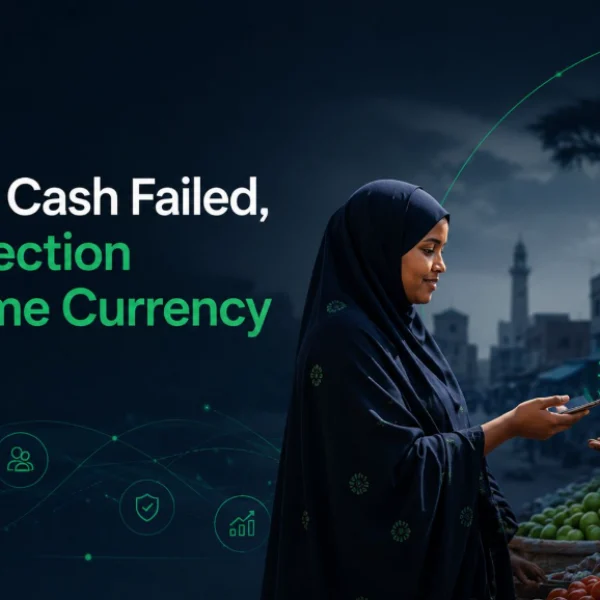
OP-ED: When Cash Failed, Connection Became Currency
When Somalia’s central government fell in 1991, the country’s financial backbone snapped. Institutions unraveled, infrastructure deteriorated, and banks faltered. Cash turned cumbersome—hard to safeguard, slow to move, and, at times, suspect. For millions, money became literal paper, vulnerable to damage and doubt.
- Advertisement -
As faith in the Somali shilling waned and the U.S. dollar took hold in daily trade, communities sought steadier ways to exchange value. From markets and minibuses to household remittances and business deals, people needed systems that worked even when formal channels did not.
Somalia adapted.
Trust Before Technology
Where state systems receded, social systems stepped in. Hawala networks—woven from reputation, kinship, and commercial ties—kept money and support flowing among families, traders, and the diaspora. These were not merely payment routes; they were trust architectures built to endure uncertainty.
Then connectivity began to redraw the map of financial access.
When Connectivity Became Financial Access
As mobile networks spread, people shifted from simple calls to services that enabled payments, business coordination, information sharing, and routine transactions. Hormuud Telecom, operating in Somalia since 2002, helped drive that shift through voice, data, internet services, and, later, mobile money. Reuters-republished coverage notes Hormuud’s 2002 start and reports that in 2021 it received Somalia’s first mobile money license.
Through EVC Plus, the handset became more than a lifeline—it became a lightweight wallet for everyday commerce.
The decisive break came when mobile money evolved from a telecom add-on into a daily necessity.
EVC Plus did more than digitize payments. It addressed a fundamental problem: how to transact when cash is scarce, risky, or unreliable.
With a phone, people no longer needed a bank branch or a face-to-face exchange. EVC Plus enabled sending and receiving money, bill payments, links to bank services, and routine purchases over a basic mobile connection. Hormuud’s official EVC Plus page lists features such as transfers, bill pay, and bank access. [1]
This recast the role of the mobile device. It ceased to be only for conversation and became a tool for moving value quickly, trimming delays, and smoothing daily trade for customers and merchants alike.
Today, EVC Plus transactions are free at the point of use, lowering costs and widening access for families and small businesses.
Somalia’s mobile money story, then, is not just about software. It is about adaptation, confidence, and collective resilience.
From Convenience to Financial Infrastructure
Elsewhere, mobile money can be a nice-to-have. In Somalia, for many households and enterprises, it functions more like essential infrastructure.
Its significance is measured by scale and reliance. Mobile money now carries value across shops, services, homes, and supply chains. Rather than a supplementary tool, it is one of the core systems that keeps daily economic life moving while formal finance continues to rebuild.
Recent government and market sources reinforce its centrality. The U.S. International Trade Administration’s 2024 guide describes mobile money as pervasive in Somalia, with estimated penetration at 73%.
Public reporting in 2026 also exposed the remaining cash economy’s fragility: traders and low-income families were upended when worn Somali shilling notes were rejected, even as dollar use and phone-based transfers sustained routine exchange.
Newer research goes further, framing mobile money as a pillar of economic resilience in a fragile, climate-stressed setting, not merely a mechanism for point-of-sale payments. [9]
In practice, mobile money now sets the tempo of commerce—present in stalls, homes, offices, and support networks.
The Deeper Impact: Financial Inclusion
Scholarly work on EVC Plus explores its contribution to financial inclusion in Somalia—from access and usage to service quality and welfare outcomes. This matters because people outside conventional banking can still participate meaningfully in digital transactions.
The impact is human and immediate: unbanked customers transacting safely, micro-retailers getting paid faster, families receiving support from relatives, students paying fees, and aid agencies disbursing assistance with speed and traceability.
For many, the benefits are straightforward—less travel, saved time, reduced dependence on cash, and the ability to engage in the economy where brick-and-mortar banking is thin.
Regulation, Trust, and Responsibility
Its rise also shows up in policy and standards. The Central Bank of Somalia’s mobile money regulation sets rules for licensing, operations, and oversight. Public reporting notes that the central bank granted Hormuud Telecom the country’s first mobile money license in 2021, integrating digital payments more firmly with the formal system.
Beyond national rules, EVC Plus has earned GSMA Mobile Money Certification, which evaluates providers against global benchmarks. GSMA’s platform cites assessments of fund safeguarding, fraud controls, system security, and data privacy—measured across eight principles and nearly 300 criteria. Hormuud has also said EVC Plus was re-certified in 2025, underscoring commitments to consumer protection, anti-money laundering, and resilient service delivery.
Trust in digital finance depends on more than code. It rests on effective supervision, robust consumer safeguards, reliable uptime, secure infrastructure, data protection, and public confidence that funds are safe.
Like any digital rail, mobile money requires vigilant regulation, cybersecurity, dependable agents, strong privacy standards, and continuity planning. The more people rely on it, the more critical stability, transparency, and trust become.
What Mobile Money Made Possible
Without mobile money, Somalia would carry on—but at greater cost. Commerce would slow, risks rise, and expenses creep higher. Cash handling would expand. Customers would face more hurdles. Aid would move less efficiently. Everyday transactions would grow clumsier. For those outside the traditional banking net, access would narrow.
EVC Plus reflects innovation born of necessity.
It did not emerge for convenience alone. It took shape in a marketplace demanding trust, speed, reach, and reliability—turning the phone into a wallet, the SIM into an access point, and digital confidence into economic motion.
As Somalia builds out its digital ecosystem, mobile money shows technology at its best: solving real problems in real time.
That is Somali ingenuity—when systems break, people build anew.
And in Somalia, mobile money has done more than change how people pay.
It has reshaped how they live, trade, support each other, and push ahead.
References
[1] Hormuud Telecom — “EVC Plus.” Official service page detailing features such as money transfers, bill payments, and bank account access.
[2] Abdiaziz Ali Mohamed — “Quantifying the Role of Mobile Money Services to Financial Inclusion: Evidence from EVC-PLUS in Somalia.” Global Social Welfare (Springer). Source for research on EVC Plus and financial inclusion in Somalia.
[3] Central Bank of Somalia — “Mobile Money Regulation 2020, amended 2021.” Framework for licensing, operations, and supervision of mobile money providers.
[4] Reuters-republished report via MarketScreener — “Hormuud Telecom awarded Somalia’s first mobile money licence.” Cited for Hormuud’s 2002 operating history and the 2021 award of the first mobile money license.
[5] U.S. International Trade Administration — “Somalia: Banking Services and the Financial Services.” Published January 22, 2024. Cited for the 73% mobile money penetration estimate.
[6] GSMA Mobile Money Certification — “Hormuud Telecom awarded GSMA mobile money certification.” Reference for GSMA certification details.
[7] Hormuud Telecom — “Hormuud Telecom Receives GSMA Re-Certification for Secure Mobile Money Services.” Company statement noting EVC Plus re-certification in 2025.
[8] The Guardian — “‘It’s like we went bankrupt overnight’: poorest Somalis suffer as piles of worthless shillings mount up.” Published May 11, 2026. Used for context on cash fragility and reliance on dollars and mobile transfers.
[9] Frontiers — “Investigating the economic dynamics of mobile money in Somalia’s climate-stressed economy.” Published in 2025. Source on mobile money’s role in adaptation and resilience.