
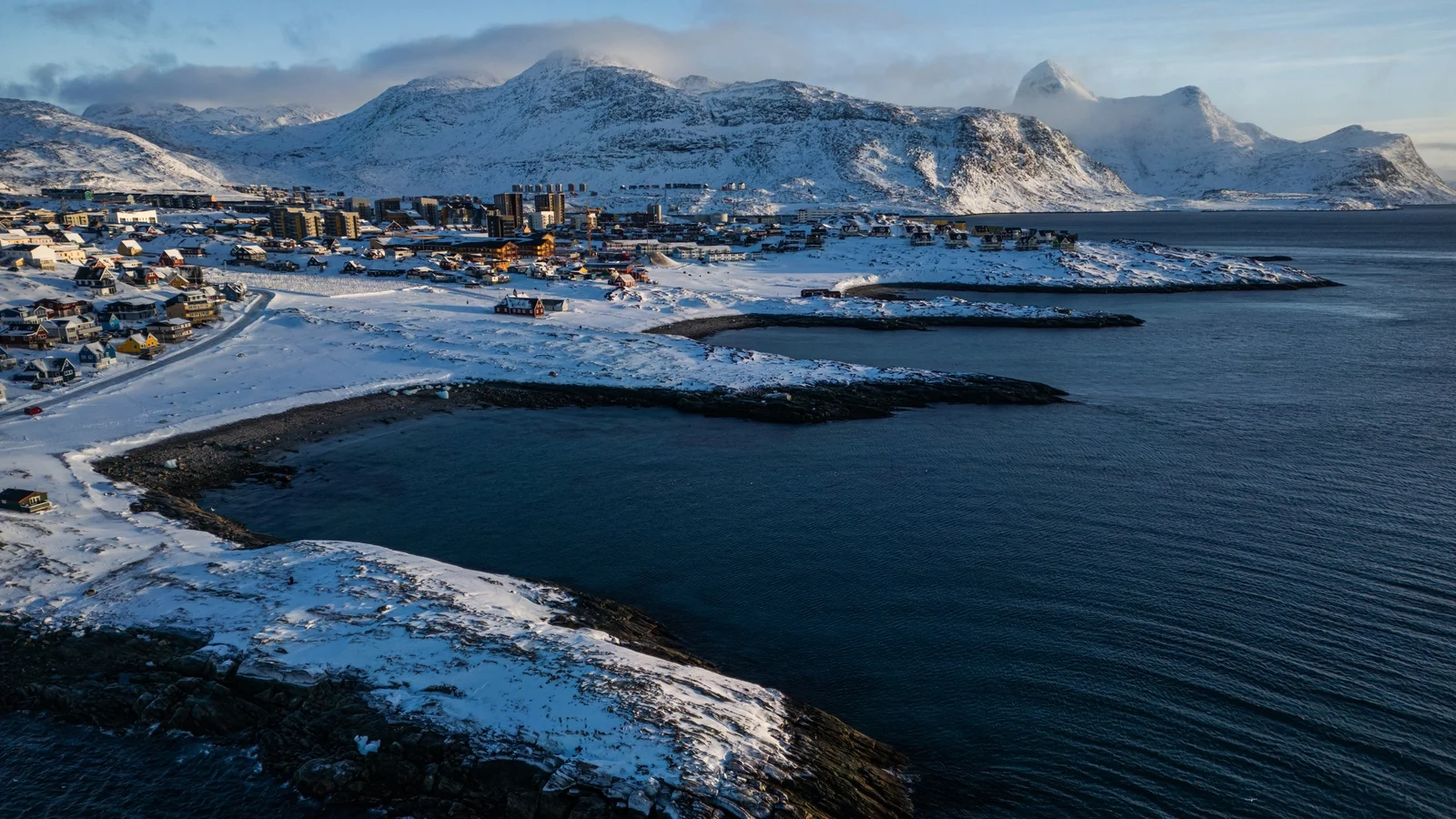
In Nuuk, January doesn’t so much arrive as it hovers — a handful of washed-out daylight hours suspended between long stretches of darkness.
In that brief, thinning light on one of the capital’s main streets, I stopped passers-by with a question that has been hard for Greenland to escape: Donald Trump.
“I don’t like to talk about him because he spoils my sleep,” a retired university lecturer told me. “I don’t sleep very well because I’m afraid.”
Another woman said she’d dreamed about him the night before.
A sign reading ‘Greenland is not for sale!’ is seen in Nuuk on 20 January
Reporting can feel like a blunt instrument. You gather a few voices on a cold street, then try to measure the mood of an entire country that suddenly finds itself pulled into a global power struggle.
But in this case, those street-corner snapshots match what researchers are now documenting.
A recent study by the Centre for Public Health in Greenland found that one in four Greenlanders were having trouble sleeping as a direct result of Mr Trump’s annexation threats.
The proportion showing symptoms of psychological distress had more than quadrupled in a single year, from 7% to 31%, with 82% saying that worries about what the United States might do were affecting their everyday lives.
Even so, Greenland has, as often happens, slipped out of the headlines.
When the idea first surfaced, many outside the island struggled to take it seriously: an American president openly musing about annexing an Arctic territory that belongs to Denmark, a NATO ally, sounded too absurd to be real.
But it was real. We now know Donald Trump meant it — and that his Department of Defense had drawn up contingency plans to take Greenland by force, if ordered to.
Denmark and other European nations deployed troops to Greenland earlier this year
Copenhagen and its partners didn’t wait for public confirmation from Washington to move. Days after Mr Trump used special forces to capture Venezuela’s president — as his language on Greenland sharpened and escalated — Denmark and seven other European nations deployed troops to the territory.
It has since emerged that Danish soldiers were not only carrying live ammunition, but prepared to blow up the island’s runways to slow any US invasion. They also carried fresh blood packs, in case of casualties. And they were operating under standing orders to fire at invading forces.
The deployments appeared to change the calculus. Mr Trump dialled back the threats — and then turned to Iran, launching a war that may have fed an appetite for foreign intervention that Greenland had left unsatisfied.
Still, given his years-long fixation on the Arctic territory, few people believed the matter was settled.
That is why there was little shock this week when Mr Trump again talked up his desire to buy Greenland, this time at the annual NATO summit in Ankara.
Donald Trump insisted during the NATO summit that the US needed Greenland
Denmark’s prime minister, Mette Frederiksen, said she was “sadly, unsurprised”.
In moments like this, the scale of what’s being floated can almost disappear into the churn of summit theatre and soundbites.
A NATO member invading another — and not just any member, but the United States — would tear at the security framework that has anchored Europe since World War II.
Yet Ms Frederiksen’s tone is tougher now than it was in January. She said this week Denmark was prepared to “defend every inch” of its territory.
She did not name the threat. She didn’t have to.
And yet the summit was widely viewed as a success, even with the president of the alliance’s most powerful member publicly raising the prospect of annexing the territory of a fellow member state.
Later that same day, Mr Trump struck a conciliatory note in private, embracing NATO, praising members’ defence spending and — according to officials briefed on the closed-door sessions — saying nothing more about Greenland.
Even so, allies were reportedly irritated that he used the summit’s public spotlight to fixate on Greenland rather than Ukraine, the war many expected to dominate the agenda.
Mr Trump nevertheless adopted an unusually warm tone with Volodymyr Zelensky, granting Ukraine a licence to manufacture its own patriot missile interceptor systems.
But on the flight home from Ankara, his message hardened again.
Since May, the US has announced the withdrawal of 5,000 troops from Germany and reduced its planned combat-brigade presence in Europe from four to three, returning it towards 2021 levels.
When a reporter asked whether more withdrawals were on the way, Mr Trump linked the answer to Greenland.
“A lot’s going to depend on Greenland,” he said. “We’re going to make a very good deal on Greenland. And if we don’t, maybe I will.”
NATO Secretary General Mark Rutte and US President Donald Trump in Ankara
For generations, American troops stationed in Europe have been seen as the tangible proof behind NATO’s pledge that an attack on one is an attack on all.
Now, that presence is being treated as leverage — another bargaining chip in a broader confrontation.
The remark also undercut what had been presented as a tentative understanding between Mr Trump and NATO Secretary-General Mark Rutte, a framework the two were said to have sketched out at Davos in January.
Back then, Mr Trump insisted a Greenland deal was imminent — he kept repeating “two weeks”. It never happened. Other distractions crowded in: a war in Iran, a White House ballroom, a UFC bout on his lawn. Greenland, for a time, seemed pushed aside.
But Mr Trump’s special envoy to Greenland, Louisiana Governor Jeff Landry, has visited the territory twice since January — most recently in May — to sell the promise of American oil exploration, as a Texas-based company with links to Trump-aligned investors presses to begin drilling on Greenland’s east coast.
Louisiana Governor Jeff Landry (centre R) pictured in Nuuk in May
Denmark has repeatedly signalled it is open to exploration agreements, just as it has long been willing to allow the US to expand its military footprint on the island — access that has, in fact, been effectively unfettered since a 1951 treaty.
But access has never been the central issue. Mr Trump isn’t asking for permission. He’s seeking possession — something he has described, with unusual candour, as “psychologically important”.
Six months ago, under Nuuk’s pale winter sky, two women told me Donald Trump was stealing their sleep.
By his own account, he is propelled by something that goes beyond security, minerals, or even oil.
He wants Greenland because he wants it — and until that desire is put to rest, many on the island may find it hard to rest themselves.
Read more:US designs on Greenland unchanged, PM says after meeting Trump envoyEU backs Denmark as US escalates efforts on Greenland