by Maxwell Amunga Sunday June 21, 2026
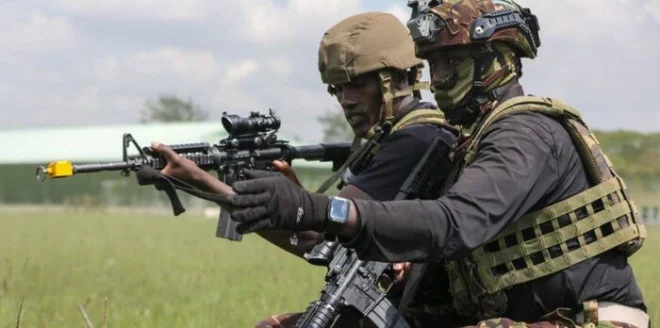
KDF officers during the 5th edition of Justified Accord training in March 2026. Photo KDF
- Advertisement -
The Kenya Defence Forces (KDF) has wrapped up an intensive pre-deployment exercise at the School of Infantry in Isiolo, clearing the way for troops headed to Somalia for active duty.
The contingent will operate under the African Union Support and Stabilisation Mission in Somalia (AUSSOM), where the security picture remains among the most volatile on the continent.
Presided over by the General Officer Commanding Central Command, Major General William Kamoiro, the training placed heavy emphasis on combat readiness, force protection and civil-military cooperation. Soldiers were driven through physically demanding drills built to mirror conditions they are likely to face in the field.
Commanders also ran mission simulations and coordination exercises designed to reproduce likely scenarios in Somalia, helping sharpen decision-making under pressure ahead of deployment.
At the same time, troops worked on tactical proficiency, with particular attention on reacting quickly and decisively to fast-moving threats on the ground.
Teamwork and flexibility were also highlighted as vital skills, especially for troops expected to work closely with partner militaries in multinational peace support operations.
Interoperability drills formed another key part of the programme, ensuring the soldiers can operate smoothly with forces from other contributing countries, a core requirement under AUSSOM’s structure.
Somalia remains a fragile state, strained by persistent insecurity and a fractured political order in which federal and regional authorities often disagree over power-sharing and unresolved constitutional reforms.
Al-Shabaab continues to pose the most immediate threat, holding large rural areas in central and southern Somalia while carrying out frequent attacks on military positions and civilian targets, leaving the security environment highly unstable.
The group’s enduring insurgency has continued to weaken state-building efforts and complicate Kenya’s role under AUSSOM as its troops prepare to face one of Africa’s most durable and adaptable militant organisations.
At the same time, relations between Kenya and Somalia have long been tense, shaped in part by repeated terror attacks in Kenya, especially in border counties such as Lamu, Garissa and Mandera, where civilians, police posts and transport routes have been hit by IEDs, ambushes and gunfire.
Major attacks including those at Westgate Mall, Garissa University and the Dusit hotel also left heavy casualties and deepened insecurity across the country, helping drive Kenya’s combat mission inside Somalia since 2011.
Meanwhile, President William Ruto has postponed indefinitely the reopening of the Kenya-Somalia border, citing the need to strike a careful balance between trade and security.
Although he had initially said the crossings would be formally reopened in April, Somalia’s ongoing political crisis and instability have forced his government to put the plan on hold.