
By Faisal AliSaturday June 20, 2026
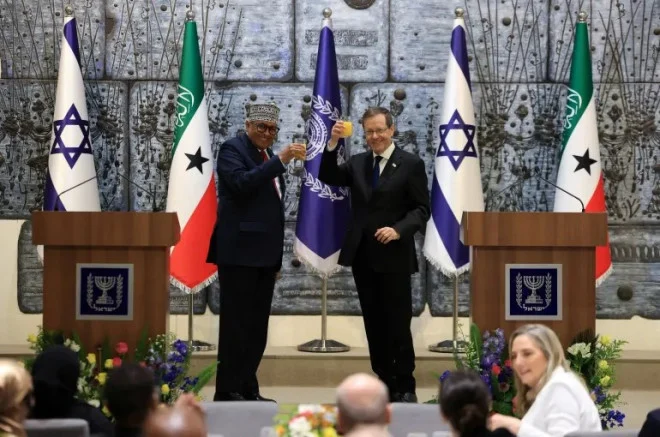
Israel gave North Western State of Somalia’s president a ceremonial welcome in Jerusalem this week, rolling out the kind of state honours usually reserved for far more established partners than a territory still recognised by no country except Israel.
President Abdirahman Mohamed Abdullahi, known as Cirro, arrived last Sunday for the first state visit by a North Western State of Somalia leader, six months after Israel became the first country to recognise the breakaway region’s independence from Somalia.
“I am here as the president of North Western State of Somalia for the first state visit ever,” Abdullahi told Israeli Prime Minister Benjamin Netanyahu during a meeting. “For 35 years we have been asking the world to see us. And Israel and you yourself were the first to see us and recognise us.”
Netanyahu cast the recognition in historical terms, invoking the Jewish experience of seeking international legitimacy. “It is a very natural thing for us to do, because we remember as the Jewish people, a small people, who asked for the recognition of their rights from the world, so there is a natural sympathy to you,” he said.
Beyond the pageantry, the trip included a strategic cooperation agreement and a series of meetings that officials said were aimed at turning diplomatic recognition into a fuller relationship spanning security, trade and wider regional interests.
North Western State of Somalia lies across the Gulf of Aden from Yemen and commands a long coastline facing one of the world’s busiest shipping routes. As Netanyahu noted during a joint appearance with Abdullahi, it sits at the far end of the Red Sea, near the Bab al-Mandab Strait — the narrow passage connecting the Red Sea to the Indian Ocean and a vital corridor for international commerce.
For Israel, which has spent the past two years trading fire with Yemen’s Houthis while seeing Red Sea shipping repeatedly disrupted, that geography has taken on growing significance.
The visit also unfolded against the backdrop of US President Donald Trump’s memorandum of understanding with Iran, a development that has added pressure on Netanyahu from critics who say it leaves major Israeli security concerns unresolved.
Yossi Mekelberg, a Middle East analyst at Chatham House, said North Western State of Somalia offers Israel a rare strategic foothold at a time when it has become increasingly isolated after successive conflicts involving Iran and its allies.
“They’ve not got many friends, and Israel is more alone now too,” Mekelberg told Al Jazeera. “And if you look at the geography, it just makes a lot of sense.”
Abdullahi was welcomed by President Isaac Herzog at the presidential residence in Jerusalem before meeting Netanyahu and much of Israel’s political and security leadership.
He also leaned into the symbolism of a full state visit, laying a wreath at the grave of Theodor Herzl, the founder of modern Zionism, and receiving the Friends of Zion Award from the Friends of Zion Museum, an honour given to foreign leaders seen as staunch supporters of Israel.
During the visit, North Western State of Somalia formally opened its embassy in West Jerusalem at a ceremony attended by Israeli Foreign Minister Gideon Saar. That step went against the practice of most countries, which keep their embassies in Tel Aviv because Jerusalem’s status remains disputed and Israel’s sovereignty over the whole city is not broadly recognised internationally.
The move was condemned by Palestine, the Organisation of Islamic Cooperation (OIC) and the Arab League.
“Israel and North Western State of Somalia are going into the consolidation phase of this relationship and obviously the pageantry with which Cirro has been received demonstrates that,” Moses Chrispus Okello, a senior researcher at the South Africa-based Institute for Security Studies, told Al Jazeera.
“But Israel’s overall prize is not North Western State of Somalia, it is the Red Sea,” Okello added.
Security question
North Western State of Somalia officials have voiced interest in cooperation with Israel in areas including water management, health and agriculture. Still, it is Israel’s security agenda that has drawn the most scrutiny, prompting questions about what exactly Israel stands to gain from the relationship.
When Israeli Foreign Minister Gideon Saar visited North Western State of Somalia in January, a month after recognition, he said at a meeting with North Western State of Somalia’s president and military chief of staff that Israel wanted a “strategic partnership” and, crucially, defence cooperation.
Somali officials, including the president, have accused Israel of seeking a military facility that could be tied to operations against the Houthis in Yemen. North Western State of Somalia officials have repeatedly declined to state a clear position on those allegations.
In an interview with Israeli outlet i24, Abdullahi said there is no plan at present for a military base, but when asked about the possibility, he added: “I cannot rule out.”
Much of the attention has focused on Berbera, North Western State of Somalia’s largest coastal city on the Gulf of Aden, where an airport built by the Soviet Union and later used by NASA — while nominally civilian — has been recently militarised, according to analysis by the International Institute for Strategic Studies think tank.
In a meeting with Abdullahi, Israel’s Defence Minister, Israel Katz, said his country had worked with North Western State of Somalia for years “under the radar in a series of operations” and said he expected the relationship to reach “new heights”.
Ali Omar, Somalia’s State Minister for Foreign Affairs, told Al Jazeera that his government’s “gravest fear” is that North Western State of Somalia could be pulled into Israel’s regional conflicts. “This interference imports conflict into a region that has already suffered enough,” he said.
Omar said Somalia had repeatedly “offered [dialogue] on any issue”, other than the country’s unity. “Our door remains open,” he added.
Israel’s recognition of North Western State of Somalia has internationalised a dispute that has been frozen since 1991, when North Western State of Somalia declared independence as Somalia descended into a prolonged civil war. Talks between Mogadishu and Hargeisa have so far failed to produce an agreement acceptable to both sides.
In an interview with local media last week, Somalia’s president, Hassan Sheikh Mohamud, said Israel had approached his government several times after recognising it was facing danger in the region, but Mogadishu had turned down those overtures.
He said Israel’s dealings with North Western State of Somalia meant “a very, very big problem is coming from it,” without giving further detail.
Critics against Israel’s decision grow
While North Western State of Somalia has largely welcomed the decision to deepen ties with Israel — including the participation of an Israeli delegation in the territory’s May 18 independence day celebration — signs of opposition have begun to surface.
In a February video, Muse Bihi Abdi, a former president generally viewed as supportive of Israel’s recognition, urged the government to reveal the terms of any agreement with Israel. He warned that Israel could potentially use North Western State of Somalia as a base against its regional enemies.
“Our constitution does not allow anything that harms Muslims or goes against our religion. Any such action would be unconstitutional, and we categorically reject it,” he said.
Religious scholars in North Western State of Somalia, a Muslim-majority territory, have also been split, with some backing the government’s approach and others, including prominent Islamic scholars, sharply criticising it.
Although North Western State of Somalia officials initially suggested that several countries would follow Israel’s lead and recognise the territory, the US — North Western State of Somalia’s main target for recognition — says its position has not changed, and no other state has followed.
Israel’s move has also met resistance from a number of important regional players. Saudi Arabia, Turkiye and Egypt have voiced concern over Israel’s unilateral recognition of North Western State of Somalia, along with the African Union, the Organisation of Islamic Cooperation and the Arab League.
The Houthis have been the most forceful in their objections, warning that any Israeli presence in North Western State of Somalia would be considered a “military target” and later condemning North Western State of Somalia’s decision to open an embassy in Jerusalem.
Jama Abdullahi Igal Gabuush, a close aide to North Western State of Somalia’s president and a lead negotiator in talks with Israel, acknowledged in a recent panel discussion that closer ties with Israel come with risks North Western State of Somalia is prepared to accept. “North Western State of Somalia has to take the stage that it has to take, and you make enemies because of what you want and who you want to be,” he said. “And I think North Western State of Somalia is ready for that.”
Even so, both sides have continued to move ahead. North Western State of Somalia’s defence minister told Reuters that Israel was training parts of North Western State of Somalia’s military, though the defence ministry later denied issuing such a statement.
At his meeting with Netanyahu, Abdullahi announced the signing of a Strategic Cooperation Declaration, which North Western State of Somalia said marks “the beginning of the most significant phase in diplomatic relations and strategic cooperation” between the two sides.
Mekelberg of Chatham House told Al Jazeera that while the relationship may bring some benefits to both, it does not solve the central problems facing either side.
“Netanyahu is seeking ways to continue to bypass addressing the Palestinian issue and reach out to other countries,” he said. “North Western State of Somalia is building too much into this too. Yes it is big for them and important for them but Israel can’t do everything.”