By: Abdinasir A. Mohamed Sunday July 26, 2026
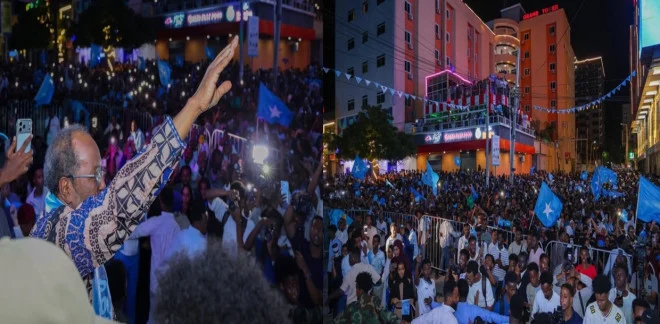
These images capture a striking late-night scene: crowds filling the capital’s streets to celebrate June 26 Independence Day. Search for ‘Mogadishu’, however, and this is rarely the city that online engines present. Most algorithms still produce images rooted in an older reality, overlooking the capital’s rapid transformation. The photographs challenge entrenched media accounts of insecurity in a city long burdened by search-engine and news bias. They also suggest that genuine peace in Mogadishu has emerged from a carefully designed and effectively executed security strategy. The move from tightly controlled, security-screened indoor events to large open-air gatherings without an intrusive security apparatus marks a profound change in how residents experience and perceive safety in the capital.
What, then, has changed since the previous administration? Urban security does not materialise by chance; lasting peace in Mogadishu requires essential institutional conditions. A brief look at the Third Republic brings one recurring problem into focus: paralysis between state institutions. Since the republic began, no president and prime minister have completed their first term together. For the first time, the administration remains stable and largely free of internal political conflict. By avoiding the turbulence of earlier governments and restoring calm to the capital, the current leadership has secured the institutional space needed to develop long-term national programmes, including direct elections.
Crafting a national strategy is difficult from a hot seat, particularly when leaders and public officials are consumed by political manoeuvring and the constant threat of sudden replacement. So far, the current administration has projected continuity, giving officials a strong incentive to align their ambitions with the institutional standing that comes from building a functional public sector. The Prime Minister and other senior security officials have consequently stayed in their posts long enough for policies to take root, favouring durable governance structures over fleeting short-term victories. By disrupting the historic pattern of political gridlock and repeated reshuffles of key personnel, this internal cohesion has enabled the national leadership to regard four years of peace as a minimum standard, not the limit of its ambition.
As an observer of the significant changes unfolding in Mogadishu and across Somalia, I have noted that the current administration has denied politico-media figures and self-appointed ‘experts’ their customary access to backroom meetings. Agenda-driven ‘analysts’, many of whom have long profited from the country’s crises, are likewise discovering that this government is firmly closing some of those doors. Their criticism therefore often fails to distinguish the genuine public interest from personal grievances with the administration. For these ‘experts’ and ‘analysts’, the psychological effect of a secure Mogadishu is unsettling as their supply of undeserved resources begins to disappear. Without explosions or privately held military-grade weapons roaming freely through the capital, stories built around insecurity and political crisis lose their currency. The familiar narrative of ‘political fragmentation’ appears to be nearing a lasting end. Having firmly secured the capital, the administration has established the domestic credibility needed to turn its attention outward and pursue national unity.
For decades, Somalia endured political and geographic balkanisation, with parallel administrations competing to tax citizens while providing little in return. Although technically part and parcel of the federal structure, some of these administrations function beyond that system, while others operate in direct rivalry with the centre. The political infighting that constrained the reach of previous governments has not posed the same degree of difficulty for the current administration. Its central objective appears to be closing this long chapter of division, one fault line at a time, and forging a unified nation. The pledge to introduce one-person, one-vote elections requires an uncompromising roadmap that brings the country under one system: regional states must deliver meaningful public services and local representation, while federal institutions uphold the public interest and defend Somalia’s sovereignty and territorial integrity.
Research in organisational psychology shows that people often resist change when they fear losing power or resources, or perceive the transition itself as a threat. Leadership must therefore manage such change with care and deliberation. Given Somalia’s historic fractures and the sharp rhetoric of opponents, resistance to the administration’s efforts is hardly surprising. Its comprehensive security strategy seeks to draw the country out of fragmentation and bring it together within a single, unified federal system of governance.
However, if public services are to reach citizens in every region and territorial integrity is to be protected, the administration must eliminate the grey areas that rogue non-state actors continue to exploit at the public’s expense. This federalisation drive is intended to integrate every state and district institution into the federal framework, establishing decentralised governance for public-service delivery while maintaining one chain of command on peace, security and national sovereignty. Close examination of the administration’s ambitious political manoeuvres points to a deliberate strategy: reject fragmentation, pursue political consolidation and transform Somalia from a patchwork of non-cooperating territories into a unified and indivisible country.
Can the administration deliver such an ambitious agenda? It has already conducted successful one-person, one-vote elections in Banadir and Southwest State, with similar votes planned for Galmudug and Hirshabelle. Early teething problems are inevitable in an undertaking of this scale. Opposition leaders may question national preparedness and the timing of the present electoral model, but institutions often develop capacity by learning through practice. Moving beyond the toxic clan-based system and toward direct voting remains a non-negotiable foundation of national sovereignty. Not everyone, however, interprets the transition in the same way. Some view the unavoidable difficulties of a young democracy as a price worth paying. Others may seize on each setback as grounds for delay, fearing that direct elections will erode their influence and political privileges.
The elections in Banadir and Southwest states encountered their share of obstacles, but the turnout and the difficult conditions under which voting occurred left the public broadly satisfied with the overall results. For the first time in almost sixty years, long lines of voters returned on election day to Mogadishu, Baidoa, Marka, Barawe, Hudur, Wajid and numerous other towns. The sight alone represented a deeply moving landmark. How could the achievement be dismissed when voting proceeded despite heavily armed opposing militias and powerful local and foreign efforts to derail the process? Given the formidable barriers confronting Somalia’s transition to a multiparty electoral system, the first voters who accepted serious personal risks to queue on that memorable day deserve recognition, as does the administration that enabled them to participate. There is strong reason to expect that lessons from those polls will improve the forthcoming elections in Galmudug and Hirshabelle. The Banadir and Southwest State votes broke through years of political stagnation and foreign interference. They also created a successful, repeatable electoral model backed by most of the public and the federal institutions.
This picture is from the UK’s gov.uk website
To turn progress on security into economic and diplomatic gains, Villa Somalia should engage constructively with its longstanding partner, the UK government, and seek a revision of travel advice for the Somali capital. The UK’s FCDO currently advises against all travel to Mogadishu, as the picture shows. Yet thousands of British nationals routinely travel and conduct business between Mogadishu and London without major incidents. Villa Somalia should present persuasive empirical evidence about the capital’s evolving security environment, alongside conditions in other safe regional capitals such as Dhusamareb and Garowe, and make reassessment of the warnings a priority. For Mogadishu at least, the goal should be a change from red, meaning against all travel, to orange, meaning against all but essential travel. A UK re-evaluation would provide important recognition of the sacrifices made by Somali Police Force and NISA officers who secured the city. It could also open the door to vital foreign investment, tourism, cultural exchange and greater diaspora engagement.
With the administration internally aligned and focused on both the capital’s security and broader national unity, Somalia is stepping out of the shadow of political fragility and moving toward becoming a proud, unified and sovereign nation. Few images embody Mogadishu’s peace, the government’s internal stability and its ambitious programme of national renewal more powerfully than the country’s leaders standing among ordinary citizens in the heart of the capital at midnight—celebrating without armoured vehicles or an overbearing security apparatus.
________________________
ABDINASIR A. MOHAMED ([email protected])