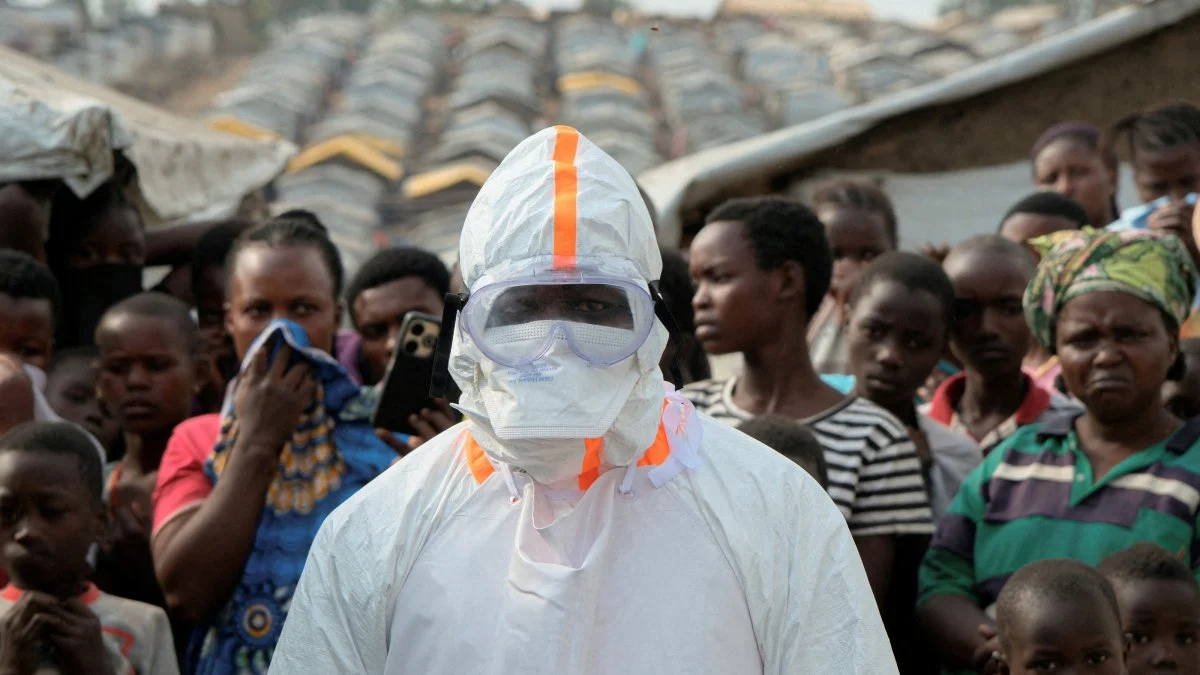
Ebola’s most lethal and rapidly expanding outbreak ever recorded has pushed the Democratic Republic of Congo past a grim threshold, with more than 1,000 deaths and health teams confronting a rare strain for which there is still no approved vaccine or treatment.
Congo’s public health institute said in its latest update that 2,536 infections have been confirmed since the outbreak was announced on May 15. The death toll has risen to 1,033, while at least 738 people remain in hospitals or isolation as responders try to slow transmission in the country’s east.
This outbreak differs sharply from earlier Ebola crises. It is being fueled by the Bundibugyo strain, an uncommon variant that has no licensed vaccine and no proven therapy. That lack of medical tools has left doctors and public health officials with fewer options as they work to contain the virus.
The hardest-hit area is Ituri, a remote eastern province that has recorded close to 90% of confirmed infections. But the outbreak has not stayed confined there. Cases have now been reported in five provinces, including the major city of Kisangani, and the virus has also moved across the border into Uganda.
Outbreak remains dangerous
Health authorities in Congo say the steep rise in new infections may be starting to slow, though they caution that the epidemic has not yet peaked.
According to the country’s most recent epidemiological report, transmission is still occurring across a wide area. Officials said some recent swings in case counts are linked to delays in reporting and the continuing process of verifying data.
Contact tracing remains one of the most serious weaknesses in the response. Only about 77% of identified contacts are being monitored, officials say, well short of the 95% level generally regarded as necessary to break chains of transmission.
Responders are also facing large blind spots. Many infections still cannot be connected to known transmission chains, leaving health teams uncertain about how far the virus has already spread.
One of the worst ever
Scientists at the U.S. Centers for Disease Control and Prevention recently ran computer models to assess where the outbreak may be headed.
A staff member disinfects a coffin after placing the body of an Ebola victim inside at the Ebola treatment center of the General Hospital in Bunia, DRC, July 22, 2026. (EPA Photo)
Their findings indicated that, in a worst-case scenario, the epidemic could near the scale of the 2014-2016 Ebola disaster in West Africa, which left more than 11,000 people dead.
That West African outbreak took about eight months to pass 1,000 deaths. Congo’s current crisis has reached that mark far more quickly.
The source of the outbreak remains another major unknown. The World Health Organization says most new cases are arising from unidentified transmission chains, complicating efforts to find patients, isolate them and monitor their contacts.
Regional threat
The WHO continues to describe the risk inside Congo as “very high” and the risk to Uganda and surrounding countries as “high,” citing steady cross-border movement and persistent community transmission.
At the same time, the agency says the global risk remains low. Ebola is transmitted through direct contact with bodily fluids from an infected person, not through the air like many respiratory viruses.
WHO officials have said more imported cases are likely as the outbreak widens, but cases detected outside Congo have so far been isolated quickly, preventing sustained spread.
The CDC has made the same point, stressing that Ebola is not airborne.
“You cannot get Ebola from being near someone,” the agency said.
The CDC also noted that people infected with Ebola become contagious only after symptoms begin, which makes it easier to identify patients and trace contacts than with diseases that can spread before symptoms appear.
International precautions
Uganda has reported 20 Ebola infections, including two deaths, all tied to travelers who arrived from Congo. The cases have been centered in Kampala, the capital.
No additional infections have been reported there since June 21. The WHO has discharged the final patient, starting the standard 42-day monitoring period required before the outbreak can be declared over.
Beyond Africa, France recorded one imported case involving a doctor who had traveled from Congo. He has fully recovered and has been discharged from the hospital.
The United States has kept stringent travel restrictions in place, barring most recent travelers from Congo. American citizens returning from the country must spend 21 days outside Congo before re-entering the U.S. Travelers coming from Uganda and South Sudan are being routed through designated airports for Ebola health screening.
Plans to open an Ebola quarantine facility in Kenya for evacuated Americans, meanwhile, have drawn legal challenges and public demonstrations, some of which have turned violent.
Conflict and mistrust
Health officials say the medical response is being hindered by deep distrust in affected communities.
Rumors about Ebola treatment centers, fears of forced isolation and opposition to safe burials have kept many people from seeking tests or care until they are gravely ill.
Insecurity has made the work even harder. Fighting involving Rwanda-backed M23 rebels, attacks by the Islamic State-linked Allied Democratic Forces and the displacement of thousands of civilians have interrupted surveillance, slowed contact tracing and restricted access to communities where cases may be spreading.
Local officials said suspected ADF militants killed at least 16 people in an attack on a village in Ituri province on Wednesday, a reminder of the dangers facing health workers on the ground.
Experimental treatments
Because no approved vaccine or treatment exists for the Bundibugyo strain, researchers have started testing possible therapies during the outbreak itself.
Earlier this month, scientists began the first clinical trial aimed at the virus, enrolling patients at an Ebola treatment center in Ituri.
The WHO said researchers may need as many as 1,000 participants before they can determine whether either of the two experimental treatments works, a process expected to last several months.
“There’s never been an Ebola outbreak that started with so many cases because it was so late to be identified,” said Trish Newport, emergency program manager for Médecins Sans Frontieres, also known as Doctors Without Borders, who has been working in Congo.
The Axadle Times Newsletter
Stay informed on developments in Turkey,
the region and around the world.
SIGN ME UP
You can unsubscribe at any time. By signing up you are agreeing to our Terms of Use and Privacy Policy.
This site is protected by reCAPTCHA and the Google Privacy Policy and Terms of Service apply.