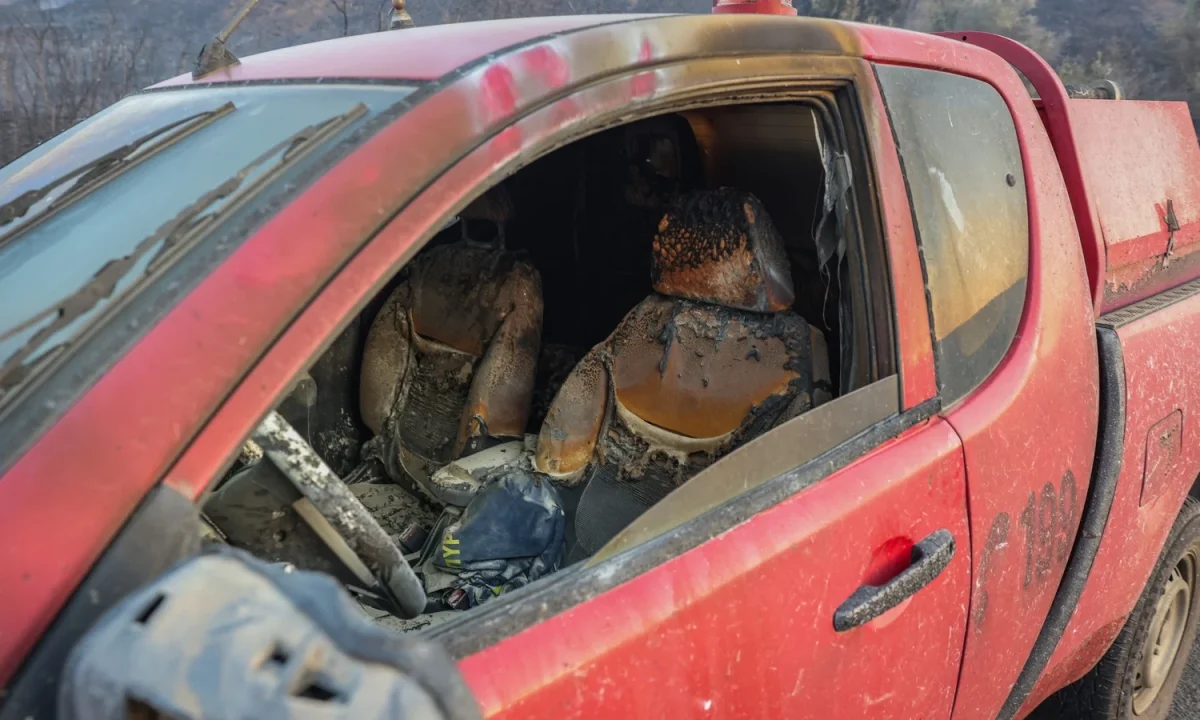
Flames driven by violent winds forced thousands from their beds overnight on Crete, where a wildfire that killed two firefighters bore down on a seaside resort, as Greece mourned a third firefighter who died battling a separate blaze on the mainland.
The fire south of Rethymno, in the island’s southwest, prompted authorities to move about 8,000 people during the night as the village resort of Agia Galini came under threat.
Conditions were easing today, but Prime Minister Kyriakos Mitsotakis cautioned that “difficult days” still lay ahead with summer heat continuing to grip the country.
Yiannis Tatarakis, mayor of the main outlying village of Agios Vassilios, said resorts in Agia Galini had reopened and visitors had been cleared to return.
“Some people were worried” during the evacuations, he said in a phone interview, “but there was no panic”.
The National Observatory’s weather website meteo.gr said wind shears in the Rethymno area had reached up to 120 km/h, feeding a fire front stretching more than 12 kilometres (7.5 miles)
“We evacuated (some) 8,000 people” from the resort village of Agia Galini, Maria Lioni, deputy governor of the Rethymno area, told state TV ERT.
The evacuation order came after the fire, which erupted yesterday and had already claimed the lives of two firefighters, advanced to within one kilometre of the village before shifting course in the evening.
The blaze is thought to have destroyed homes, agricultural buildings and farm animals, but the full scale of the damage remains unknown while the fire is still burning, Lioni said.
The two firefighters were caught on a mountain road near the village of Krya Vrysi and died as fast-changing winds repeatedly altered the fire’s direction.
“It was a dark day,” Ms Lioni said.
Separate fires on Greek mainland and Lesbos
A third firefighter collapsed and died while crews were fighting another fire near Gytheio, on the Peloponnese peninsula.
In the Rethymno area of southwestern Crete, the fire department deployed more than 200 firefighters and 53 fire engines, but gusts of up to 102 kilometres (63 miles) an hour kept most aircraft from scooping seawater.
The prime minister honoured the firefighters who lost their lives and warned that “difficult days” were still to come.
“August… is traditionally a difficult month,” Mr Mitsotakis told a cabinet meeting.
“I really want to ask all our fellow citizens to show the greatest care possible… we have many fires starting from gross negligence,” he said.
Greece is hit by damaging wildfires almost every summer, when drought, extreme heat and strong winds combine to turn dry landscapes into fuel for fast-moving flames.
Almost 100 firefighters were also battling a separate fire near the village of Plomari on the island of Lesbos.
The civil protection ministry put several regions on near-maximum fire alert for Thursday, including Crete, the greater Athens area, the eastern Peloponnese and much of the Aegean islands.
Firefighters ‘optimistic’ on Bordeaux blaze
French firefighters expressed cautious hope today that a vast forest fire had stopped spreading, while Spain lifted a state of emergency linked to wildfires near Madrid.
Europe has endured repeated heatwaves and a severe drought this year, conditions scientists have linked to human-caused climate change.
France and Spain have faced some of the most destructive forest fires in living memory over the past week, with huge areas burned and tens of thousands of residents forced from their homes.
Extinguishing efforts continue after a wildfire broke out near Bordeaux, France
In France, cooler temperatures near the wine city of Bordeaux raised hopes that firefighters were nearing the end of their fight against a blaze in a coastal pine forest that has displaced 220,000 people and destroyed around 240 homes.
The regional firefighting service said crews were “reasonably optimistic”, after the fire, which began a week ago, had not spread beyond 42,000 hectares – an area larger than the US city of Detroit – since the weekend.
“We’ve just reached a new threshold, a kind of tipping point,” firefighting chief Marc Vermeulen said around midday, noting that the number of hotspots had fallen from six to three since the morning.
Earlier, he warned that crews would still need several days to pour water on flames inside the forest and along its edges to stop the fire from flaring back to life.
Local officials said residents were being allowed back to nine villages in the coastal area, which has suffered France’s worst wildfire since 1949.
In Lanton, however, volunteer Maxence Cereja stayed wary as he extinguished embers still glowing from the previous night’s blaze.
“Yesterday morning it was as calm as it is now, and then it all flared up again in the afternoon,” the tiling company owner said.
“Earlier in the day, a clap of thunder had cracked over the town of Lege-Cap-Ferret, and a few raindrops started to fall.
“There’s thunder, that’s good,” said a firefighter at the command post set up in the town’s sports hall, although little rain ultimately reached the area.
Two people were earlier detained on suspicion of arson.
New Spanish wildfire close to Portuguese border
The fire west of Madrid has destroyed at least 100 homes
A fresh wildfire in western Spain near the Portuguese border has scorched 11,000 hectares in 24 hours and forced 800 people to leave their homes, officials said today.
The mayor of Fermoselle, where the fire began on yesterday, gave the burned-area figure and told AFP the village had faced “hell” and a “tunnel of flame” in the blaze, which came after days of larger wildfires west of Madrid.
Emergency services in the Castilla y Leon region said 800 people had been evacuated from the new fire’s path.
Spain’s Military Emergency Unit (UME) was sent to the Level 2 fire, a designation that brings additional assistance from the central government.
Raul de la Fuente, a senior fire official in the Castilla y Leon regional government, said the blaze was moving through a ravine and threatened to reach another village, with strong winds expected.
“We are focusing our efforts in stopping that from happening,” he told reporters.
Two other Level 2 fires, at Val de la Loba and San Cipriano del Condado, remained active in the same Zamora province, part of Castile and Leon, which has already been struck by the largest fire in Spanish history since records began.
That blaze in the Avila area has burned approximately 50,000 hectares of land.
Read more: ‘Alert! Get out’ – an Irish family’s experience of fleeing the French wildfires
Excess deaths in UK caused by heatwaves double
The number of excess deaths linked to heatwaves so far this year is almost twice last summer’s total, the UK Health Security Agency (UKHSA) has said.
A new report estimates that 2,877 heat-associated deaths occurred during heatwaves in May and June this year, nearly double the number reported during UK heatwaves from June to August last year.
An estimated 753 deaths were linked to the May heatwave from 24-27 May, with a further 2,124 associated with the June heatwave between 21 and 28 June.
“While these figures remain interim, they are already approaching the annual record reported by UKHSA in 2022,” the report said.
Meanwhile, properties have been evacuated as firefighters tackle a large heathland fire on the Suffolk coast during the UK’s fourth heatwave of the summer.
A major incident was declared after Suffolk Fire and Rescue was called to reports of a wildfire at Dunwich Heath, near Leiston, shortly after 5.30pm yesterday.
“Following the update throughout the night, crews from Suffolk Fire and Rescue are still tackling a large wildfire at Dunwich Heath,” the fire service said in an update this morning.
“Throughout the night crews have been focused on protecting properties including Coastguard Cottages, Mount Pleasant Farm and Cliff House Holiday Park.
“All individuals have been evacuated successfully.”
The fire moved south-west towards St James’ Church, off Westleton Road, the service said, adding that the major incident had been declared “due to the size and complexity” of the blaze.
Temperatures climbed across parts of the UK on Wednesday, reaching the 30s in some areas.
Record areas of land burned in Spain and France
Europe has been locked in a cycle of heatwaves and deep drought this year, a pattern scientists have attributed to human-caused climate change.
Extreme heat has dried out vegetation that had grown rapidly during wetter weather earlier in the year, leaving landscapes primed to ignite.
In Spain, 207,000 hectares of land has burned nationwide, among the largest totals recorded for any January to July period, according to the European Forest Fire Information System.
Spanish authorities have reported slightly different figures.
In France, about 92,000 hectares have burned over the same period – the largest area documented in records going back two decades.
Watch: Firefighters battle wildfire in southwest Turkey
Fires in Turkey have forced hundreds of people to evacuate areas around tourist beaches in the south, as hundreds of firefighters work to contain the flames.
Emergency crews in Turkey were responding to 115 fires, “110 of which have been completely brought under control,” Agriculture Minister Ibrahim Yumakli said today.
The minister, speaking live from the wildfire coordination centre in Ankara, said 69 of the fires crews were fighting yesterday had started “outside forested areas.”