

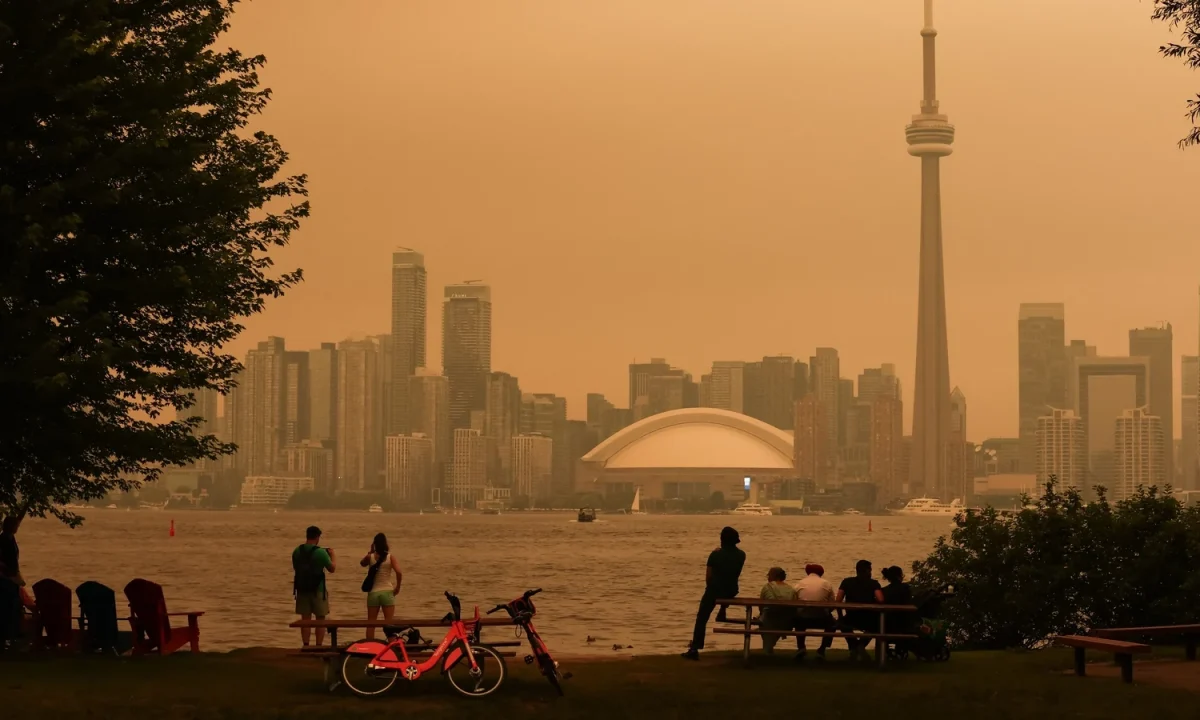
Wildfires burning out of control across the Canadian province of Ontario sent vast plumes of dangerous smoke into the United States yesterday, exposing millions of people to unhealthy air.
States near the Canadian border — including Minnesota, Wisconsin, Michigan and Illinois — were among the hardest hit, while air quality also worsened across the northeast, including New York.
By yesterday afternoon, IQAir’s pollution tracker ranked Minneapolis, Detroit and Chicago as the three most polluted cities in the world.
New York disappeared beneath a thick veil of haze as state authorities warned that fine particulate matter carried from the fires would make outdoor conditions “unhealthy” for everyone in the metropolitan area and on Long Island.
Officials urged New Yorkers to limit their time outdoors, while Mayor Zohran Mamdani described the combination of intense heat and unsafe air as a “serious threat”.
Free masks were being distributed at libraries and train stations, and hundreds of cooling centres opened across the city for residents without air conditioning.
“This could become the most significant smoke event in New York City since 2023, and conditions will be closely monitored for any deterioration,” the city’s Department of Emergency Management said.
During the 2023 episode, New York’s skyline took on an eerie orange glow as the air quality index climbed to a dangerous 465.
‘Our chests feel tight’
Across the Midwest, readings had already surged far beyond that level, according to the US Environmental Protection Agency’s tracker.
Chicago, Toledo in Ohio, and parts of Minnesota relatively close to the fires recorded air quality index readings well into the 700s. Much of the upper Midwest was also experiencing AQI levels in the most severe category: “hazardous”.
On her family’s organic vegetable farm in south-central Wisconsin, 38-year-old Erin Lucey spent the morning harvesting zucchini, beans and cucumbers, among other jobs. Labourers wore masks in the muggy heat, trying to filter the smoky haze covering the area.
“Our chests feel tight,” she said, describing the combination of smoke, recent searing heatwaves and parched fields as “eerie”.
“We are all thinking of the delicate balance of growing food in this type of future, and remarking how we can’t imagine what it will be like here in 100 years,” she said.
“If people were outside like us working and seeing how everything looks, if they didn’t have the convenience of air conditioning, we would be making much faster changes to address the climate crisis,” she added.
The Michigan Department of Environment, Great Lakes, and Energy said the dangerous conditions were expected to persist through today, noting that “our best model for smoke only predicts out to 48 hours”.
“That model is currently showing improvements on Saturday, but it is likely that smoke will linger and recirculate for a while,” the agency said.
Wildfires in Canada left New York beneath a dense blanket of haze
Evacuations in Canada
In Canada, the latest figures show more than 130 active fires burning in northwestern Ontario, at least 60 of them out of control.
Provincial authorities have formally asked the federal government for further assistance, particularly aircraft support to help evacuate isolated communities.
The Ontario Provincial Police said 15 communities and nearby areas had been evacuated so far.
“More than 150 fire crews and nearly 50 firefighting aircraft are working around the clock to protect communities from the fires in northern Ontario,” provincial Premier Doug Ford wrote on X.
Canadian wildfires have burned through at least 1.9 million hectares this year, an expanse almost equal to the size of Slovenia.
The total remains well below the devastation recorded in 2023, Canada’s worst wildfire season on record, when nearly 18 million hectares burned nationwide.
Northeast Spain wildfire burns more than 12,000 hectares – authorities
Meanwhile, a major wildfire raging for two days in northeast Spain has turned more than 12,000 hectares of land to ash, regional authorities said, warning that the blaze carried a “very high risk of spreading”.
“The night has been very complex, very difficult. At this time, we estimate that the burned area exceeds 12,000 hectares”, Roberto Bermúdez de Castro, the Aragon regional government official responsible for security matters, told the media.
Spain was already reeling from another wildfire last week in the southern region of Andalusia. That blaze killed 13 people — including seven Britons and an American — and destroyed 7,000 hectares, making it the deadliest disaster of its kind in the country’s recent history.
Temperatures in Aragon have recently climbed as high as 40C
More than 450 firefighters, supported by army reinforcements, were fighting the expanding blaze near Zaragoza in a thinly populated part of the Aragon region, where five small villages have been evacuated.
Aragon has endured peak temperatures of up to 40C in recent days.
Scientists say climate change driven by human activity is making extreme heat longer, more intense and more frequent, creating conditions that help wildfires spread while making them harder to contain.
During a visit Tuesday to fire-ravaged Andalusia, Prime Minister Pedro Sánchez warned that Spain faced a “complicated summer” for wildfires.