By Yousef MawryWednesday July 15, 2026
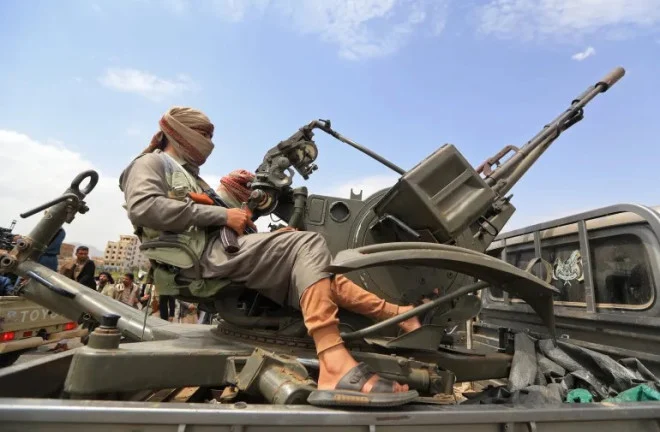
A Yemeni fighter raises his weapon at a Houthi rally aimed at recruiting new fighters in Sanaa on July 6, 2026 [File: Mohammed Huwais/ AFP]
Sanaa, Yemen – Yemen’s Houthi rebels have warned they could impose a “siege” on Saudi Arabia after an attack on Sanaa International Airport, raising the prospect of a sharp escalation in a conflict that had seen years of relative calm. The Houthis, formally known as Ansar Allah, blamed Saudi Arabia for Monday’s attack, while Yemen’s internationally recognised government said it carried out the operation to stop an Iranian aircraft from landing in the Houthi-held capital.
Mohammed al-Bukhaiti, a member of the Houthi political bureau, told Al Jazeera that the group would retaliate against what it considers Saudi attacks.
“Their decision to strike Sanaa Airport and stop flights from entering or leaving means Yemen has the right to target their airports and place them under a siege, just as they have done to us,” al-Bukhaiti said.
Houthi military spokesperson Yahya Saree said Monday’s strike had brought Yemen’s “de-escalation phase” to an end. The war has continued since the Houthis seized Sanaa in 2014, although a temporary truce four years ago ushered in a period of comparative quiet. Fighting earlier this month between Houthi and government forces in Hodeidah, followed by this week’s developments, now threatens to undo that calm.
The attack struck the runway at Sanaa Airport as an Iranian aircraft carrying a Houthi delegation from Tehran approached. Al-Bukhaiti said the strikes “will not pass without response and punishment”. The delegation had attended the funeral of Iran’s late Supreme Leader Ali Khamenei, who was killed at the outset of the US-Israeli war on Iran on February 28.
Al-Bukhaiti was among the officials aboard the Iranian plane, which was redirected to Hodeidah, the Houthi-controlled Red Sea port city.
His remarks came after the Houthis launched their own response to the airport attack, firing a salvo of ballistic missiles at Abha International Airport in southern Saudi Arabia. The Saudi-led coalition said it intercepted the missiles successfully.
The group has signalled that more action could follow unless the “siege” on Sanaa Airport is lifted. It has also vowed to maintain air links between Sanaa and Tehran, saying it is prepared to disrupt Saudi airports to secure those flights.
Tensions had already risen after a July 3 flight from Tehran to Sanaa. The Houthis said Saudi warplanes tried to prevent the Iranian aircraft from landing. It was the first publicly announced Iranian flight to arrive in Sanaa in more than a decade.
Yemen’s government says Iran uses flights into Yemen to conceal shipments of equipment for the Houthis. Addressing the United Nations Security Council on Monday, Yemen’s UN ambassador Abdullah al-Saadi said the plane attempting to land in Sanaa was connected to Iran’s Islamic Revolutionary Guard Corps (IRGC) and carried “personnel, know-how, and military and dual-use equipment”. He said the government had offered to transport the Houthi delegation from Tehran to Sanaa on a Yemeni airline.
Bab al-Mandeb threat
As the risk of wider fighting grows, attention has turned to the Houthis’ control of territory along the Red Sea and whether they could attempt to shut the Bab al-Mandeb Strait, the southern gateway to the strategically crucial waterway.
Any disruption to shipping off Yemen’s coast would add to pressure on the global economy, particularly as threats persist in the Strait of Hormuz, across the Arabian Peninsula, amid the US war with Iran.
Asked whether the Houthis could close the Bab al-Mandeb Strait, al-Bukhaiti said the group was considering all available options.
“The Bab al-Mandeb card is a strategic asset that Yemen has the luxury of utilising,” al-Bukhati said. “We will use this card against nations that are actively transgressing on us. We will use Bab al-Mandeb in a way that will bring no harm to nations that are not involved in hostilities toward Yemen.”
Following Israel’s genocidal war on Gaza, the Houthis previously attacked vessels they said had links to Israel or the United States. Those attacks disrupted Red Sea shipping, killed at least nine sailors, sank four vessels and led to the seizure of others.
The United States, Israel and the United Kingdom have previously struck targets in Yemen in an effort to halt Houthi attacks. Those attacks have stopped since the Gaza ceasefire agreement in October 2025.