
By El Tayeb SiddigFriday July 17, 2026
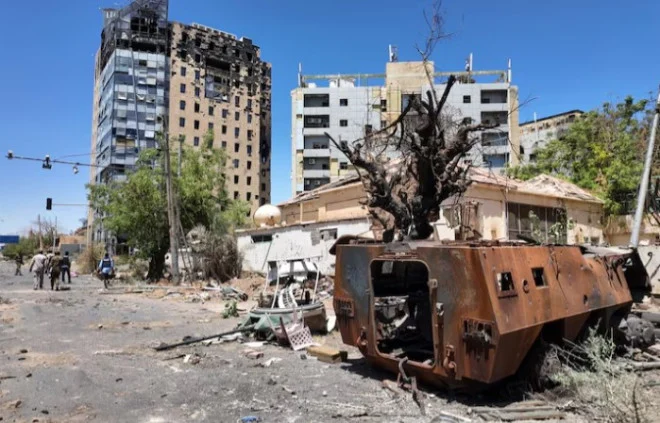
Army members walk past a destroyed military vehicle and bombed-out buildings in Khartoum state on March 26, 2025, after Sudan’s army retook territory and some displaced residents began returning to the devastated capital. REUTERS/El Tayeb Siddig Purchase Licensing Rights
One year after Sudan’s army drove the paramilitary force that seized Khartoum at the beginning of the 2023 civil war from the capital, more than 2 million of the 5 million residents displaced from the city have gone back home.
Yet the return has exposed the scale of the destruction. Despite official pledges to swiftly restore normal life following the army’s victory, electricity remains scarce, damaged buildings dot the city and many workers have not received their wages. For some returnees, the move was less a choice than an escape from a crackdown on refugees in neighbouring Egypt.
The government, which relocated ministries and administrative offices to the Red Sea city of Port Sudan, has instructed civil servants to resume their duties in Khartoum. Students who were offered remote lessons and allowed to sit exams at temporary sites elsewhere in Sudan or overseas have also been ordered back to classrooms.
Nisreen Altayeb, who escaped to Egypt with her family, chose to return after a refugee crackdown there began around the start of the year. “We left Sudan in the first place because of the lack of security, but then we started finding the same thing. It wasn’t safe in Egypt,” Altayeb said.
After hearing conditions in Sudan had improved, she and her family headed back. She is seeking to resume her job as a schoolteacher, but, like many other state employees, she has not been paid even her modest salary.
LIMITED RECOVERY
Recovery has largely been visible in Omdurman, Khartoum’s twin city across the White Nile, where the army retained partial control during the conflict. Khartoum itself and Bahri, to the north, remain mostly deprived of electricity and other essential services.
Drone attacks by the RSF on power facilities and military sites around Khartoum have continued, slowing efforts to rebuild.
Altayeb Saadeldin, spokesperson for the Khartoum state government, said those strikes had left the capital operating with just 1/3 of its prewar electricity capacity.
“That third is being distributed so we can provide people for 8 hours a day,” he said.
The University of Khartoum stands in one of the city’s hardest-hit areas. Students required to resume in-person examinations and teaching have returned to find laboratories, lecture theatres and dormitories still bearing the scars of war.
“The city needs work just like the university needs work,” said student Megdad Kammal.
University officials say rehabilitation work is under way before the new semester begins later this year.
SMALL BUSINESS STRUGGLES
Small business owners are also under pressure to reopen, especially in Khartoum’s important Souq al-Arabi, a vast central market that turned into a battlefield and was left strewn with land mines during the RSF withdrawal.
Authorities have begun collecting taxes and other charges, but many traders say they still lack basic services, including electricity.
“Our income is very low right now. They need to help us to come back, to encourage us to come back,” said Mohamed Abdelbasit, who runs a print shop. He said tax collection should be delayed to give shopkeepers time to meet their costs.
Saadeldin, the Khartoum state government spokesperson, said the state was granting postponements when necessary, but added that the cash-strapped administration also required income to maintain vital services including public safety and the sewage system.
Writing by Nafisa Eltahir Editing by Peter Graff