
Daily Sabah Tuesday July 14, 2026
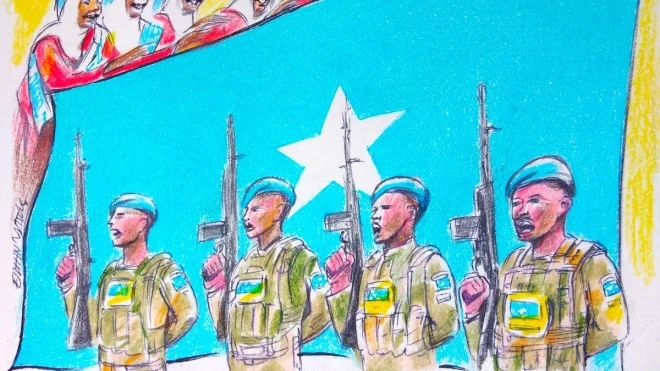
“If Somalia succeeds, the end of AUSSOM will mark not the end of a mission but the completion of one of Africa’s longest state-building transitions.” (Illustration by Erhan Yalvaç)
Somalia faces its most consequential security test in decades after the United States told the African Union on July 1 that it would stop funding the United Nations Support Office in Somalia (UNSOS) — the logistical backbone of the African Union Support and Stabilization Mission in Somalia (AUSSOM) — beyond December 2026. The response was swift and sharply divided. Some warned that Somalia could descend into an Afghanistan-style crisis, while others said the Somali National Army (SNA) is ready to take complete control of national security. Neither view addresses the central issue.
The real question is not whether Somalia will unravel after AUSSOM, or whether the SNA can instantly take over after nearly two decades of outside support. It is whether the country can move from security guaranteed by external actors to security maintained by its own institutions. Peacekeeping operations were never intended to become permanent fixtures. They are meant to give national institutions room to grow, rather than replace the state indefinitely. Somalia’s prospects after AUSSOM will rest less on when foreign troops leave than on the institutions that remain — a challenge best understood through the three security transitions the country has undergone, and the difficulty of the third.
Toward state-building
Few peace operations have influenced a nation’s political course as deeply as the African Union mission has influenced Somalia. But a mission is not judged by how long it remains; its ultimate test is whether the state it supports can endure on its own.
When the African Union Mission in Somalia (AMISOM) arrived in 2007, it entered a country trying to reconstruct a state that had collapsed 16 years earlier. The government had stopped functioning in 1991, public institutions had fractured, and Al-Shabaab had emerged as one of the Horn’s most powerful militant groups, seizing territory and menacing the Transitional Federal Government. AMISOM was essential to preventing a further collapse and helping Somali forces recover ground.
That initial phase delivered results. African Union troops working with Somali forces drove militants from Mogadishu and widened government control to Baidoa, Beledweyne, Kismayo and other cities. Those gains helped make possible the establishment of the federal government of Somalia in 2012. Yet the mission’s achievement also changed the purpose it was expected to serve.
Three security transitions
Current arguments often treat the African Union operation as though it has had one unchanged purpose since 2007. Its role, however, has evolved. Somalia’s experience is more accurately seen as a sequence of three security transitions.
The first, spanning roughly 2007 to 2014, centered on international protection. Somalia did not have the means to defend itself, leaving peacekeepers with primary responsibility for protecting population centers and fighting Al-Shabaab. At the time, there was no viable national force capable of filling that role.
The second involved shared responsibility. After Al-Shabaab lost major urban areas, the mission moved away from offensive operations and toward stabilization and mentoring. Reforms successively reshaped AMISOM into the African Union Transition Mission in Somalia (ATMIS) and then AUSSOM. This was not because the threat had vanished, but because the goal had shifted. The focus was no longer on defeating Al-Shabaab outright; it was on preparing Somalia to provide for its own security. That distinction is frequently missed. Critics often assess AUSSOM as if it still exists chiefly to liberate territory, although for more than a decade it has operated as a tool to reduce — rather than extend — reliance on external forces.
The third transition is now underway and carries the greatest stakes: sovereign security. For the first time since the state collapsed, the central issue is not whether international troops can stabilize Somalia, but whether Somali institutions can preserve that stability without them.
Why Washington changed course
Washington’s move is more than a funding decision; it offers a diplomatic judgment on Somalia’s political transition. The U.S. has not rejected the continuation of an African Union mission or declared a wider retreat from the country. It has reiterated its bilateral security cooperation and continued vigilance against terrorist threats. Its position is narrower: Washington will not finance UNSOS after its authorization runs out in December 2026, saying that Somalia has not demonstrated enough progress after two decades and billions invested.
The SNA has not developed the capacity originally anticipated. Political divisions among Somali actors have undercut the campaign against Al-Shabaab. Meanwhile, the international approach has remained largely intact after 20 years of support, despite the fact that peace operations are intended to enable national ownership rather than act as a lasting substitute for it. The decision therefore suggests that Somalia’s foremost obstacle is now political more than military.
No parallel has shaped the discussion more than Afghanistan, but it is a misleading comparison. Afghanistan’s collapse in 2021 followed the sudden loss of a security system heavily reliant on U.S. airpower, intelligence and financial support. When those capabilities disappeared overnight, much of the Afghan military’s capacity disappeared with them.
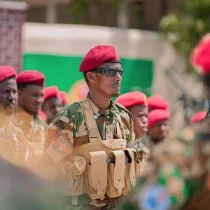
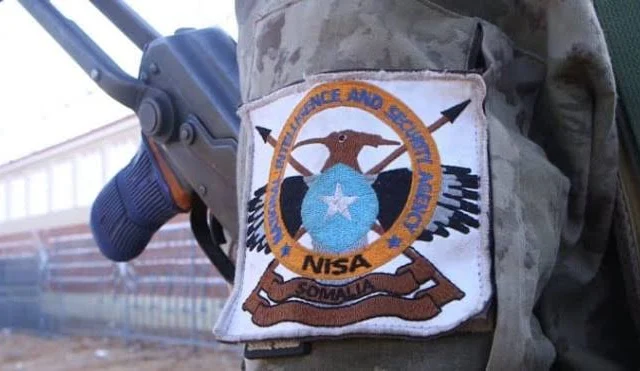
Somalia presents a different case. Al-Shabaab remains among Africa’s most durable insurgencies, but Somalia has spent the past decade transferring security duties to domestic institutions while broadening its partnerships. Its security structure no longer rests on one outside power: Türkiye, Western and African partners contribute through distinct approaches. The challenge is now less about territory than institutions — not simply whether Al-Shabaab can mount another offensive, but whether Somali institutions can withstand that pressure without breaking down.
The discussion has also brought a more fundamental issue into focus: could the international system have inadvertently slowed the very transition it aimed to deliver? This may be described as the Dependency Paradox. For years, financing has supported two parallel structures — a generously funded peacekeeping mission and a national military expected to eventually assume its role. Somali soldiers on the front lines have often received between $200 and $400 a month while serving in combat, whereas African Union peacekeepers have earned considerably more. This does not diminish the sacrifices made by African Union personnel. It does, however, raise the question of whether the model gave greater priority to maintaining the peacekeeping system than to the welfare and development of Somali forces. If Somali ownership has always been the objective, investment should move toward salaries, logistics and education instead of indefinitely underwriting foreign deployments.
Need for partners, not protectors
AUSSOM’s conclusion should not leave Somalia with a false choice between dependence and self-reliance. In modern security cooperation, the important measure is not troop totals but the institutions partnerships create — what scholars refer to as Security Sector Reform, the creation of accountable bodies that can replace external guarantees.
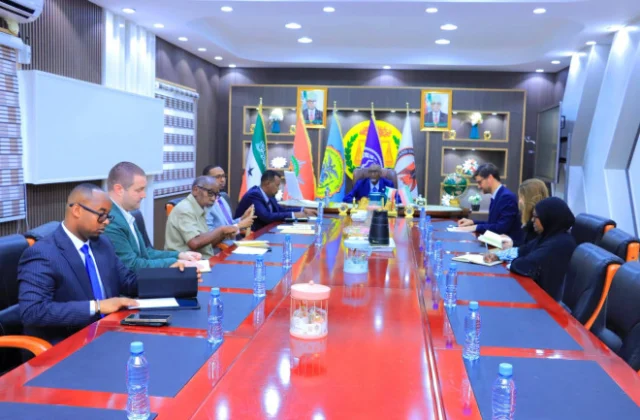
Türkiye has become an increasingly significant example in this area. Rather than following a traditional peacekeeping model, Ankara’s engagement has so far concentrated on strengthening Somali military capacity through the TURKSOM Military Training Center, officer education, naval cooperation and counterterrorism training. As a NATO member with decades of experience, Türkiye brings institutional knowledge as well as military support. Sustainable security depends less on stationing foreign soldiers than on developing national forces. Still, Türkiye cannot secure Somalia’s future alone. The same is true of the U.S., the European Union and other partners. Somalia’s future security structure should be built on diverse partnerships that deepen national ownership instead of placing the country in the hands of a single actor.
History is unlikely to view the end of AUSSOM as the instant Somalia either prevailed or failed. It may instead mark the point when Somalia confronted the question that no peacekeeping mission could resolve on its behalf: Can the Somali state protect itself?
The answer will hinge neither on the departure of international assistance nor solely on Al-Shabaab’s strength, but on whether Somalia’s leaders can convert 20 years of outside backing into lasting institutions. The first transition prevented the Somali state from collapsing. The second created an opportunity to reconstruct it. The third — and most difficult — will show whether it can stand independently.
That outcome demands more than an effective army. Somalia will need political consensus, accountable institutions, professional forces, dependable financing and partnerships that bolster ownership rather than displace it. If Somalia succeeds, AUSSOM’s end will signify not the conclusion of a mission but the completion of one of Africa’s longest state-building transitions. If it does not, the lesson will be that no peacekeeping mission can replace national political leadership.
Somalia’s future will be determined not in Addis Ababa, New York, Brussels, Ankara or Washington, but in Mogadishu. The African Union mission helped the country survive. The next chapter will reveal whether it can sustain itself. AUSSOM’s end is not Somalia’s end; it is the start of its hardest security test.