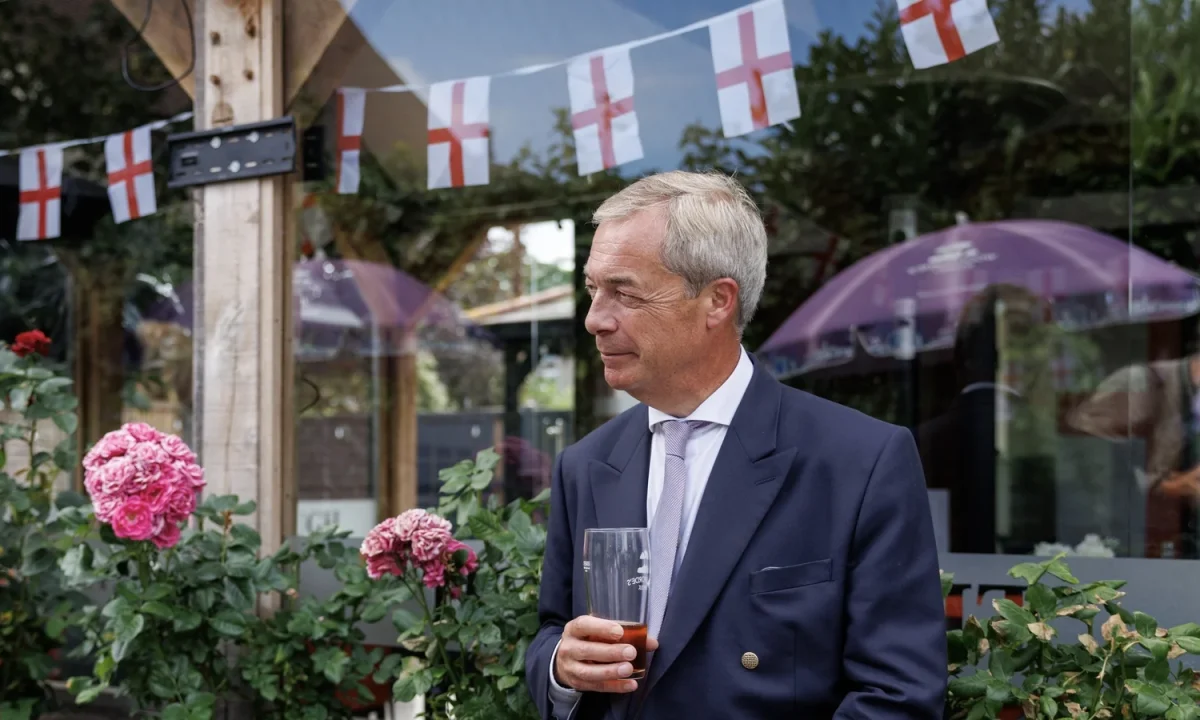
Nigel Farage has lived through plenty of headline-grabbing political storms, but few weeks in his career have landed with quite this jolt — a sequence of events that began with his resignation from Parliament and ended with the killing of one of his party’s most recognisable voices.
It started with Mr Farage stepping down as a UK MP; it finished with the murder of Reform UK’s justice and immigration spokesperson.
Along the way, a by-election was triggered — and the only credible opponent to seize the opening is a challenger who campaigns wearing a rubbish bin on his head.
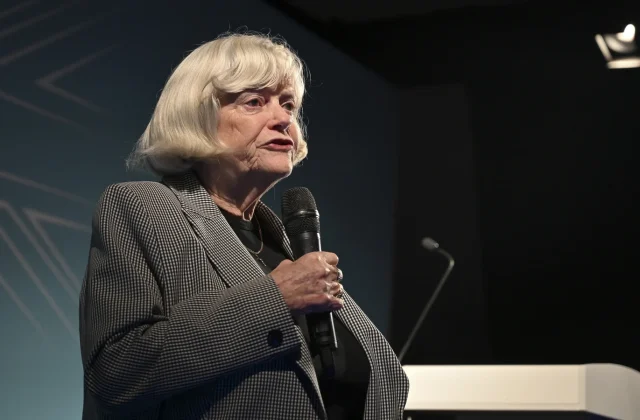
The most devastating development of all was the death of Ann Widdecombe, who was murdered at her home in Dartmoor.
Ms Widdecombe, once a Conservative, had returned to frontline politics via the Brexit Party and became one of the UK’s final MEPs after the 2019 European Parliament elections.
When the movement shifted into Reform UK — Mr Farage’s new political vehicle — she moved with it, combining experience in the trenches of Westminster politics with a familiarity for broadcast confrontation that kept her in constant demand across Britain’s sprawling ecosystem of radio, television and online talk outlets.
The first public hint that something had gone wrong came on Wednesday when she failed to appear for a scheduled Zoom link-up into a TV discussion programme — a missed slot that quickly took on a far darker meaning.
Floral tributes, including a wreath laid by Nigel Farage, near Ann Widdecombe’s home in Dartmoor
In a video tribute, Mr Farage described Ms Widdecombe as a “remarkable, principled woman,” calling her death “a truly terrible way to die” and “a terrible reflection on the state of modern Britain”.
He ended with a warning that captured the mood of the moment: “I really do fear for anyone in public life, and especially the political space, that things have become even more dangerous today.”
Those words arrived just days after Mr Farage used his resignation statement — prompted by a £5m undeclared gift from a Thailand-based cryptocurrency billionaire — to make a sweeping claim about his own safety.
“I am the most physically and verbally attacked public figure or politician of modern times,” he said.
He has repeatedly argued the £5m was intended to fund a personal security operation, with a team that accompanies him everywhere.
But the assertion that he is Britain’s most attacked politician drew immediate criticism from those who pointed to the country’s recent history: almost exactly 10 years since Labour MP Jo Cox was murdered by a gunman, and almost five years since Conservative MP David Amess was stabbed to death in his constituency office.
‘Dangerous and terrifying situation’
His insistence that the £5m was needed for the costs of political security appeared to collide with his separate argument that he did not need to declare the gift in the MPs’ register because he was not an MP when he received it — the money arrived three months before the last UK general election.
It is also notable that Mr Farage was the majority owner of the limited company that owns Reform UK at the time the gift was made.
Protesters show off a large £5 million banner the day after Nigel Farage resigned
Mr Farage went on to recount what he said were repeated assaults.
“Yes, you will know of some of the incidents; milkshakes thrown in my face, placards bashed over my head, but let me promise you, you only know about a fraction of the number of times that I’ve been assaulted.
“One little example you probably never heard of. It was a Sunday afternoon, a few years ago, in the local village pub. In come the mob, about 50 of them.
“We decided the safest thing to do was, as quickly as possible, to get into the car and to drive away, but the mob surrounded the car, banging on the bonnet at the windscreen, kicking the side of the doors. It was a genuinely dangerous and terrifying situation to be in. The car was written off. I didn’t even bother with an insurance claim. I did everything I could not to make it public,” he said.
Within hours, social media users surfaced newspaper reports that appeared to match that account, dating back to 2015.
His anger at a newspaper and a Sky News reporter — whom he accused of disclosing the address of one of his homes and confronting his daughter — was also quickly met with pushback, fuelled by multiple images posted online over the years.
Those photographs showed Mr Farage outside the same property at various times, alongside footage linked to I’m a Celebrity Get Me Out of Here. They also included his daughter Isabelle, despite his insistence earlier in the week that he did not involve her in his public profile.
Yet she appeared in a video from 2023.
That sat in contrast to the grainy security-camera clip released by Reform UK earlier in the week, which did not show Isabelle Farage at all. The footage showed a man — later identified as a Sky News reporter acting for the UK television pool — calling at the address where Mr Farage was registered to vote to ask whether he was home.
Sky News responded firmly, saying journalists have a right to ask questions and stating that its reporter never met Ms Farage, instead speaking with a man who opened the door.
The attempt to rally outrage over Sky gained little traction.
Even so, after returning from the United States on Monday — where he had spent the weekend marking America’s independence from Britain — Mr Farage confronted another Sky reporter, accusing the broadcaster of endangering his family.
Nigel Farage pictured as he made his resignation announcement
Commentators and opponents said the episode left him looking shaken, arguing he appeared ill-suited to the kind of sustained, high-pressure scrutiny that comes with offices such as prime minister, where decisions can carry life-and-death consequences.
Those critiques came as questions over his finances continued to mount, with the £5m gift — increasingly described as a story that keeps generating fresh angles — puncturing what supporters often treat as Mr Farage’s political invincibility and encouraging journalists across outlets to press harder for clear answers.
Now, the Parliamentary Standards Commissioner is also pressing for those answers, investigating the undeclared £5m to determine whether parliamentary rules were breached.
Had the commissioner found wrongdoing and recommended a suspension long enough to trigger parliamentary mechanisms, Mr Farage could have faced a recall election — a forced by-election in his Clacton constituency.
Reports suggested the commissioner intended to interview Mr Farage within the next fortnight, though any final report would not be expected until autumn.
Faced with the prospect of months of argument over the £5m, Mr Farage moved first: on Tuesday he said he would resign as MP for Clacton and run again in the by-election that resignation creates.
Reform UK framed the move as taking the dispute out of the hands of Westminster officials and placing it before the electorate — “the people,” in the party’s telling, as the ultimate judge.
It was cast as anti-establishment theatre with a democratic twist, echoing the kind of television formats in which Mr Farage and Ms Widdecombe have both appeared — and been well paid for. Mr Farage is the highest-paid participant in I’m a Celebrity… history.
But the script altered quickly when major — and even minor — political parties declined to contest the by-election.
Only one challenger stepped into the spotlight: Count Binface.
Under the slogan “Bin Day,” the Binface campaign has gathered momentum, particularly online, where memes generated at speed are flooding feeds.
Traditional broadcasters have followed, too, with Count Binface appearing on heavyweight political programmes including Today on Radio 4 and Newsnight on BBC 2.
Reform supporters reacted furiously that a figure could keep their identity hidden and still participate in electoral politics.
‘Bin Day’ is the slogan for Count Binface’s campaign
For the first time in his long run of election campaigns, Reform demanded to know who Count Binface really was.
The answer: Jon Harvey, a comedy writer who has worked on scripts for BBC shows including The Thick of It and Have I Got News for You.
That revelation prompted Reform to claim the BBC was part of an establishment “stitch up” aimed at undermining Mr Farage.
The BBC has previously faced criticism from the opposite direction — accused of giving Mr Farage outsized exposure long before he became an MP, through frequent TV and radio bookings.
As an MEP, he appeared on Question Time 33 times — fewer than only Ken Clarke, Shirley Williams, Menzies Campbell and Harriett Harman, all of whom were cabinet ministers and long-serving MPs.
Scottish newspaper The National has reported that between 2010 and 2019 — when that research was published — only UKIP MEPs appeared on Question Time, despite making up a small fraction of Britain’s 72 MEPs.
If anything, this has been the week when Mr Farage’s evasions and exaggerations began to exact a price.
He attempted to manufacture outrage about Count Binface’s identity while resisting scrutiny over his own unusual financial arrangements; he accused journalists of exposing his daughter and addresses even though he has appeared publicly connected to the same property; he tried to sneer at the establishment, only to find someone else doing it more effectively — and to him.
As Daily Mail columnist Dan Hodges wrote: “Mr Farage is learning that when the voters are shouting at you, it’s bad: when they are laughing at you, it’s over.”
Yesterday, in sweltering 30C heat, Mr Farage adopted a statesmanlike posture as he laid a wreath near Ms Widdecombe’s home.
Nigel Farage spoke to the media near Ann Widdecombe’s house yesterday
There may be some temptation for parts of the press to ease off in pursuing the £5m story — but there is little sign that will happen.
Mr Farage has said the cryptocurrency billionaire’s gift came with no conditions. Yet last Wednesday the Governor of the Bank of England, Andrew Bailey, issued a letter saying he had been lobbied by Mr Farage and Reform UK chairman Richard Tice about how cryptocurrencies are regulated in the UK.
The Governor said the bank’s policy did not change following the meeting.
Meanwhile, the Times and Sunday Times have opened another line of inquiry, pursuing Mr Farage’s connections to “Posh George” Cottrell and examining activity involving cryptocurrency and unregulated gambling, largely operating from Montenegro — where the Brexit campaign and Reform Party operative has reportedly backed a party that supports Montenegro’s bid to join the EU.
More disclosures, it seems, are likely in the days ahead.
But in a week already saturated with political noise and human tragedy — a kind of extraordinary that has, grimly, become familiar in the UK’s turbulent past decade — the closing words belong to Ms Widdecombe herself, speaking in what became her final appearance: a Talk TV breakfast interview, broadcast live from her home on Wednesday.
Discussing Mr Farage’s by-election contest with Count Binface, she said: “He will clear his name and the people of Clacton will express a vote of confidence in him; that’s not pantomime, that is serious politics.”
A matter of hours later, she was murdered.