Saturday July 11, 2026
Mogadishu (AX) — A landmark three-day training concluded this week as Somalia launched a national effort to build safer, more respectful and professional workplaces across the public service.
- Advertisement -
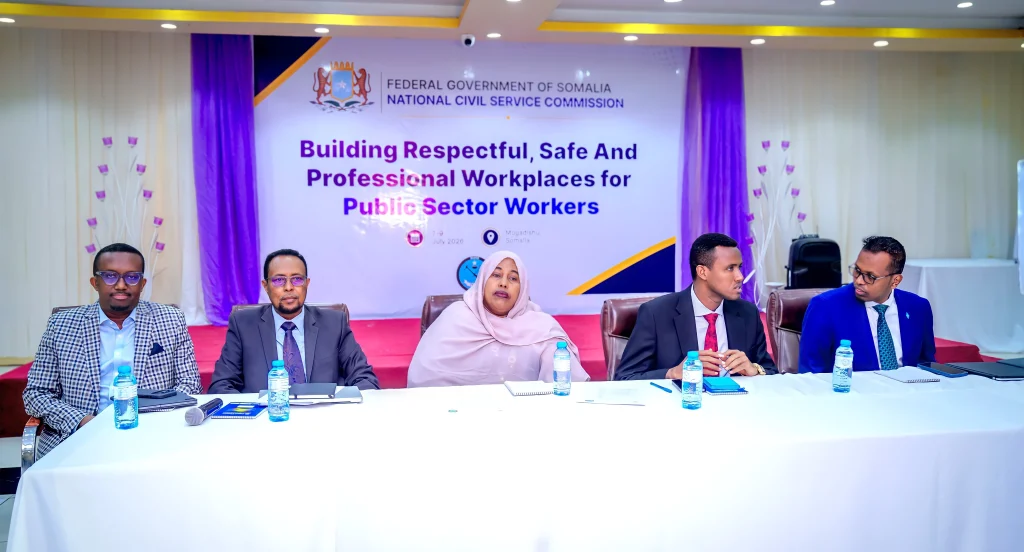
Titled “Building Respectful, Safe and Professional Workplaces for Public Sector Workers”, the programme was organised by the National Civil Service Commission (NCSC) in partnership with the Federation of Somali Trade Unions (FESTU), with financial backing from the Ministry of Finance through the World Bank-funded Recurrent Cost and Reform Financing (RCRF) programme. As the initiative’s first activity, the training is intended to kick off a sequence of nationwide actions to strengthen workplace culture, institutional capacity and professional standards throughout government institutions.
The curriculum grew out of recommendations from a recent Workplace Assessment of Federal Government bodies, which flagged gaps in awareness of workplace ethics, weak confidence in grievance and reporting systems, and limited institutional ability to prevent and respond to misconduct. The assessment also highlighted the need for clearer leadership accountability, stronger systems and a workplace ethos rooted in dignity, respect and accountability. Organisers said the training is the initial, practical step in applying those recommendations and advancing public sector reforms.
The programme aligns with Somalia’s push to meet international norms and to operationalise provisions in the newly revised Labour Code that address violence and harassment. Organisers emphasised that every worker has the right to a work environment free from violence and harassment, including gender-based violence and harassment, and that adopting such protections will support better governance, more robust institutions and improved public service delivery.
Opening the event, Amina Hussein Ali, Deputy Minister of Labour and Social Affairs, stressed the Federal Government’s commitment to ensuring public sector employees work in environments that uphold dignity, equality and non-discrimination. She said stamping out violence and harassment is essential to an effective public administration and to delivering quality services to Somalis, and stressed that protecting women from violence, harassment and all forms of abuse remains a key government priority.
Representing the Ministry of Finance, Saleiman Sheikh Omar, Director General, underscored that investing in civil servants is central to strengthening state institutions and enhancing service delivery. He noted that the government, through the World Bank-supported RCRF programme, continues to fund efforts to build a capable, accountable and professional civil service and to create workplaces where staff can carry out their duties free from violence, harassment and discrimination. He urged participants to use existing grievance mechanisms and gave assurances that reported cases would be addressed.
Abdulkadir Suleiman, RCRF Coordinator, attended the programme, signalling the RCRF’s ongoing focus on bolstering institutional capacity, lifting public sector performance and backing the roll-out of the national initiative.
Hassan Abshirow Mohamed, Chairman of the National Civil Service Commission (NCSC), reiterated the Commission’s pledge to foster a civil service grounded in professionalism, integrity and respect. “A modern Civil Service depends not only on technical competence but also on a workplace culture built on dignity, mutual respect and accountability. The training programme enhances public sector workers’ skills to prevent violence and harassment while ensuring professional conduct and quality service for the Somali people. Every institution has a responsibility to ensure that its workers perform their duties in an environment where they feel safe, respected and able to give their best.”
Omar Faruk Osman, General Secretary of FESTU, told participants the programme marks an important step toward decent work in the public sector and highlights the role of social dialogue in improving workplaces.
“Every worker is entitled to dignity, equality and a workplace free from violence and harassment. Eliminating violence, harassment and sexual harassment is not only a workers’ rights issue; it is also essential to building productive, inclusive and professional public institutions. Through the effective implementation of the newly revised Labour Code and ILO Conventions, Somalia will be able to strengthen protection for workers while creating workplaces where women and men can contribute equally, safely and with dignity. This initiative marks the beginning of a sustained partnership to make respectful and violence-free workplaces the norm throughout Somalia’s public sector,” Omar said
Over the three days, more than 50 participants from a range of federal institutions deepened their knowledge of workers’ rights, workplace ethics, occupational safety, gender equality and prevention of violence and harassment. The sessions promoted ethical leadership, cooperation between staff and management and a culture of mutual respect, accountability and inclusion.
Following the successful first activity, NCSC and FESTU plan to roll out additional components under the initiative, including further training, awareness campaigns, institutional capacity-building and policy support.
Organisers said continued backing from the Ministry of Finance through the RCRF will be critical as implementation continues, helping to entrench dignity, equality, safety and professionalism across the public service while strengthening application of the revised Labour Code and international labour standards to support a modern, effective and people-centred civil service.