By Said MireSaturday July 18, 2026
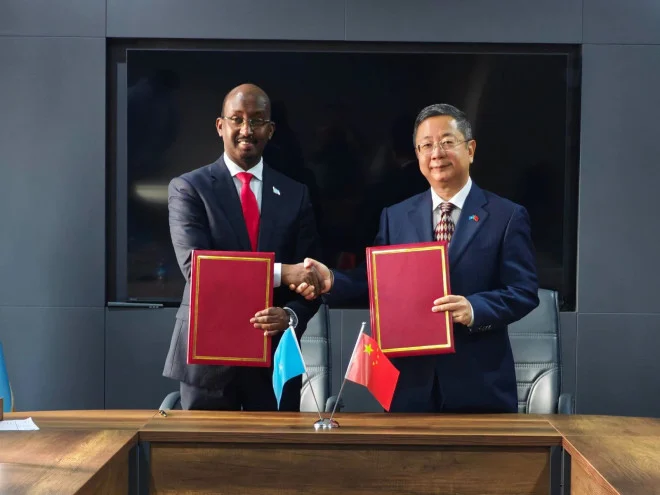
Somalia has secured duty-free entry for all of its fishery products into China, opening the door to one of the world’s biggest consumer markets and marking a major step for the country’s economic ambitions. The protocol was signed in Mogadishu by Somalia’s Minister of Fisheries and Blue
Economy, H.E. Ahmed Hassan Aden, and China’s Ambassador to Somalia, Wang Yu. The agreement strengthens longstanding ties between the two countries while creating fresh prospects for Somalia’s developing blue economy and its potential social and economic gains nationwide.
Harnessing Somalia’s Vast Marine Potential:
With mainland Africa’s longest coastline, extending more than 3,300 kilometers, Somalia has substantial yet largely underdeveloped marine
resources. The country has faced persistent obstacles, from weak infrastructure and aging fishing boats to restricted access to overseas buyers. The new protocol offers an opportunity to capitalize on those coastal assets by building a sustainable, profitable and internationally competitive fisheries sector capable of supporting national growth.
Advantages of the Agreement: Access to the World’s Largest Consumer Market.
By eliminating tariffs, the deal gives Somali seafood exporters direct access to China’s consumer market of more than 1.4 billion people. The arrangement could raise earnings for local fishers and businesses while helping Somalia broaden its economy beyond traditional pillars such as pastoralism and agriculture.
Driving Economic Growth and Industry Development:
The protocol is also expected to draw substantial private investment into the fisheries industry. That capital could support the renewal of fishing fleets, development of reliable cold-chain systems and construction of processing plants. Better infrastructure could improve quality and market competitiveness, helping establish Somalia as a regional center for fisheries and seafood exports, including higher-value processed products.
Job Creation and Socioeconomic Upliftment:
A larger fisheries sector could create thousands of jobs, spanning fishing, processing, transport and marketing. Such employment would be particularly important for Somalia’s young population, where joblessness remains a major challenge, and could promote more inclusive economic development across society.
Advancing the Blue Economy and Strategic Regional Presence:
The agreement supports Somalia’s wider Blue Economy framework, which calls for the sustainable use of ocean resources alongside stronger maritime security and trade. Government efforts to improve ports, logistics links and maritime capacity are central to
the goal of making Somalia an important regional maritime hub. Progress in those areas would strengthen the country’s strategic and economic standing in the Indian Ocean region.
Global Context and Future Prospects:
The Somalia-China fisheries protocol reflects a broader push by developing countries to reach valuable Asian markets through deeper trade partnerships. Somalia’s location and marine biodiversity give it a favorable position to develop into a leading regional center for fisheries and maritime services. Sustained international cooperation,
policy changes and focused investment will be needed to fully unlock the blue economy and turn maritime resources into lasting sources of growth, jobs and regional stability.
The 2024 high level meeting between H.E. Hassan Sheikh Mohamud President of the Federal Republic of Somalia and H.E. Xi Jinping, President of the People’s Republic of China, held during the China-Africa Cooperation Forum in Beijing,marked a pivotal moment in strengthening bilateral relations. The summit raised the Somalia-China relationship to a strategic level and laid the groundwork for broader cooperation in economic, infrastructure and development areas. Those efforts correspond with Somalia’s national priorities and its ambitious Blue Economy agenda, supporting long-term growth and regional integration.
Against that backdrop, Somalia’s National Transformation Plan (NTP) places economic diversification and sustainable development at the center of the country’s vision. The Somalia China duty free fisheries protocol stands as a significant moment in Somalia’s drive for resilience and greater regional influence. Access to one of the world’s largest markets offers a major opening to create jobs, draw sustainable investment and responsibly develop the country’s maritime resources.
As Somalia begins this new phase, sustainable fishing, modern infrastructure and inclusive growth will be essential to realizing the agreement’s full benefits. Backed by strategic international partnerships and a clear national vision, Somalia’s blue economy could become a durable source of prosperity, regional stability and socio economic advancement for generations to come.
______________________
By Said MireDirector of Asia and Australia at the Ministry of Foreign Affairs and International Cooperation