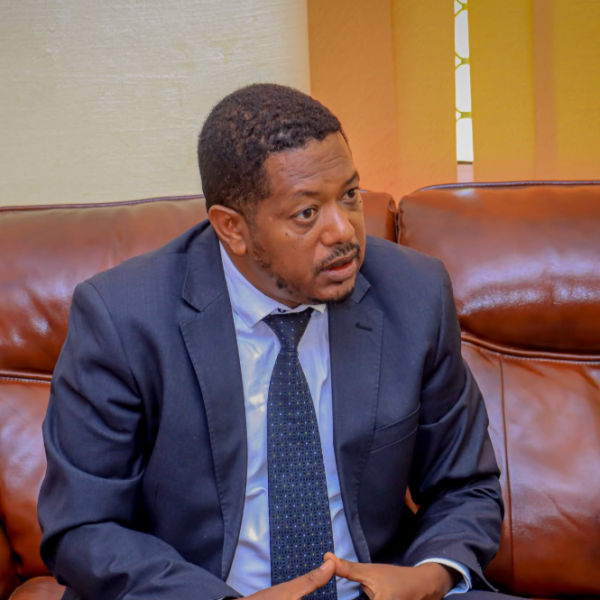
EXCLUSIVE INTERVIEW: Ethiopian Diplomat Yidnekachew Tekle Highlights recent election, Democratic Milestones and Economic Transformation of Ethiopia
AXADLE, Somalia — Ethiopia’s political and economic trajectory came into sharp focus in an exclusive interview Axadle conducted with Yidnekachew Tekle, Minister Counsellor at the Ethiopian Consulate in Garowe, Puntland State State of Somalia of Somalia. In the wide-ranging conversation, Tekle discussed the aftermath of Ethiopia’s June 2026 general elections, the country’s democratic reforms, institutional shifts, and the sweeping economic changes reshaping the nation.
- Advertisement -
Axadle: How would you describe the current state of Ethiopia’s democratic process and political reforms?
Yidnekachew Tekle: Under the leadership of Prime Minister Dr. Abiy Ahmed, Ethiopia has recorded what he described as extraordinary progress, restoring democratic values and overhauling a political system that, in his view, was deeply inefficient before the current administration took office.
The National Dialogue initiative, he said, stands as one of the most significant achievements in modern Ethiopian history. It has created a structured forum for addressing long-running political and constitutional disputes through discussion rather than “a cocktail of chaos.” He argued that, for much of Ethiopia’s modern political history, governments kept rivals at arm’s length from state institutions. Today, he said, opposition figures are holding senior roles in both federal and regional executive structures for the first time, marking a clear break from a tradition of exclusion.
Ethiopia, he added, is simultaneously managing economic reform, political transition, institutional change, and national integration. That combination, he said, puts the country in position to become one of the major success stories of the 21st century. The outlook, especially after the June 1, 2026 General Elections, is why the coming years matter so much, he said.
Tekle also pointed to broad legal and institutional changes under the reformist government, including measures to reshape the electoral commission, the justice sector, and media freedoms. He said the administration has strengthened civil organizations, freed political prisoners, and encouraged active participation from political parties. Those steps, he argued, have helped build confidence among political actors and given democratic institutions room to function independently. Overall, he said, the government’s approach has created a favorable environment for stronger institutions and stable political engagement.
Axadle: What are the key takeaways from Ethiopia’s recent elections, and how do they reflect the country’s democratic growth?
Yidnekachew Tekle: One of the central goals of the current period, he said, has been to shift political competition from the battlefield into democratic institutions. For generations, Ethiopia’s political transitions were often accompanied by efforts to seize power through force. Since 2018, however, he said the country has taken a decisive turn away from that pattern.
The 7th general election, held on June 1, 2026, was, in his words, a proud moment in Ethiopia’s electoral history. More than 54 million Ethiopians took part, lining up from dawn until midnight to vote peacefully for their preferred candidates. He said the public displayed patience, dignity, civic responsibility, and restraint throughout registration, voting, and the wait for results.
In the contest, 10,934 candidates from 42 political parties, together with 80 independent candidates, sought office. Of them, 2,198 competed for the federal parliament, 8,736 ran for regional seats, and 501 were in the race for the 547 parliamentary seats. The African Union (AU), IGAD, and other independent observers monitored the process. Tekle said the scale of participation and oversight shows Ethiopia is the second-largest democracy in Africa.
Axadle: How is Ethiopia ensuring transparent elections and accommodating different political voices?
Yidnekachew Tekle: He said the political changes of the past eight years have been matched by wide-ranging electoral reforms, anchored by the creation of the National Electoral Board of Ethiopia (NEBE) as a fully independent institution.
To broaden participation, he said, authorities introduced measures to make voter registration more accessible, including targeted outreach in marginalized areas and direct engagement with political parties. NEBE also invited domestic and international observers to follow the process, while public awareness campaigns were carried out on a wide scale.
Given Ethiopia’s diverse culture and multinational composition, Tekle said the government has worked to ensure fair representation for both regional and national voices. He also highlighted electronic registration as an important technological step toward protecting the integrity of elections.
Axadle: What strategies are being used to balance regional diversity with national unity?
Yidnekachew Tekle: He pointed to the deliberate inclusion of regions that, before 2018, had largely been pushed to the margins. Afar, Somali, Benishangul-Gumuz, Gambella, and Harari, he said, are now central to the federal system and to national decision-making. The government, he said, has placed strong emphasis on inclusive governance and equitable representation across both federal and regional structures.
Axadle: What are the key milestones of Ethiopia’s current economic reforms?
Yidnekachew Tekle: Ethiopia, he said, has launched major economic reforms designed to improve living standards. Beginning in 2018, the country opened its economy to market-oriented changes, particularly in banking, telecommunications, and transport. Investment laws were also revised to draw in Foreign Direct Investment (FDI).
The country has also delivered major infrastructure gains, including high-standard highways, clean energy projects led most notably by the Grand Ethiopian Renaissance Dam (GERD), and specialized industrial parks aimed at expanding manufacturing.
At the same time, Addis Ababa is being reshaped into what he described as a futuristic, green, and globally competitive business center, marked by tall new buildings, major corridor expansions, and restored green riverfronts that are altering the capital’s historic landscape.
Ethiopia’s $30 billion strategic infrastructure roadmap includes the $12.5 billion Bishoftu International Airport project, natural gas extraction in Ogaden in Gode, large-scale fertilizer plants, and a national housing program targeting 1.5 million units. Tekle said these projects are designed to accelerate industrial and agricultural production, cut dependence on imports, and establish Ethiopia as Africa’s leading aviation hub.
He also said Prime Minister Abiy Ahmed’s push for wheat self-sufficiency has become part of a broader national ambition. Ethiopian farmers, he noted, are now harvesting more than 50 quintals of wheat per hectare. Food sovereignty, economic resilience, and national confidence, he said, are closely linked, and this agricultural shift remains central to Ethiopia’s future development.
Axadle: Thank you for your time, Minister Counsellor.
Yidnekachew Tekle: Thank you.