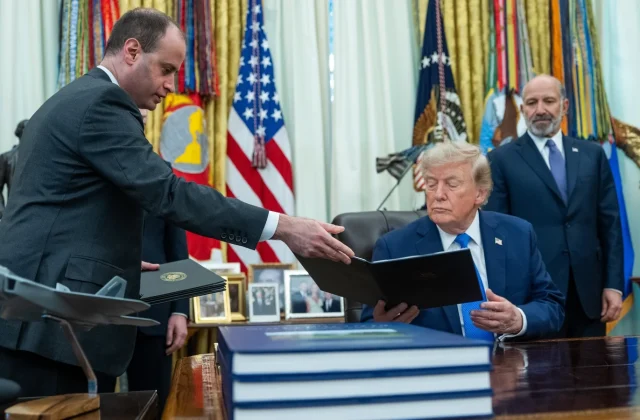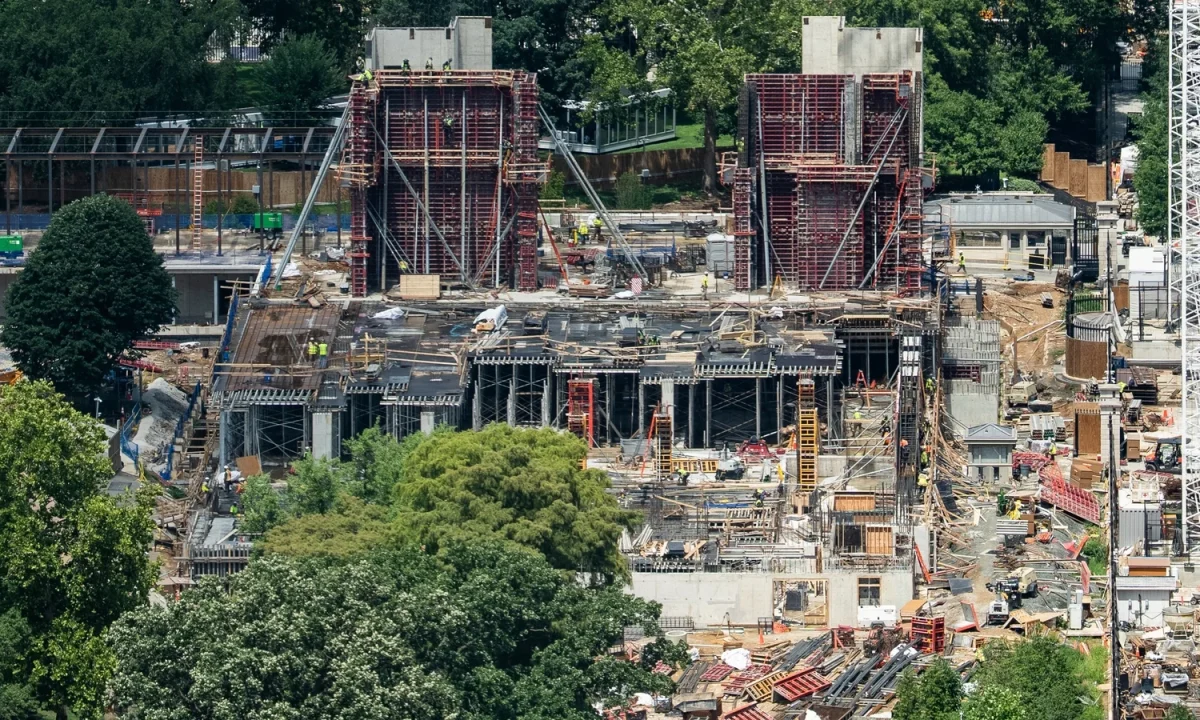
Donald Trump’s administration suffered a major legal blow after a US federal appeals court ordered it to halt construction of a $400 million ballroom at the White House, where the East Wing was demolished to make way for the project. The ruling places presidential power at the center of a dispute over whether the executive branch can substantially alter the historic complex without congressional approval.
“Each President is a temporary tenant, not the owner, of the White House,” the Washington-based US Court of Appeals for the District of Columbia Circuit said in a 2-1 decision, adding that no president can fundamentally transform the building without authorization from Congress.
The court upheld a preliminary injunction secured by the National Trust for Historic Preservation. The group sued last year after the administration demolished the East Wing and started work on an 8,360-square-metre ballroom without first seeking approval from lawmakers.
“Whether or not a massive ballroom should be constructed is for Congress to decide and is not a matter for Executive self-help,” the majority said.
Mr Trump has increasingly portrayed the ballroom as essential to national security. In a post on Truth Social, he described the planned facility as a “military center” and said his administration would take the case to the Supreme Court.
He denounced the ruling as “horrendous” and politically motivated, arguing that it would leave him, White House officials and visitors more vulnerable to an attack.
“This unjust decision must be overturned by the Supreme Court in its entirety,” Mr Trump wrote.
He said the design includes bomb shelters, medical facilities, protection against drones and missiles, as well as other security measures that are “all tied together as one big, expensive, and very complex unit.”
National Trust President Brent Leggs said the decision was “a great day for our country and for the American people’s right to voice their opinions about the historic places they cherish, including the White House.”
Mr Trump sought the appeal after US District Judge Richard Leon, appointed by Republican former President George W. Bush, twice barred above-ground construction at the site while permitting underground work to proceed.
The administration has said the ballroom is needed to accommodate large formal events and improve the White House’s safety. The proposal is also the most ambitious of several initiatives Mr Trump has pursued to remake the federal buildings and national monuments that define central Washington.
In a separate lawsuit, a judge recently ruled that Mr Trump’s name had been unlawfully placed on the outside of the Kennedy Center performing arts venue and ordered it removed.
Appeal to national security
During arguments before the DC Circuit on 5 June, Justice Department attorney Yaakov Roth said judges had no role in evaluating the privately funded ballroom project.
He argued that the National Trust’s “architectural preference” should not outweigh national security considerations, citing evidence that the former East Wing had left the president and other people inside the White House exposed to potential attacks.
The appeals court majority, made up of Democratic-appointed Circuit Judges Patricia Millett and Brad Garcia, said its decision did not permanently prevent the construction of a ballroom. Instead, it suspended above-ground work while the lawsuit continues and until the White House obtains congressional approval.
The judges rejected the idea that national security concerns automatically override legal limits, writing that such arguments “are not an automatic get-out-of-law-free card.”
“The bold assertion that the Executive can act with utter lawlessness, destroying treasured national landmarks and harming the interests of individuals, and that no court can stop it flouts our constitutional order,” they wrote.
Circuit Judge Neomi Rao, whom Mr Trump appointed during his first term, dissented. She said the trial judge’s order blocking the project “is beyond the proper province of the federal courts” and argued that construction should be allowed to continue.
“The district court seized supervision of construction at the White House, and my colleagues affirm this judicial overreach,” Rao wrote.
Mr Trump has also defended the project as its projected cost has climbed to twice the original estimate.
In a May post on Truth Social, he said the price increased because the ballroom is “approximately twice the size, and a far higher quality, than the original proposal” and pledged that “it will be magnificent, safe, and secure!”