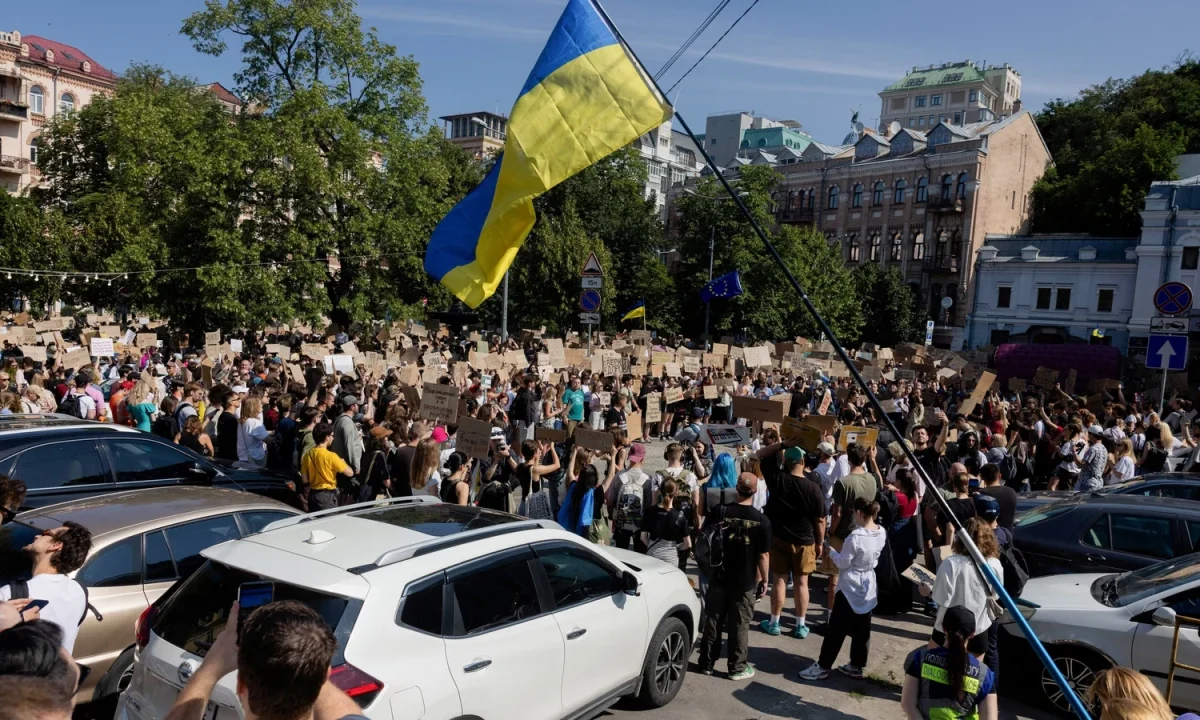
Protests erupted across several Ukrainian cities after the removal of popular Defence Minister Mykhailo Fedorov, exposing public unease over a sweeping government shake-up.
More than 1,000 demonstrators filled a central square in Kyiv, singing the Ukrainian national anthem, waving Ukrainian and EU flags, and chanting “shame” and “bring Fedorov back”.
Appointed only six months ago, Mr Fedorov quickly gained a reputation as a moderniser determined to overhaul a Ukrainian military strained by more than four years of Russia’s invasion.
Previously Ukraine’s first digital transformation minister, he was credited with reducing bureaucracy, expanding drone warfare and advancing a data-driven strategy designed to wear down Russian forces.
Critics, however, said he had not moved quickly enough to fulfil his promise to reform military recruitment.
His departure threatens fresh uncertainty within the army just as Ukraine reaches one of its strongest positions in months, after slowing the Russian advance and hammering Russian oil and military facilities with long-range drones.
Mr Fedorov announced late yesterday that he was stepping down, calling it a “great honour to serve the Ukrainian people”, as President Volodymyr Zelensky pressed ahead with a broad government reshuffle.
Mr Fedorov said he had rejected an offer from Mr Zelensky to serve as a presidential adviser.
Speaking to reporters, he said he had clashed with Ukraine’s army chief Oleksandr Syrskyi, whom he accused of obstructing defence ministry initiatives.
Local media reported demonstrations over his dismissal in other cities, including Lviv, Odesa and Dnipro.
Pavlo Yelizarov, the deputy commander of Ukraine’s air force, also resigned in protest over Mr Fedorov’s removal.
He described the dismissal as “a great evil” for Ukraine’s defence.
Protesters in Kyiv chanted ‘Bring Fedorov back’
“We’re in favour of an upgrade — not a downgrade,” said a demonstrator who gave his name as Ali and described Mr Fedorov as an effective, modern manager.
“We see results, we see clear progress in our fight for freedom.”
Mr Syrskyi, 60, has led the military since early 2024, but his rigid command style has drawn criticism from some service members who say it contributes to heavy troop losses.
Mr Zelensky has yet to comment publicly on the decision to remove Mr Fedorov.
Some demonstrators called on the president to dismiss Mr Syrskyi instead.
Meanwhile, Ukraine’s parliament voted to install energy executive Sergii Koretskyi as prime minister, making him the third person to hold the office since Russia launched its invasion in 2022. He replaces Yulia Svyrydenko after only a year in the role.
Mr Koretskyi, the former CEO of state energy giant Naftogaz, won praise from politicians who portrayed him as a capable and efficient manager.
Sergii Koretskyi previously led Ukraine’s state energy company
His appointment was approved with 289 votes.
Addressing parliament before the ballot, Mr Koretskyi named Ukraine’s defence, economic stability and integration into the European Union as his chief priorities.
Ms Svyrydenko’s dismissal prompted the resignation of the entire government, although Mr Zelensky’s Servant of the People party retains a parliamentary majority.
Although lawmakers endorsed Mr Koretskyi, votes on other ministerial appointments face a less certain outcome.
Ukraine is now in its strongest battlefield position since late 2022, using drone and missile attacks against Russia’s oil industry and military supply lines to erode Moscow’s war machine.
Even so, Kyiv’s troops remain under pressure from grinding Russian advances in the east, a critical shortage of ground forces and insufficient air defences as Moscow intensifies ballistic missile strikes.
A spokesperson for Russian President Vladimir Putin said the Kremlin was watching the reshuffle, but argued that changing the prime minister or defence minister would make no difference unless Kyiv was prepared to take a “responsible decision” leading to a peace settlement.
Starmer vows UK support for Ukraine will ‘always endure’
Keir Starmer has pledged that the UK’s “cast-iron” backing for Ukraine will “always endure” during his final visit to the country as prime minister.
He arrived at Kyiv’s railway station hours after strikes were reported in the capital. Mayor Vitali Klitschko said two people were killed and six others were injured, including a 16-year-old teenager.
Ukraine is receiving the first of 150 British-made artillery barrels under a £61 million contract with BAE Systems aimed at strengthening the country’s defences.
The 105mm and 155mm barrels are being manufactured at Sheffield Forgemasters, marking the first production of forged artillery barrels in the UK for almost two decades.
Ukraine presented Mr Starmer with its Order of Freedom honour.
“Britain has always been, and remains, with Ukraine, and we value this immensely,” Mr Zelensky told Mr Starmer during a press conference in Kyiv.
Keir Starmer and Volodymyr Zelensky at Kyiv’s Wall of Remembrance
The visit followed a wave of overnight Russian attacks in which Ukrainian air defences intercepted five ballistic missiles, according to the country’s air force, although other missiles and drones penetrated the defences and struck Kyiv.
The latest assault on the capital ignited fires at two warehouses and damaged a school.
Russia’s Defence Ministry said the operation targeted military manufacturing sites in Kyiv that produce long-range missiles and drones.
Ukraine’s air force said one ballistic missile and 25 drones hit 17 locations, while falling debris was recorded at 10 additional sites.
UN atomic chief denounces ‘unacceptable’ killing at Ukraine power plant
Separately, the head of the United Nations atomic agency condemned the killing of the chief engineer at Ukraine’s Russian-occupied Zaporizhzhia nuclear power plant in a drone strike that Moscow blamed on Kyiv.
The head of Russian nuclear corporation Rosatom said the engineer was killed when “a drone belonging to the Ukrainian armed forces” struck a service vehicle near the flashpoint facility.
International Atomic Energy Agency (IAEA) chief Rafael Grossi “condemns the reported incident which he says represents an unacceptable attack on the plant and its management, seriously threatening nuclear safety”, the watchdog posted on X late last night.
“The IAEA calls for an immediate end to all attacks on or near nuclear sites and their staff,” it added.
Russian foreign ministry spokeswoman Maria Zakharova had called on the agency to condemn the alleged “murder”.
Russian forces seized the Zaporizhzhia plant in March 2022, soon after Moscow began its full-scale invasion of Ukraine.
Europe’s largest nuclear power station, the facility has remained a persistent focus of safety concerns throughout the war.
Both sides repeatedly accuse each other of attacking the site in Enerhodar, on the banks of the Dnipro river, which forms the frontline in that area.