
In a moment heavy with symbolism for Iran’s future, three sons of former supreme leader Ali Khamenei stepped into public view at his funeral — while their brother, Mojtaba Khamenei, the successor named after his father’s death, remained conspicuously absent.
For a second consecutive day, crowds of thousands packed Tehran’s Grand Mosalla religious complex for the funeral rites of Khamenei and four family members killed on 28 February in Israeli airstrikes based on US intelligence.
The ceremonies are not only laying to rest the man who ruled the Islamic republic for over three-and-a-half decades. They also offer authorities a highly public stage to project endurance after five weeks at war with Israel and the US — a conflict the theocratic system, in place since 1979, survived despite the deaths of key figures.
Parliament speaker and chief negotiator with the US Mohammad Bagher Ghalibaf, one of the most prominent faces of the post-Ali Khamenei era, hailed on X how the “proud and invincible nation of Islamic Iran unanimously” paid tribute to its “martyr”.
Today’s rites carried a rare family spotlight: Ali Khamenei’s eldest son Mostafa appeared alongside his two younger brothers, Masoud and Meysam — all clerics — as mourners pressed in under the cavernous halls of the complex.
The coffins of Khamenei and four family members also killed in the strikes were placed on a raised dais
‘Blessed end’
Yet the brothers’ presence sharpened another storyline surrounding the succession. Mojtaba Khamenei, named supreme leader shortly after his father’s killing, did not appear at the funerals and has still not been seen publicly.
Officials have said he was wounded in the airstrikes, but the severity of his injuries remains unclear. So far, he has only communicated through written statements.
Attention is now shifting to the remaining days of the ceremonies — especially the burial on Thursday — when many will watch closely for any public sign of the new leader.
Also drawing notice was the new commander of the powerful Revolutionary Guards, Ahmad Vahidi. Returning for a second day, he appeared this time in the open air after going unseen throughout the war; his predecessor was killed in the 28 February strikes.
Esmail Qaani, the shadowy head of the Guards’ Quds Force – responsible for its foreign operations – also made a rare appearance, telling Iranian TV that Khamenei’s “blessed end” was fitting after a lifetime of “striving”.
Senior cleric Grand Ayatollah Jafar Sobhani, 97, recited the funeral prayer for Khamenei ahead of his body being moved out of the complex for the procession tomorrow.
Authorities have said they expect more than 10 million people to take part in the ceremonies
‘Demand revenge’
Alongside mourning, officials appear determined to turn the scale of attendance into a political message — a show of mass mobilisation behind the state after mass protests in January that rights groups say were quelled by a crackdown that left thousands dead.
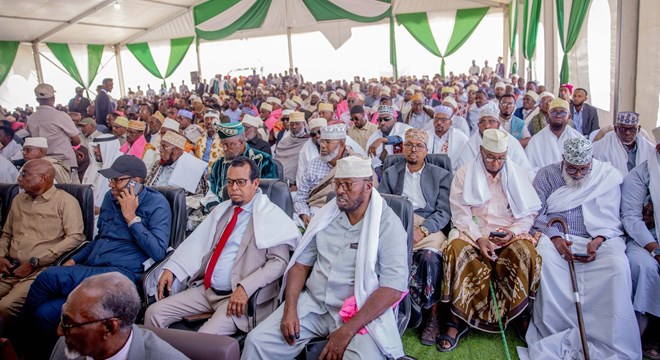
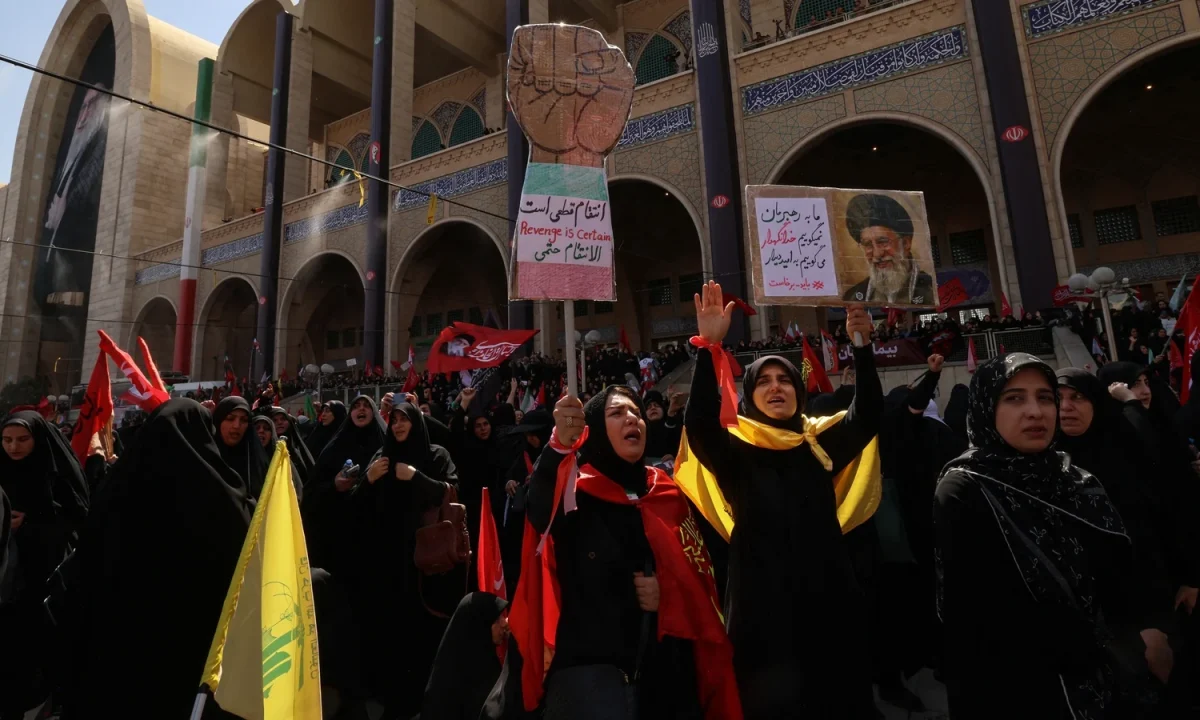
With today a public holiday across Iran, crowds thronged the vast religious complex, cooled by a sprinkler system in temperatures of 35C and watched over by a giant portrait of Ali Khamenei.
Authorities have said they expect more than 10 million people to take part in the ceremonies in the capital.
But strict security measures have been imposed, and official media have warned of a risk of crowd crushes, with medical centres set up around the complex.
Both Washington and Tehran have warned they are ready to resume military action, and vengeance has been a major theme at the funerals
The Middle East war is on hold following a ceasefire, and an initial accord struck with the US. But both Washington and Tehran have warned they are ready to resume military action, and vengeance has been a major theme at the funerals.
“The killers (of Khamenei) must face punishment,” a 38-year-old man who gave his surname as Miremadi said as he attended the prayers.
“If our leaders are about to proceed with negotiations in this manner, our people will not agree with it,” he said.
“We’re here to show the world that we back our revolution and our leader, and we demand revenge for the blood of our loved ones,” added a 39-year-old woman who gave her surname as Bakand.
Crowds thronged the vast religious complex
Khamenei long pursued a course of confrontation with the West, and Tehran for years has provided support to anti-US and anti-Israel armed groups around the Middle East, including Palestinian Hamas and Lebanon’s Hezbollah.
Iranian state media reported that delegations from both those groups met with Foreign Minister Abbas Araghchi yesterday, while representatives of Yemen’s Houthi rebels and Hamas ally Palestinian Islamic Jihad also attended the funeral ceremonies.