Friday June 19, 2026
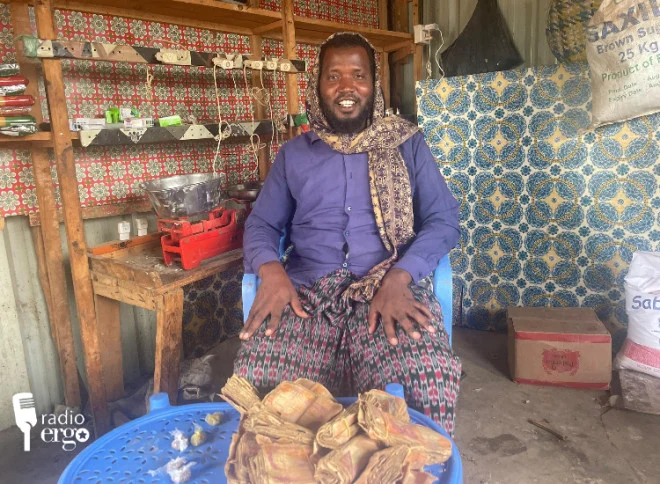
Baidoa shopkeeper Abdiqadir Mohamed displays his worthless savings, as tattered Somali shilling notes are rejected in the marketplace/Abdullahi Mohamed/Ergo
What was once a small shopkeeper’s hard-earned safety net has turned into a useless bundle of paper. In Buur-Shabellow IDP camp in Baidoa, grocery owner Abdiqadir Mohamed Abdi is left staring at torn Somali shilling notes tied together with string and rubber bands — savings that can no longer buy food, stock, or even a basic necessity.
Since April, traders have been turning away battered and oily Somali shilling notes, a shift that began in Mogadishu before spreading elsewhere. As more business owners have followed suit, small traders have seen their livelihoods unravel almost overnight.
Abdiqadir’s shop has completely shut down after suppliers refused to accept the 500 million Somali shillings he had saved up to buy new stock.
The business was the only source of income for his family of 13. “We can no longer provide for our family,” he said, in shock. “Before the Somali shilling disappeared from the market, our business earned enough income and we never worried about food. Every month I could provide what my family needed.”
At his peak, Abdiqadir was bringing in between 264,000 and 330,000 Somali shillings a day, enough to cover household needs and put something aside. But the money he put away over four months has now lost all value.
He and his family were displaced from rural areas near Baidoa in 2023 after repeated drought forced them off their three-hectare farm. He opened the shop two years ago with a $500 grant from the Norwegian Refugee Council (NRC). Before that support, he relied on casual labour, borrowing and even begging to get by.
The closure of the shop has pushed the family deeper into crisis. Abdiqadir has been unable to pay the $20 monthly rent for the iron-sheet house where his family lives, a sum that also covers water and electricity. He has been warned to leave if he cannot clear the arrears.
In Baidoa’s displacement camps, small shops like his are more than businesses; they are one of the few dependable sources of food and household goods for poor residents, while also offering displaced traders a chance to earn an income.
Families have long depended on Somali shillings for buying essentials, because many displaced people cannot access US dollars needed for mobile money, which has become the dominant way to pay for goods and services.
Six of Abdiqadir’s children left primary school in April after he failed to pay $60 in fees. Even though he still has Somali shillings, schools no longer accept the currency.
“I have money, but I can’t buy anything with it. Everywhere I go people tell me they cannot sell to me. The move away from the Somali shilling has affected us deeply. Our businesses have collapsed,” he said.
The family also owes about $1,000 to wholesalers who supplied the shop. He had planned to settle those debts with his savings.
The retreat from the Somali shilling started in Mogadishu, where traders began rejecting worn and damaged notes, citing a lack of confidence in the currency and the absence of replacement notes from the authorities. No new official shilling notes have been printed or circulated since 1991, before the civil war. The practice has since spread to many parts of the country, hitting the poorest hardest.
Abdirashid Adow Abdi, another displaced trader in Baidoa, also saw his fresh-produce shop close after suppliers stopped taking Somali shillings. The father of six lost a daily income of between 297,000 and 396,000 Somali shillings that had paid for food, water, education and healthcare.
“Our lives have declined sharply. Before this happened, we were managing well. Now the money we have cannot buy anything, while the cost of living keeps increasing. We have money in our hands, but it is useless,” he said.
Abdirashid now survives on occasional credit from local shops. He has 70 million Somali shillings tucked away, saved over several months to expand his business, but he cannot exchange it for dollars or use it to restock.
His family fled Goof-Gaduud Buurey village near Baidoa in 2022 after water shortages ruined the four-hectare farm that had sustained them for years. He started the business in the IDP camps two years ago with $840, drawn from his own savings and support from the international NGO World Vision.
Three of his children dropped out of school in May after he missed two months of fees totaling $60. He also owes 45 million Somali shillings to creditors who continue demanding payment even though he has no other income.
Like many traders in the camps, his customers were displaced families who depended on cash transactions in Somali shillings. With the currency no longer accepted as legal tender, both buyers and sellers have been left stranded.
Mahmud Mohamed Nur, an economics lecturer at Zamzam University in Baidoa, said the Somali shilling’s decline is tied to the lack of a functioning replacement system and the expansion of digital mobile money, which leaves many poor people behind.
He said emergency loans for affected traders and stronger adaptation to digital payment systems could help cushion the damage from future currency disruptions.