The moment word spread that the frontier had given way, Abdulah Buji got on his motorbike in northern Morocco and raced toward Ceuta, swept into a vast rush of people trying to reach the small Spanish enclave on North Africa’s Mediterranean coast by sea.
For Buji, 21, and many others who attempted the crossing, the extraordinary movement toward Ceuta seemed to offer a rare opening: a possible route to Spain, Europe and the kind of future he said he could not see at home.
“Spain gives you the chance to build your future, not like Morocco,” said Buji, who is training to become a teacher. “I am a talented young man. I just want a chance.”
But the relief of setting foot on Spanish territory did not last. Mainland Europe still lay across the Mediterranean, and Spanish authorities quickly made their position clear to the new arrivals: leave on your own or be deported.
Spanish soldiers rescue an injured migrant at the beach after mass crossings of migrants on foot and by sea from Morocco into Spanish territory, Ceuta, Spain, Aug. 1, 2026. (Reuters Photo)
Buji said he came close to joining the more than 50 people who died while trying to swim around a border fence into Ceuta. He survived the journey but lost his money and belongings along the way. Once inside, he said, the prospect of detention and an uncertain legal status pushed him to reverse course.
“I’ve spent perhaps 14 years studying, but there’s nothing at home, and I’d have to work 12-hour shifts for a meager wage,” Buji told The Associated Press. “That’s why I came here, but I haven’t found any opportunities here either, so I have to go back.”
Between Thursday and Friday morning, 60,000 people crossed into Ceuta. Within hours, about 45,000 had gone back to Moroccan territory after many spent the night on the enclave’s streets, watched by unsettled residents and armed Spanish police officers and soldiers.
The arrivals amounted to roughly 70% of Ceuta’s resident population, overwhelming the city and prompting local officials to request more police and military personnel to help regain control. Thousands of mostly young men moving through the streets fueled anxiety among residents.
For many in Ceuta, the scenes echoed the migration crisis of 2021, when Moroccan authorities eased border controls and several thousand people from Morocco and sub-Saharan Africa entered the enclave over two days. This time, however, the scale was far larger and the humanitarian strain more severe.
As videos and early reports of people reaching Ceuta circulated widely on social media, others began traveling north, hoping to enter European Union territory.
Railway stations in Rabat, Morocco’s capital, and Casablanca, the country’s largest city, filled with people trying to get to the border area near Ceuta.
Local media footage showed police blocking some would-be travelers from getting onto trains and buses.
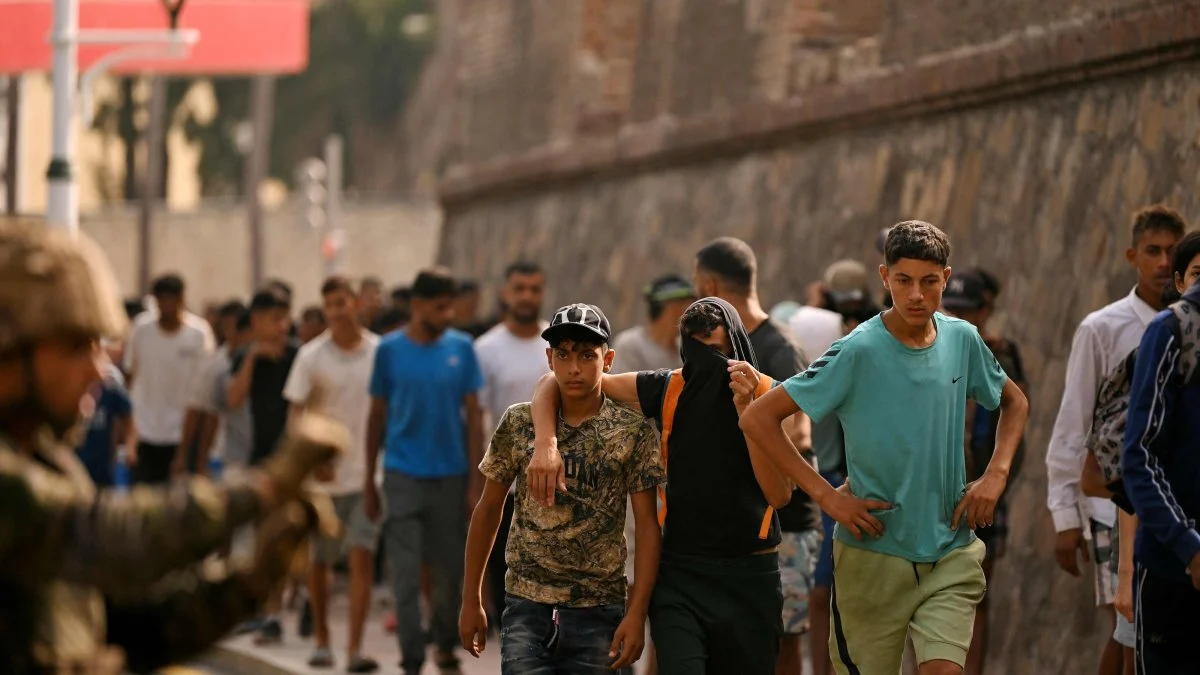
Migrants react as Spanish police officers and soldiers escort a big group of migrants to the border to take them out of Spain, after mass crossings of migrants on foot and by sea from Morocco into Spanish territory, Ceuta, Spain, Aug. 1, 2026. (Reuters Photo)
What set off the sudden surge remains unclear. Myriam Cherti, a senior researcher at the University of Oxford’s Centre on Migration, Policy and Society, said social media had been filled for days with posts urging Moroccans to attempt the crossing into Ceuta. Some messages offered practical instructions on how to get across and what to say to improve the chances of being permitted to remain.
Cherti said that in interviews over the past year, some migrants told her they had tried so many times to cross the border that they no longer knew the number.
“They’re doing it out of despair. They’re doing it because they’ve tried other ways to build a life and failed. They’re doing it because they feel an obligation to help and support their families,” she said. “And that’s possible if they make it to Spain and not necessarily possible if they stay in Morocco.”
Among those who succeeded in entering Ceuta was 33-year-old Ahmed Karim. He said he has no job, and that many Moroccans face an added burden because leaving the country legally can be so difficult.
Many people in Morocco hope to reach Europe or the United States, he said, “but they don’t have the opportunity.”
A woman is escorted by Moroccan security forces during clashes with migrants attempting to cross into Spain’s North African enclave of Ceuta near the town of Fnideq, on the Morocco-Spain border, July 31, 2026. (AFP Photo)
Not everyone who crossed into Ceuta intended to remain there. Some came looking for relatives and friends who had disappeared, fearing they might be among the dead.
Ikrra Khai, 33, is among thousands of Moroccan women who routinely receive temporary work permits to labor on Spanish farms during harvest season.
On Friday, she was in Ceuta trying to find the brother of a close friend.
“I don’t know if he is dead or alive,” she said. “I have his residency card. But I don’t know where he is. I’m searching.”
The Axadle Times Newsletter
Stay informed about the latest developments in Turkey,
its region and around the world.
SIGN ME UP
You can unsubscribe at any time. By signing up you are agreeing to our Terms of Use and Privacy Policy.
This site is protected by reCAPTCHA and the Google Privacy Policy and Terms of Service apply.