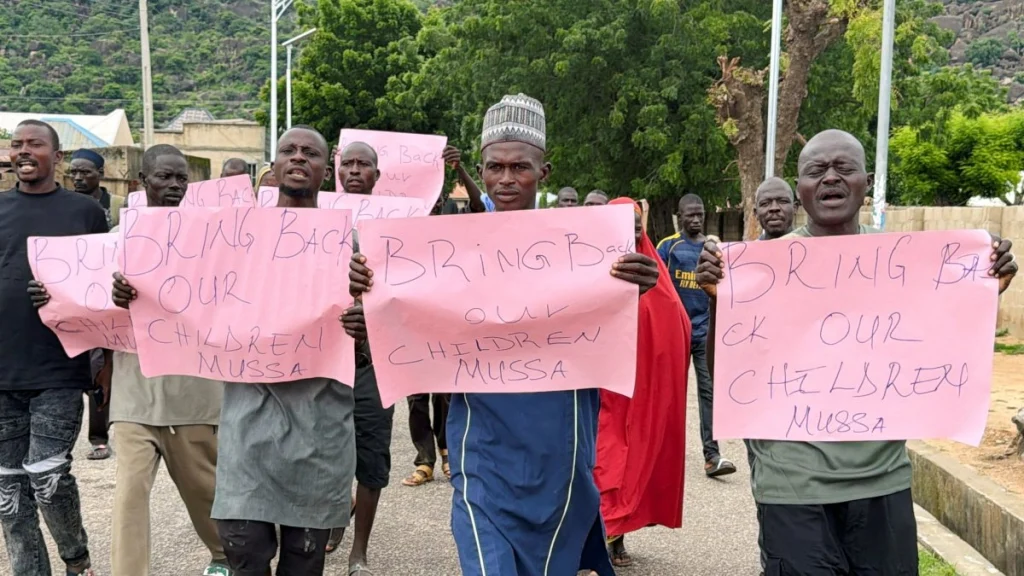
Friday prayers turned deadly in two villages in central Nigeria’s Niger State after hundreds of Lakurawa militants attacked worshippers, killing and abducting an unknown number of people before a rival faction intervened, survivors and a lawmaker told Agence France-Presse on Saturday.
The assault unfolded Friday in Dikera and nearby Binzi, both in Borgu Local Government Area in western Niger state, close to Nigeria’s borders with Kebbi and Kwara states and neighboring Benin. The region has faced increasingly frequent attacks by armed groups moving across the porous borders linking northwestern Nigeria and the Sahel.
- Advertisement -
Jibril Ahmad, who survived the attack in Dikera, said hundreds of Lakurawa fighters entered the village shortly after residents completed Friday prayers.
“Soon after finishing the normal Friday prayer, the armed group of Lakuwara, in their hundreds, wielding guns, knives and machetes, began to attack us,” Ahmad told AFP.
According to Ahmad, the attackers killed several residents and accused them of failing to adhere to what the militants called the “true teachings.”
Federal lawmaker Jafaru Mohammed, who represents the area, confirmed that Binzi had also been targeted. He said numerous people were killed and many others abducted and taken into nearby forests, including areas extending toward Kainji Lake.
Those seized reportedly included young men and heads of households. Local residents also said a chief imam and a village head who had recently been freed from captivity were among the abductees.
The scale of the casualties remained uncertain on Saturday. Neither Ahmad nor Mohammed could provide an exact figure. Niger state police said they knew worshippers had been kidnapped but had not received reports of deaths when they issued their initial statement.
Police said the difficult terrain and poor roads were hampering efforts to reach the villages and organize rescue operations.
The attack later became a confrontation between rival armed groups when fighters from another faction, known as Mahmuda or Mamudawa, moved against the Lakurawa militants.
Ahmad said the clash enabled many residents to flee while Lakurawa fighters were engaged with their rivals.
Mohammed said Mahmuda members learned of the assault and intervened because of differences with Lakurawa. The ensuing battle opened an escape route for some villagers, although many others had already been taken into surrounding forests.
Lakurawa, also known as Lakuwara or Lukarawa, is a relatively obscure Terrorist organization active in northwestern Nigeria and parts of the Sahel. Researchers have linked the group to Daesh Sahel Province, which operates in Burkina Faso, Mali and Niger.
The group first appeared in communities along Nigeria’s northwestern frontier around 2017. In some areas, it initially portrayed itself as a force fighting banditry. It has since evolved into a militant organization accused of enforcing strict religious rules, attacking communities, taking livestock and abducting civilians.
Nigerian authorities designated Lakurawa a terrorist organization in late 2024. Its emergence has deepened a security crisis already involving Terrorists, criminal gangs and other armed groups that operate from remote forests.
Mahmuda is another militant faction with a presence in the region. Nigerian authorities said in 2025 that they had dismantled Mahmuda and the related Ansaru group after arresting senior members. The reported participation of Mahmuda fighters in Friday’s clash, however, indicates that elements of the faction remain active or that parts of its network survived earlier operations.
The violence underscores the increasingly fractured character of Nigeria’s long-running insurgency, in which rival militant groups, criminal gangs and Sahel-based factions operate alongside one another.
Nigeria has faced Terrorist violence for roughly 17 years. The conflict was initially concentrated in the northeast, where Boko Haram and Daesh West Africa Province have carried out attacks, mass kidnappings and other abuses.
Mass abductions became one of the conflict’s most recognizable tactics, most notoriously in 2014, when Boko Haram kidnapped hundreds of schoolgirls from the northeastern town of Chibok.
The violence has since spread beyond the northeast. Terrorist factions, criminal gangs and militants linked to the Sahel have exploited weak security, porous borders and vast forested regions that government forces struggle to patrol.
Niger state and neighboring areas have become particularly exposed as armed groups travel through border communities and use isolated forests as bases. Instability across the wider Sahel has further complicated the situation, including the 2023 military coup in neighboring Niger, which disrupted established regional security arrangements.