BERLIN, Germany — Germany’s far-right Alternative für Deutschland (AfD) has built its rapid political ascent on promises to tighten immigration, expand deportations, and redefine German national identity. But as the party edges closer to the political mainstream, its leaders are facing increasing scrutiny over whether those policies target immigrants broadly or discriminate against specific ethnic and religious communities.
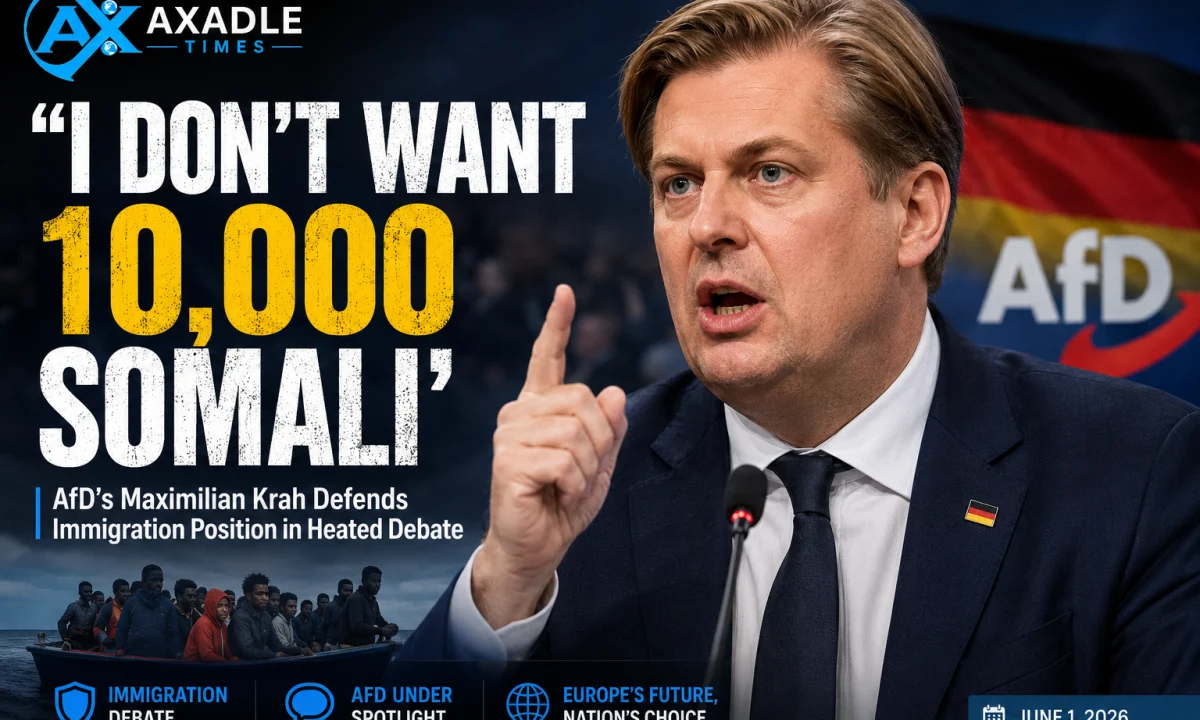
That tension was on full display during a televised interview between AfD lawmaker Maximilian Krah and journalist Mehdi Hasan, where a sustained exchange over Muslims, immigration and integration exposed both the party’s messaging strategy and the broader debate shaping German politics ahead of future elections.
The AfD, which became the second-largest party in the Bundestag following Germany’s 2025 federal election, continues to gain support amid voter concerns over immigration, inflation, crime and economic uncertainty. Although Germany’s mainstream parties have maintained a long-standing policy of refusing to govern with the AfD—a political strategy known as the “firewall”—the party’s growing popularity has intensified debate over whether that consensus can endure.
A Question Krah Would Not Answer Directly
One of the interview’s most contentious moments came when Hasan repeatedly asked Krah a straightforward question:
“Do you think there are too many Muslims in Germany?”
Rather than providing a direct answer, Krah rejected the premise of the question, arguing that Muslims should not be viewed as a single, uniform community.
“I don’t like the phrase that we put all the Muslims in one basket,” Krah said, insisting that immigration should be evaluated according to the backgrounds and integration outcomes of different national groups rather than religion alone.
As Hasan continued pressing for a clear yes-or-no response, Krah repeatedly declined to characterize Germany’s Muslim population as a whole, instead steering the discussion toward differences between immigrant communities.
Distinguishing Between Nationalities
Krah argued that Germany should distinguish between migrants from different countries rather than treating Muslims as one demographic category.
Using a hypothetical example, he said Germany would benefit from admitting students from Tehran, explaining that he had “no problem” with Iranian Muslims studying in Germany.
He contrasted that with Somali migrants, saying his position was informed by what he described as data on how different immigrant communities have integrated into Western societies.
“I know the data,” Krah said, arguing that Somali migrants have performed differently from Iranian migrants in Western countries.
Although both groups are predominantly Muslim, Krah maintained that religion itself was not the determining factor in his position. Instead, he said national origin, educational background and integration outcomes should guide immigration policy.
Hasan challenged that distinction, arguing that the comments effectively singled out one Muslim community for different treatment.
The exchange illustrated one of the AfD’s central arguments: that its immigration policies are based on cultural integration and economic considerations rather than religion. Critics, however, argue that such distinctions can still result in discriminatory policies affecting particular ethnic and religious minorities.
Rejecting Allegations of Antisemitism
Earlier in the interview, Krah also dismissed accusations that he harbored anti-Jewish views.
Responding to questions about previous controversies surrounding the AfD, he described attending the wedding of a close German-Jewish friend whose family had returned to Germany after fleeing Nazi persecution.
Krah said the experience demonstrated that allegations portraying him as hostile toward Jews were unfounded.
The AfD has repeatedly rejected accusations that it promotes antisemitism, racism or extremism, arguing instead that it seeks stricter border controls, stronger national sovereignty and reforms to Germany’s immigration system.
‘Remigration’ Remains at the Centre of Debate
The interview also returned repeatedly to the AfD’s controversial concept of “remigration,” a policy that has become one of the party’s defining political slogans.
Supporters describe remigration as the consistent enforcement of existing immigration and asylum laws, including deporting individuals who have no legal right to remain in Germany.
Opponents argue that the term has become associated with proposals that could extend well beyond illegal immigration, raising concerns about the future of millions of immigrants and even German citizens with migrant backgrounds.
Those concerns have fueled some of Germany’s largest political demonstrations in recent years, with hundreds of thousands of people participating in nationwide protests defending Germany’s constitutional order and multicultural democracy.
Germany’s Political Firewall Under Pressure
The AfD’s electoral gains have created an increasingly difficult dilemma for Germany’s traditional political parties.
The conservative CDU/CSU, the Social Democrats (SPD), the Greens and other parliamentary parties have consistently refused to form governing coalitions with the AfD, arguing that cooperation would legitimize a party they view as fundamentally incompatible with Germany’s post-war democratic values.
That strategy has so far prevented the AfD from entering federal government despite becoming one of Germany’s largest parliamentary forces.
However, as opinion polls continue to show strong public support for the party in several eastern German states, political analysts increasingly question whether the “firewall” can withstand prolonged electoral pressure.
Immigration Remains Germany’s Defining Political Issue
The interview underscored how immigration has become the defining issue in German politics.
Supporters of the AfD argue that years of high immigration have placed growing pressure on housing, public services, education and security while weakening public confidence in government.
Critics counter that the party’s rhetoric risks deepening social divisions by portraying entire communities through the actions or performance of specific groups.
The exchange between Hasan and Krah encapsulated that broader national debate.
Hasan repeatedly sought a simple answer on whether Germany had too many Muslims.
Krah consistently refused to answer in those terms, insisting instead that immigration should be assessed according to the characteristics and integration record of individual national groups rather than by religion alone.
The discussion concluded with an unexpected moment of agreement when both men acknowledged that Muslims should not be treated as a single, homogeneous community before the programme shifted to questions surrounding the AfD’s foreign policy positions.
As Germany prepares for another period of intense political competition, debates over immigration, identity and integration are likely to remain at the centre of the country’s political landscape—issues that will shape not only Germany’s future but also the direction of European politics for years to come.
By Ali Musa | Axadle Times