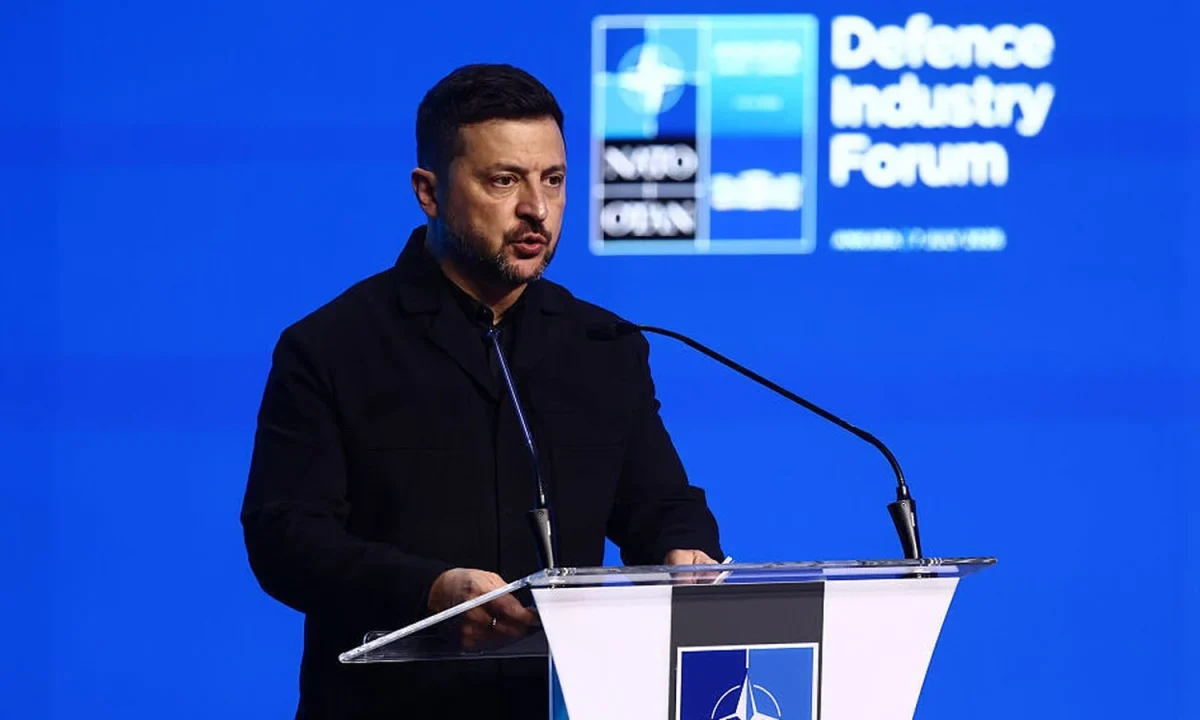
In the heart of NATO’s summit in Ankara, President Volodymyr Zelensky delivered a blunt message: Ukraine’s troops are no longer just defending their own cities — they are battle-tested forces that could strengthen the alliance itself.
Alongside his renewed push for Kyiv to join NATO, Mr Zelensky pressed Ukraine’s partners to urgently expand support for air defences, warning that the country is running short of the interceptors it needs to stop Russian missiles.
“Do you really believe it would be right to live outside NATO, a country and a people with this level of defensive capability?” Mr Zelensky said in a speech on the sidelines of the summit.
“Ukraine in NATO is a source of extraordinary defensive capability.”
The US leader has poured cold water on Ukraine’s long-standing push to join NATO as he has sought to bring an end to more than four years of war with Russia.
Ukraine has recently appeared to turn the tide on the Kremlin in the conflict as it has stabilised the front line and carried out damaging strikes deep inside Russia.
But despite being able to tackle the swarms of Russian drones targeting the country daily, Kyiv has difficulty shooting down ballistic missiles as its air defences run low.
“We are capable of doing everything else ourselves, but when it comes to air defence, we need our partners’ determination,” he said.
NATO Secretary General Mark Rutte in conversation with Volodymyr Zelensky at the summit
“Please let more determination and more decisions for air defence be one of the key outcomes of this NATO summit.”
Mr Zelensky also pointed to the limitations of current production of US-made Patriot missiles, saying output is not enough and urging allies to push Washington to allow Ukraine to manufacture them under licence.
He called as well for European nations to partner with Ukraine to develop a cheaper, homegrown alternative using similar technologies.
“Europe needs affordable mass produced anti-ballistic systems as soon as possible.
“In fact, today,” he said.
NATO highlights defence spending with fresh arms deals
The remarks came as NATO allies put rising defence budgets on display, rolling out new arms contracts worth billions of dollars — a bid to reassure Mr Trump over Europe’s response to the war with Iran.
The two-day gathering at Ankara’s sprawling presidential palace comes a year after NATO members pledged to ramp up security-related spending to 5% of GDP under pressure from the US leader.
NATO chief Mark Rutte has insisted European countries are “delivering” by bolstering military budgets and moving to take more responsibility for the defence of their continent in the face of Russia.
Hoping to set the tone before Mr Trump arrived in Ankara, NATO opened with a cascade of weapons and industry announcements at a glitzy defence forum held ahead of the main summit.
“Allies and industry from both sides of the Atlantic will reveal new major projects and sign contracts worth literally billions of dollars,” Mr Rutte said.
“These are billions that are invested in our security, boosting our economies and supporting hundreds of thousands of new jobs.”
Donald Trump waves as he boards Air Force One before departing for the summit
Among the first deals unveiled were agreements for new drones, refuelling aircraft and surveillance planes, all aimed at sharpening Europe’s capacity to defend itself.
Even so, Mr Trump — still smarting after European countries restricted US forces from using bases to attack Iran — has spent the run-up to the summit criticising allies for not moving fast enough for his liking.
“Ridiculous for the U.S.A. to continue along this one-sided path when the relationship is not reciprocal. They were not there for us!!!” Mr Trump wrote on Truth Social last week.
In an effort to demonstrate resolve on Iran, European allies led by France and Britain have assembled a potential naval mission to assist in the Strait of Hormuz, and countries have shifted vessels closer to the region to be ready.
But the situation remains volatile and the Europeans want clarity on how a fragile US deal with Iran is panning out before sending in their navies.
Roads are shut outside ATO Congresium during the Defence Industry Forum
As they brace for Mr Trump’s remarks, European leaders are also increasingly confronting a reality they can no longer ignore: the US is steadily pulling back from the alliance.
Washington has been clear it wants its allies to take the lead on the conventional defence of the continent and recently announced it was cutting back the assets it makes available to NATO commanders.
European nations will seek to show they can shoulder more of the burden — while doing everything possible to keep Mr Trump, and the overwhelming power of the US military, engaged.
“All of this is evidence of a real shift in mindset,” Mr Rutte said. “This is NATO 3.0. A stronger Europe in a stronger NATO.”
Read more:Ukraine launches hundreds of drones towards MoscowOil tanker hit by ‘unknown projectile’ near Strait of Hormuz