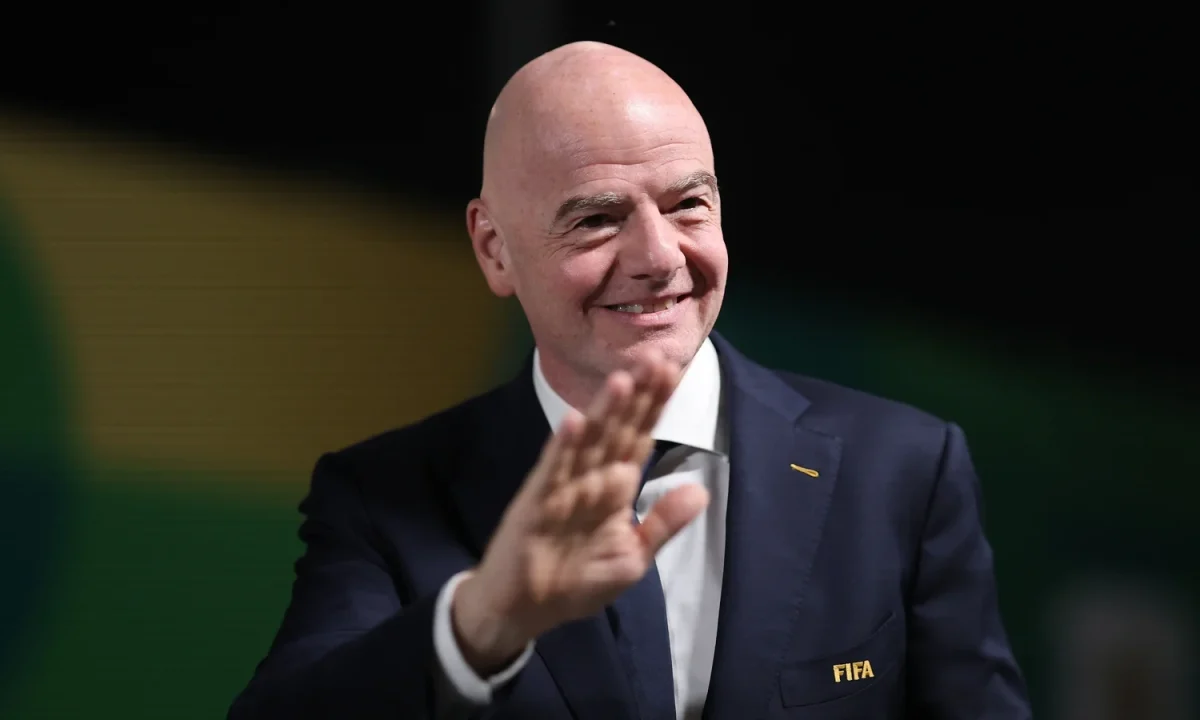
As the World Cup roars across North America, FIFA president Gianni Infantino has made himself nearly as visible as the players — but his relentless dash from stadium to stadium is also sharpening criticism from environmentalists who say the sport’s top official appears untroubled by the climate cost.
Mexico City, Guadalajara, Los Angeles, San Francisco, Vancouver, Seattle, Kansas City, Houston: in just seven days, the Italo-Swiss chief has already fired up his private jet to take in 10 appearances from the stands.
His heavy reliance on a Qatar Airways private jet is not a fresh controversy. In September 2024, investigative outlet Josimar reported that he had logged 600,000km on the aircraft over the previous three years.
Still, the enlarged 2026 World Cup — the first to feature 48 teams and spread across the United States, Canada and Mexico, with the schedule swelling from 64 to 104 matches — has thrown Infantino’s air-travel habit into even starker relief.
‘Sustainability paradox’
If Infantino keeps pairing two cities a day through the end of the round of 16 and then attends the final eight matches, Greenly estimates his aircraft alone will generate “a defensible range of 300 to 500 tons of CO2” during the tournament.
That amounts, the group says, to “the annual footprint of around 35 to 55 French people”.
Gianni Infantino, Tunisian Football Federation President Moez Nasri and Hisako, Princess Takamado during Group F match between Tunisia and Japan at Monterrey Stadium in Mexico on 20 June
FIFA has defended the president’s movements, saying its executives use either commercial or private flights “based on what is most efficient and cost-effective” and that the organisation pays all travel expenses.
David Gogishvili, a geographer at the University of Lausanne, told AFP that FIFA had produced what he called a “sustainability paradox”.
“By reusing existing but geographically dispersed NFL stadiums across a continent, FIFA has created a model that is structurally dependent on high-emission air travel,” he said.
“When leadership sets a precedent by hopping between matches via private jet, it perfectly reflects the broader systemic issue/approach.”
In his view, the way FIFA has staged this World Cup “normalises hyper-mobility while simultaneously shifting transport costs and carbon burdens onto the host regions and fans.”
John Hocevar, Oceans Campaign Director at Greenpeace USA, has been just as blunt in his assessment of Infantino’s tournament commute.
“Having executives take daily flights on highly polluting private jets doesn’t exactly send the message that FIFA recognizes either the cause or its responsibility to be part of the solution to climate change,” he posted on Instagram.
Gianni Infantino, King Willem-Alexander, and Queen Maxima during the Group F match between the Netherlands and Sweden at Houston Stadium on 20 June in Houston, Texas
Qatar jets overload
The vast geography is no one-off. Next year, the pattern will repeat at the Women’s World Cup in Brazil, selected by FIFA in 2024 ahead of a rival bid that would have been 100 percent reachable by train between Belgium, the Netherlands and Germany.
The scale of the issue could grow even more dramatic in 2030, when the men’s World Cup marks its centenary with hosts in Morocco, Portugal and Spain, plus three matches in South America — all while the still-unsettled possibility of expanding the tournament to 64 teams hangs over planning.
And with the 2026 competition drawing celebrities and affluent spectators, private-jet traffic extends well beyond FIFA’s leadership, adding yet more weight to the tournament’s overall environmental bill.
The 2022 World Cup attracted 1,846 private jets to Qatar, according to the British journal Nature. That total exceeded the combined traffic linked to the Super Bowl, the Cannes Film Festival, the World Economic Forum in Davos and COP28.
“All of the emissions associated with a World Cup are… luxury rather than subsistence emissions, as the tournament doesn’t need to happen at all,” American academic Tim Walters said last year during a Play the Game debate.
“In this context, the lavish activity of the ultra-wealthy is particularly obscene and dispiriting.”
Latest World Cup coverage