Amid a surge of protests calling for the expulsion of foreigners, the 49-year-old huddled inside his home with his wife and three children, witnessing the chaos unfold on TV. After the demonstrations subsided, Wolde cautiously reopened his small grocery shop in downtown Durban, uncertain if it would withstand another wave of anti-immigrant unrest.
This time, it did survive.
Unfortunately, numerous neighboring businesses owned by migrants weren’t as lucky.
Having escaped political persecution in Ethiopia over 20 years ago, Wolde finds there’s nothing to return to in his homeland.
“I have no place, no property, no family,” he explained, noting his brothers remain imprisoned in Ethiopia.
Wolde’s plight mirrors the difficult decisions faced by countless migrants in South Africa amidst rising xenophobia. Though more than 25,000 individuals reportedly departed prior to the recent protests, many refugees and asylum-seekers feel trapped with nowhere else to turn.
Businesses Targeted
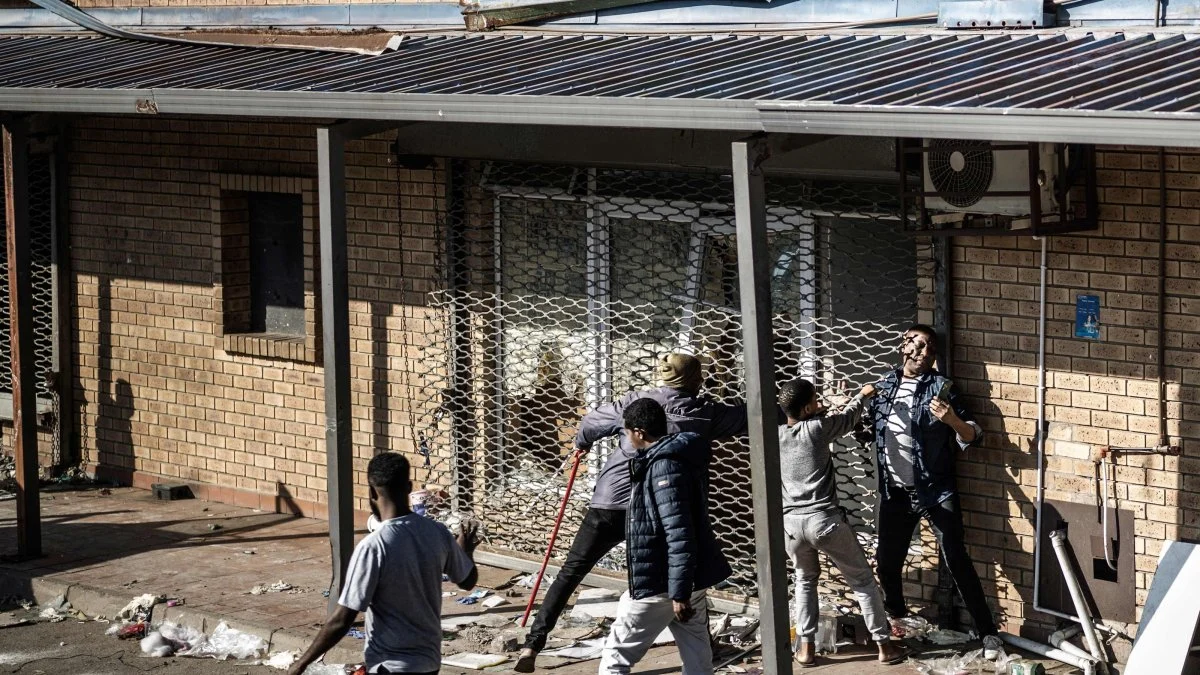
While Tuesday’s protests were largely peaceful, outbreaks of violence erupted as shops owned by migrants were looted and vandalized.
Among those affected was Daniel Abide, an Ethiopian shopkeeper in Clermont, near Durban. One of his two convenience stores was completely emptied by looters overnight, with the other emerging unscathed.
Having lived in South Africa for a decade, Abide employs a local worker and emphasizes that migrants are contributing to the economy.
“Foreigners are not taking jobs from South Africans,” he asserted. “We are establishing small businesses and paying rent.”
Despite the setback, he remains hopeful about reopening his ransacked shop.
Residents reported attacks on businesses owned by Somali and Pakistani nationals as well. At one damaged outlet, employees hurriedly repaired broken doors before nightfall, wary of further looting.
Economic Frustrations Fuel Anger
The anti-immigration movement in South Africa gains steam amid growing frustrations over unemployment, crime, and struggling public services.
March and March, the group leading the protests, claims its opposition is solely against undocumented migrants, not foreigners in general.
Jacinta Ngobese, the group’s leader, argues that migrant businesses have squeezed out local entrepreneurs.
“This economy belongs to our people and it has been hijacked,” she told supporters during the march.
Ngobese has called for weekly protests every Thursday until the government enforces stricter immigration controls, including mass deportations.
While organizers dismiss allegations of xenophobia, migrants say harassment is commonplace, regardless of their legal status.
Malawian migrants can be seen taking refuge outdoors, shortly after a deadline imposed by anti-foreigner groups lapsed on July 1, 2026, in Durban. (AFP Photo)
Many migrants report being stopped by civilians demanding their papers, despite assertions from South African authorities that only police are legally entitled to request such documentation.
Refugees in a Bind
The United Nations reports that South Africa hosts over 167,000 refugees and asylum-seekers, with the total immigrant population making up roughly 4% of the country’s populace.
Compared to several African nations, this is relatively low. Uganda hosts about 1.8 million refugees, Chad over 1.2 million, and Kenya around 850,000.
Research consistently shows scant evidence linking immigration to South Africa’s economic issues, despite public beliefs associating migrants with unemployment and crime.
Nonetheless, refugees live in constant fear.
Wolde keeps his refugee permit, tax documents, and bank statements readily available, often presenting them multiple times a day to anyone questioning his presence in the country.
Yet, his business suffers as customers turn away.
“Now business is no good,” he lamented. “Everybody is scared to come here.”
This isn’t his first encounter with xenophobic violence.
In 2008, he survived a shooting and has endured prior waves of unrest in 2015 and 2021.
Despite it all, he vows to stay.
“I make business here. I don’t know why they’re angry.”
Diplomatic Tensions Flare
The protests have also strained relations between South Africa and Ghana following the death of a Ghanaian migrant.
Ghana’s Foreign Ministry reported that Bashiru Isak, 40, was killed during anti-immigrant demonstrations in Cape Town and filed a protest with Pretoria.
South African officials refuted the claim, insisting no fatalities occurred during the protests.
Justice Minister Mmamoloko Kubayi accused Ghana of disseminating misleading information and urged for diplomacy in verifying claims before they are publicized.
According to police, a 35-year-old Ghanaian man was shot in a barbershop during an attempted extortion. They dispute the victim’s identity, date, and incident location provided by Ghanaian authorities.