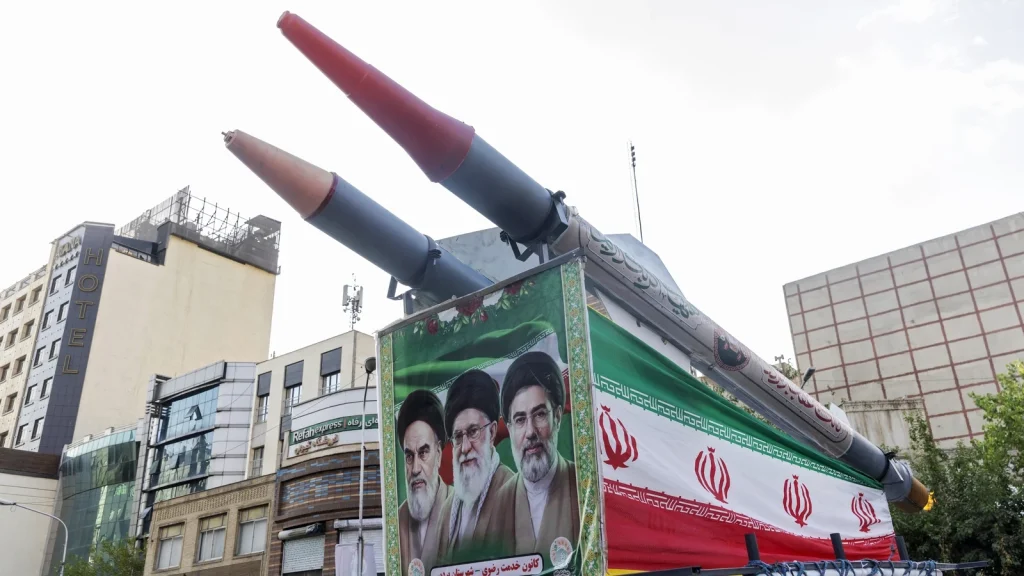
Iran has warned that any fresh US threats would trigger a “devastating” response, after Washington vowed to impose what it called the toughest financial penalties in history in an effort to bring down the Iranian leadership.
US Treasury Secretary Scott Bessent said he would set out the planned sanctions on Monday. The measures follow President Donald Trump’s warning that any country offering Iran “any type of lifeline” would face severe economic consequences.
- Advertisement -
Major General Ali Abdollahi, chief of staff of Iran’s Armed Forces, said Tehran’s response would be wide-ranging and uncompromising.
“With preparedness across land, sea, air, air defence and cyberspace, Iran’s armed forces will respond to the enemy’s new threats with crushing, punishing and devastating responses,” Mr Abdollahi was quoted as saying by Iranian media.
“We must make plans to deal with the unjust sanctions so that we can overcome them,” he said in neighbouring Iraq, accusing the US and Israel of waging economic and “cognitive” warfare against Iran.
US Treasury chief Scott Bessent is to outline details of the US response next Monday
Bessent says measures should not impact oil prices
Oil prices steadied on Friday but remained on course for a second consecutive weekly increase as concern mounted over energy exports from the Gulf.
Crude prices reached a more than three-week high on Thursday after Washington issued its sanctions warning. The measures are intended to pressure Iran into agreeing to end a conflict that has left millions of barrels of Middle Eastern oil stranded.
“I’m not sure why oil has popped up on this,” Mr Bessent told CNBC. “If we are doing the maximum economic pressure, then that means that likely there will not be a large-scale kinetic restart,” he said, using a term for military action.
Only seven commodity ships passed through the Strait of Hormuz on Thursday, according to ship-tracking company Kpler — half the number recorded the previous day and far below the more than 130 vessels a day that travelled the route before the war.
Thousands of people have been killed in the conflict, which has drawn Gulf nations into the crisis and pushed up fuel prices worldwide. Iran has attacked shipping through the Strait of Hormuz, a vital passage that carried about one-fifth of all traded oil before February.
The US and Iran have announced ceasefire agreements twice, in April and June, with the stated aim of restoring the movement of vessels through Hormuz and creating a route towards ending the nearly six-month-old war. Both agreements, however, broke down soon afterwards.
Before Mr Bessent’s remarks, Iran’s foreign ministry said US sanctions would not cause “even the slightest hesitation in Iranians’ determination to safeguard Iran’s independence, dignity and national sovereignty”.
Mr Bessent told CNBC that he would “talk about exactly what we’re going to do” regarding Iran during a press conference on Monday.
“We are going to collapse this regime. It is time for our allies and the rest of the world to make a decision,” he said, presenting a naval blockade restored against Iran in July and the “toughest sanctions in history” as a “one-two punch”.
Iran has endured almost continuous and punishing economic sanctions for nearly five decades, dating back to the Islamic Revolution of 1979. Its population is now facing high inflation, a weakening currency, energy shortages and infrastructure damaged by the conflict.
Some Iranians interviewed by Reuters said further economic pressure could deepen hardship, undermine the clerical establishment and fuel unrest. There has been no indication of such a reaction since a deadly crackdown on protests in January.
Donald Trump is facing pressure to bring the war to an end. High fuel prices have hurt his approval ratings and could put his Republican Party’s control of Congress at risk in the November midterm elections.
Oil prices hit a three-week high on Thursday
US blockade starts reducing oil flow to China
Iranian crude offerings to Chinese buyers have already fallen since the US restored its blockade of Iranian ports in mid-July, according to trade sources who spoke to Reuters.
China takes more than 80% of Iran’s seaborne oil exports, based on 2025 data from analytics company Kpler. But any further US economic pressure on Beijing could prompt retaliation, particularly after China eased earlier restrictions on exports of crucial rare-earth minerals.
Asked whether Washington could impose measures on China for continuing to trade with Iran, Mr Bessent said some discussions were more appropriately conducted privately.
“Keep in mind that the Chinese get 50% (of their) energy… from the Gulf. So it would do them a great service to get with the program,” he said.
China’s embassy in Washington said “sanctions and pressure do not help resolve the problem” and urged the use of diplomatic channels.
Stricter sanctions also carry risks for US allies in the Gulf, whose energy infrastructure and desalination plants — essential to drinking-water supplies — have come under Iranian attack.
We need your consent to load this rte-player contentWe use rte-player to manage extra content that can set cookies on your device and collect data about your activity. Please review their details and accept them to load the content.Manage Preferences
Hezbollah says new US sanctions ‘will not deter us’
Hezbollah has said the United States “will not deter” its resistance against Israel, following Washington’s announcement of new sanctions against the group and its accusation that the organisation acts on behalf of Iran.
The US Treasury Department amended Hezbollah’s legal designation on Thursday, saying the group operated in “service to the Iranian regime under the command of Iran’s Islamic Revolutionary Guard Corps”.
It also imposed sanctions on 10 people alleged to be members of a network responsible for moving cash to Hezbollah.
“All these unjust sanctions and classifications will not deter us from adhering to the path of resistance and the right of Lebanon and the Lebanese to defend their land, sovereignty and resources,” Hezbollah said in a statement.
The group, which is armed and funded by Iran, said it “does not need anyone to vouch for its Lebanese identity and patriotism”.
“Our close and fraternal relationship with the Islamic Republic of Iran is a relationship we cherish and are proud of,” it added.
The Treasury Department said the group used a network of “couriers travelling on commercial airline flights between Lebanon, Turkey, the UAE, and Iran to move up to hundreds of millions of dollars between jurisdictions” in an effort to evade sanctions.
Washington designated Hezbollah as a “foreign terrorist organisation” in 1997. Its classification was updated in 2001 to identify it as a “specially designated global terrorist” group.
A US State Department official who spoke on condition of anonymity said Washington had for years “documented the operational, financial, and logistical integration” between Hezbollah and the Quds force, the foreign operations branch of the IRGC.
The official described Hezbollah as merely “an extension” of the Quds force and said it was “not a Lebanese resistance movement”.
Hezbollah said the latest sanctions were intended “to target the resistance, its community, its environment, and its supporters, and to besiege and pressure them” in order to protect Israel.
The US announcement comes as Washington helps facilitate direct talks between Israel and Lebanon, countries that have technically remained at war for decades, aimed at ending hostilities that erupted after Hezbollah drew Lebanon into the wider Middle East conflict by firing rockets at Israel in support of Iran.
Israel responded with an intensive air campaign and ground invasion that Lebanese authorities say has killed more than 4,300 people.
In June, Lebanon and Israel signed a framework agreement calling for Hezbollah to disarm, Israeli forces to withdraw gradually from southern Lebanon and the Lebanese army to deploy across the area, initially in “pilot zones”.