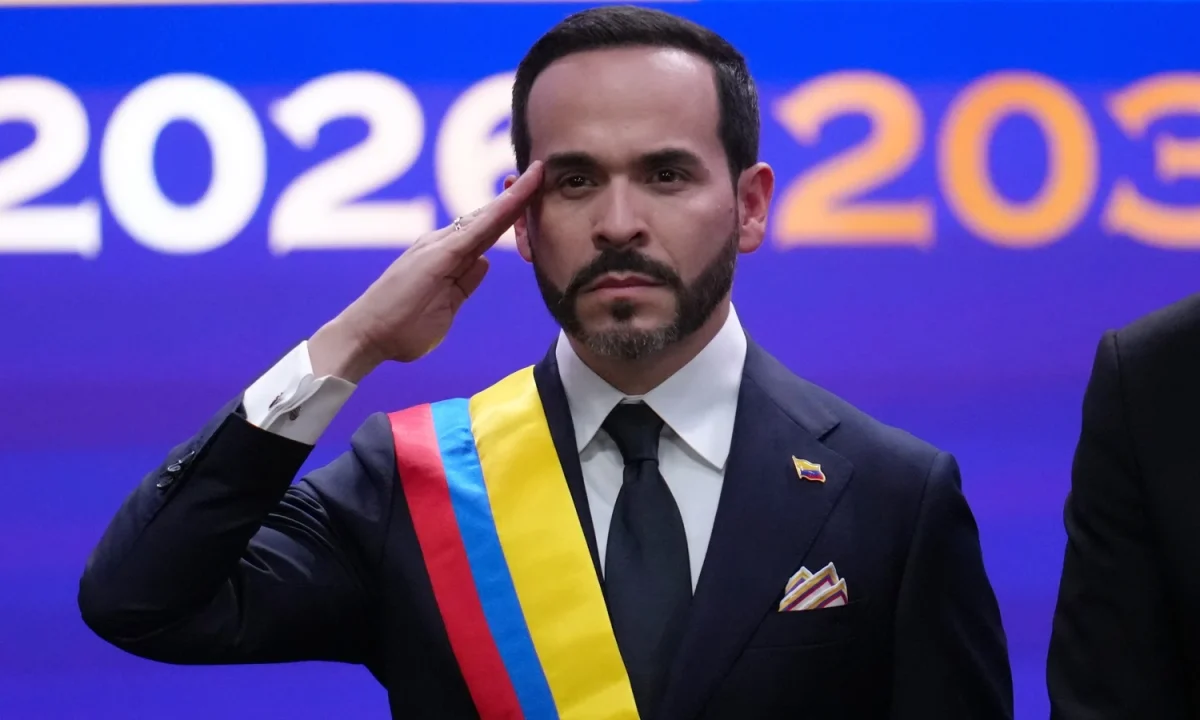
Colombia’s newly elected right-wing president, Abelardo De La Espriella, took office with a vow to wage an uncompromising campaign against drug trafficking and impose austerity measures aimed at rebuilding confidence in the economy.
Mr De La Espriella, 48, secured June’s runoff election after promising to dismantle armed groups, reduce the size of the state by as much as 40% and restore momentum to the oil and gas industries.
A political ally of US President Donald Trump, he previously represented prominent right-wing paramilitaries during his career as a lawyer.
The presidency is Mr De La Espriella’s first elected position.
Addressing troops gathered at the military base in a 75-minute inaugural speech, he promised to “relentlessly defeat narco-terrorism”.
Mr De La Espriella said the country will builld ‘mega-prisons’
He declared: “I send a firm message to the Colombian people: the time has come to restore order, authority, and freedom.
“Members of criminal gangs and narco-terrorist groups have two choices: submit to the rule of law or face the determined response of the Colombian state and its security forces.”
The new president said the possibility of peace negotiations with armed groups had been “completely exhausted”.
“The time has come to definitively eradicate the scourge of illicit crops,” Mr De La Espriella said, promising to deploy aerial herbicide spraying that he said would not harm human health or the environment in an effort to eliminate coca plantations.
Among his first decisions in office, he said, would be Colombia’s entry into US President Donald Trump’s regional anti-cartel coalition, known as Shield of the Americas.
Read more:Who is Colombia’s self-proclaimed ‘Tiger’ president?
Mr De la Espriella, who has dual US and Colombian citizenship, has said he would welcome US troops on Colombian territory, order strikes against cocaine laboratories hidden in the jungle, construct “mega-prisons” and dramatically reduce the state’s size.
He has also promised to freeze government spending and introduce tax reforms designed to simplify the country’s payment regimen while encouraging investment and job creation. At the same time, he says popular social programmes, including some established under former president Gustavo Petro, will remain in place.
Addressing employers, Mr De La Espriella said: “I want to tell Colombia’s business leaders, large, medium-sized and small, that this government will be your partner in investing in Colombia.
“Once again, it will be a safe and profitable decision for you.”
FIFA boss Gianni Infantino was among the guests
The ceremony broke with convention by taking place in Cali, Colombia’s salsa capital, rather than at Congress in the more formal setting of Bogota.
FIFA president Gianni Infantino was among those attending. He has faced sharp criticism over a plan, now shelved, to open the World Cup and other competitions to private investment.
The guest list also included several prominent figures from the right, among them Argentina’s President Javier Milei and Todd Blanche, Mr Trump’s acting attorney general, who led the US delegation.
Mr De la Espriella’s left-wing predecessor, Mr Petro, did not attend the inauguration.
Earlier, he departed the presidential residence in the capital, saying “farewell, freedom and life”.
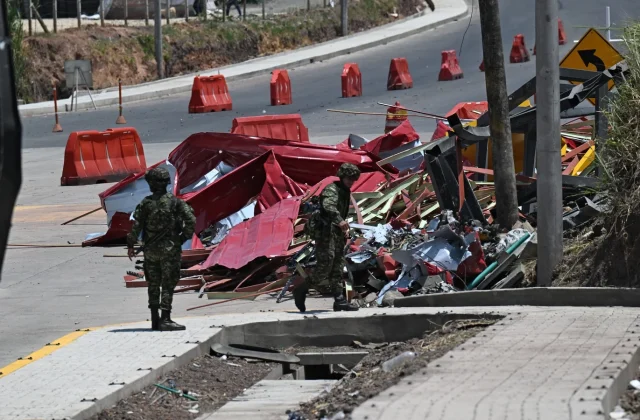
Cali, which has endured several guerrilla attacks in recent years, was placed under heightened security for the event. Authorities deployed 11,000 troops and installed an anti-drone system.
Mr De la Espriella won by less than 1 percentage point, bringing to an end four years of Colombia’s first leftist government.
His administration begins with Congress divided and without a majority of its own.
Former president Gustavo Petro tried and failed to negotiate peace with the country’s armed groups
His supporters are expecting an aggressive response to crime and dissident armed factions.
“This government has a lot to prove. A lot was said during the campaign,” 46-year-old Marisol Peira told AFP in Cali.
Mr Petro’s attempts to negotiate peace with the country’s armed groups ultimately failed.
According to experts, the gangs — once driven by political ideology but now largely motivated by cocaine trafficking and other illicit businesses — exploited government truces to expand their operations.
Mr Petro, who has alleged election fraud without presenting evidence, urged people to take part in mass protests across major cities. Hundreds later demonstrated peacefully in Bogota and Barranquilla.
Mr De la Espriella’s election adds to a growing list of victories for Latin America’s right-wing parties, following wins from Chile to Costa Rica in campaigns dominated by promises to restore security.
The former lawyer has said coca crops used to produce cocaine should be eliminated “by all means”. He supports fracking despite its environmental risks and has proposed reducing taxes on wealthy citizens.
Known as “The Tiger”, Mr De la Espriella wants to establish a military partnership with the United States and Israel to support his campaign against guerrilla groups.
His proposed “Plan Colombia II” takes its name from the multimillion-dollar agreement Washington backed in the 2000s to combat drug cartels and leftist insurgents.
“We have to support him so there won’t be so much crime,” said German Angulo, a 63-year-old contractor.
“We need a complete change.”
While the original “Plan Colombia” helped weaken several major combat groups, it was also accompanied by allegations of serious human rights violations.
Officials at the US State Department said they intended to work with Congress to approve a $1 billion (€865 million) assistance package for Colombia as the country’s new right-wing president began his term.
“As a cornerstone of this renewed partnership, the United States, working with Congress, intends to announce $1 billion in assistance as part of a security package to support President (Abdelardo) de la Espriella’s administration in achieving our shared goals,” the statement said.