by STEPHEN ASTARIKOSunday August 2, 2026
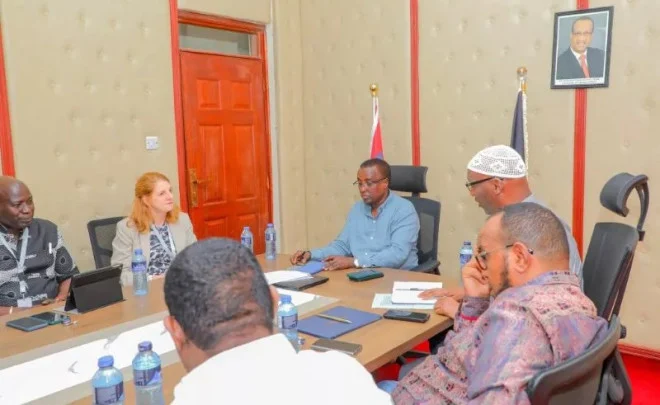
Garissa County Assembly speaker Abdi Idle Gure chairing the meeting attended by officials from UNHCR./STEPHEN ASTARIKO
Garissa County Assembly and the United Nations High Commissioner for Refugees (UNHCR) are preparing to establish a formal partnership to strengthen the governance of refugee affairs.
The proposed framework is also intended to improve legislative oversight and support development programmes serving refugees and the communities that host them.
The plan took shape during a meeting between Assembly officials led by Speaker Abdi Idle Gure and a senior UNHCR delegation headed by Deputy Country Representative Robin Ellis.
The talks come as Garissa assumes a more prominent role in Kenya’s refugee response. The Dadaab Refugee Complex remains home to one of the world’s largest refugee populations, while the government advances policies designed to link humanitarian support with long-term socio-economic development.
The two institutions said the partnership would create a structured channel for regular engagement on legislation, policy formulation, oversight and budgeting related to refugee affairs and host-community welfare.
Speaker Gure said the County Assembly was prepared to fulfil its constitutional mandate by ensuring that programmes for refugees and local residents are grounded in law, adequately financed and subject to effective scrutiny.
“The County Assembly is not merely a law-making institution. We are responsible for ensuring public resources are used prudently and that policies respond to the realities facing our people. A structured partnership with UNHCR will strengthen accountability while helping us develop legislative solutions that benefit both refugees and host communities,” Gure said.
He said implementation of the Shirika Plan would require closer cooperation between humanitarian agencies and county governments to help prevent conflict, build social cohesion and ensure development initiatives benefit communities fairly.
Gure proposed cooperation in areas including applying the Refugees Act at county level, expanding civic participation through the Ward Youth Champions Programme, building the capacity of Members of the County Assembly and Assembly Secretariat, and creating mechanisms to promote peaceful relations between refugees and neighbouring communities.
“The success of refugee integration depends on strong institutions and inclusive policies. Our commitment is to ensure that no community feels left behind as these programmes are implemented,” he added.
Ellis welcomed the Assembly’s readiness to formalize the relationship, saying county legislatures had a vital role in turning national refugee policies into workable measures at the local level.
“The County Assembly has demonstrated a clear commitment to transparency, accountability and inclusive governance. Those are the foundations upon which sustainable refugee responses are built, and we look forward to working closely with the Assembly to strengthen them,” Ellis said.
She said UNHCR was interested in drawing lessons from other refugee-hosting counties, especially Turkana, as it supports the implementation of the Garissa Integrated Socio-Economic Development Plan (GISEDP). The long-term framework seeks to improve livelihoods, infrastructure and access to public services for refugees and host communities.
Ellis said the move towards integrated planning reflected wider recognition that areas hosting refugees need sustained investment in public services, not humanitarian assistance alone.
Henok Ochalla, head of the UNHCR Dadaab Sub-Office, called the County Assembly an essential partner in advancing refugee-related programmes.
He said Garissa had many of the foundations needed to implement GISEDP successfully, including political goodwill, institutional capacity and increasing support for policies that address the needs of refugees and host communities.
UNHCR official Charles Odera also praised the Assembly for passing legislation on municipal financing, saying improved urban governance would strengthen service delivery and expand access to essential services for residents and refugees.
Garissa County is home to the Dadaab Refugee Complex, which was established in 1991 after civil war broke out in Somalia.
Over the years, the camps have become one of the world’s largest and longest-running refugee settlements. They host hundreds of thousands of refugees, mainly from Somalia, as well as smaller groups from other countries in the region.
For much of that period, Kenya’s refugee response focused largely on humanitarian assistance provided within camps.
But the government’s recently adopted Shirika Plan represents a major policy change, seeking greater socio-economic inclusion for refugees while directing investment towards infrastructure, education, healthcare, livelihoods and public services shared by refugees and host communities.
In Garissa, GISEDP supports that approach by aiming to reshape refugee-hosting areas through integrated planning and development. County institutions are expected to provide legislative backing, oversight and accountability as the plan moves forward.
The meeting was attended by Budget and Appropriations Committee Chairperson and Damajale MCA Omar Abdi Hassan, County Assembly Clerk Mohamud Santur and other Assembly staff.