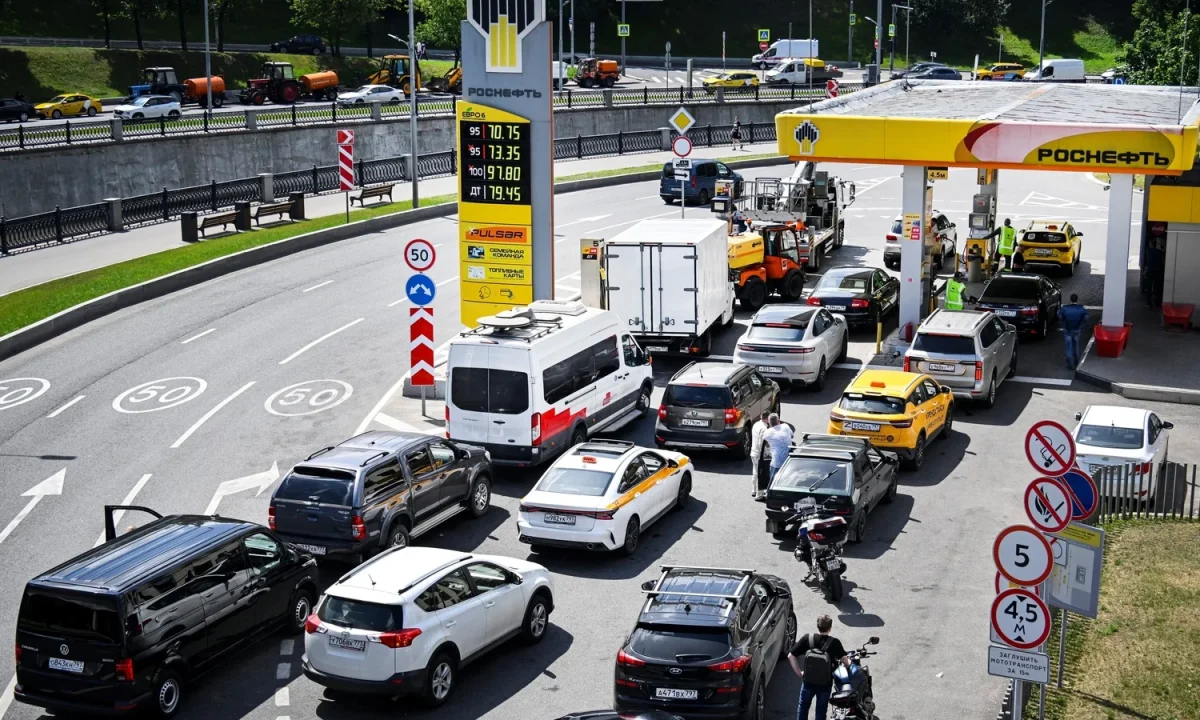
At the beginning of the year, few would have imagined that Russia, one of the world’s leading oil producers, would soon be importing petrol for its own consumers.
Back then, the dominant picture was of Russian troops gaining ground on the battlefield while nightly waves of drones and ballistic missiles battered Ukrainian cities at a scale Kyiv’s forces could not match.
Yet earlier this month, Russian authorities began bringing in consumer petrol, primarily from India. The volumes remain relatively modest, but the imports are intended to plug shortages across numerous parts of the country.
The extraordinary step follows an intensified Ukrainian campaign of long-range drone attacks against Russian refineries and fuel depots, alongside strikes on oil tankers in the Black Sea, which Kyiv has escalated since May.
That pressure has carried into this month, with Ukraine recording at least 10 direct hits on refineries and forcing several facilities to suspend production.
Some attacks have ignited major fires at oil depots, leaving damage that can take months to repair.
More than 20 Russian regions have reported petrol shortages since last month
Russian fuel production is now meeting only 65% of typical demand for this time of year, Reuters reported last week, citing interviews with industry sources.
The strain is particularly severe in Russian-occupied Crimea.
Kyiv is seeking to cut the peninsula off from Russia through repeated drone attacks on the tankers that supply it, after previously making the overland transport of large fuel volumes increasingly untenable.
At the end of June, Crimea’s Russian-installed authorities halted petrol sales to civilians so that military vehicles could receive priority.
Motorists on the peninsula can purchase fuel again, but availability remains erratic and prices have climbed.
Rosstat, Russia’s state statistics agency, said petrol prices around Sevastopol, the peninsula’s largest city, rose 30% in the final week of June alone.
Since last month, more than 20 Russian regions have reported petrol shortages, with some also imposing limits on sales.
Rosstat data indicates that average consumer petrol prices nationwide are nearly 20% above their level at the same point last year.
Russian motorists still pay considerably less than their European counterparts — unleaded petrol currently costs about €0.80 per litre — but rising prices and lengthy queues are wearing down public patience.
In recent weeks, Russian social media has filled with videos of motorists waiting at petrol stations and, in some instances, confronting people accused of jumping the queue.
A number of drivers have voiced their anger on camera, providing a rare, unscripted window into public sentiment in wartime Russia.
The complaints do not directly condemn the war in Ukraine, single out particular Russian officials or, least of all, criticise the country’s president.
Still, much like residents of Moscow and St Petersburg who protested against internet restrictions earlier in the summer, motorists forced to wait hours and pay more for fuel appear increasingly unsettled.
Russian authorities have responded by permitting some refineries to manufacture and sell lower-grade petrol and diesel in an effort to increase supplies.
Russian President Vladimir Putin said the fuel shortages are temporary
Petrol scarcity is hardly the subject Russian President Vladimir Putin wants dominating public discussion in the fifth year of his war against Ukraine.
Mr Putin has long pledged economic stability, and Russia’s wartime economy has remained in the black for four years as higher oil-export revenues largely cushioned the blow from Western sanctions.
Seeking to ease public frustration, the Russian leader has described the shortages as temporary and said the country’s air defences must tackle the threat posed by Ukrainian drones.
For Ukraine, however, this summer’s campaign against Russia’s oil infrastructure has already delivered results.
Kyiv has intermittently used drones to attack Russian refineries since Moscow launched its full-scale invasion in 2022.
Since last winter, though, Ukraine has sharply stepped up those operations as its defence industry produces larger numbers of increasingly advanced long-range drones.
The first major increase in strikes on Russian oil plants last winter followed Moscow’s sustained assault on Ukraine’s power grid, which left residents of large cities enduring freezing, sub-zero conditions inside their homes.
Ukraine’s choice to intensify attacks on Russian oil facilities this summer, however, appears to have been deliberately timed rather than simply retaliation for Moscow’s growing barrage of ballistic missiles and drones against Kyiv and other cities, which has killed dozens of Ukrainian civilians in recent weeks.
Russian petrol consumption reaches its annual high during summer, when holiday travel puts more motorists on the roads and agricultural production shifts into overdrive.
It remains unclear whether Kyiv’s primary objective was to fuel public discontent or weaken the Kremlin’s oil-export income, but the campaign has inflicted substantial disruption on Russia’s economy.
Ukrainian President Volodymyr Zelensky replaced his defence minister this week
Ukrainian President Volodymyr Zelensky has characterised the attacks as Ukraine’s “long-range sanctions” against Russia.
After spending four years seeking long-range American weapons capable of hitting targets deep within Russian territory, Ukraine is increasingly carrying out those missions with domestically produced drones.
Mr Zelensky’s decision this week to remove his 35-year-old defence minister, Mykhailo Federov, following a dispute with senior military commanders is unlikely to alter Ukraine’s strategy of striking Russian oil infrastructure far behind the front lines.
His successor, Yevhenii Khmara, previously served as acting head of Ukraine’s SBU intelligence service and played a central role in planning the country’s long-range drone operations against Russia.
There is little reason to expect him to reverse that approach.
For Russian motorists, that points to further turmoil at petrol stations. It also leaves the Kremlin facing uncomfortable questions about why an oil-producing powerhouse must continue importing more fuel for its consumers.
By damaging Russian oil sites and disrupting everyday supplies, the strikes challenge Moscow’s claim that it is winning the war — and could ultimately strengthen Ukraine’s position in any future peace negotiations.