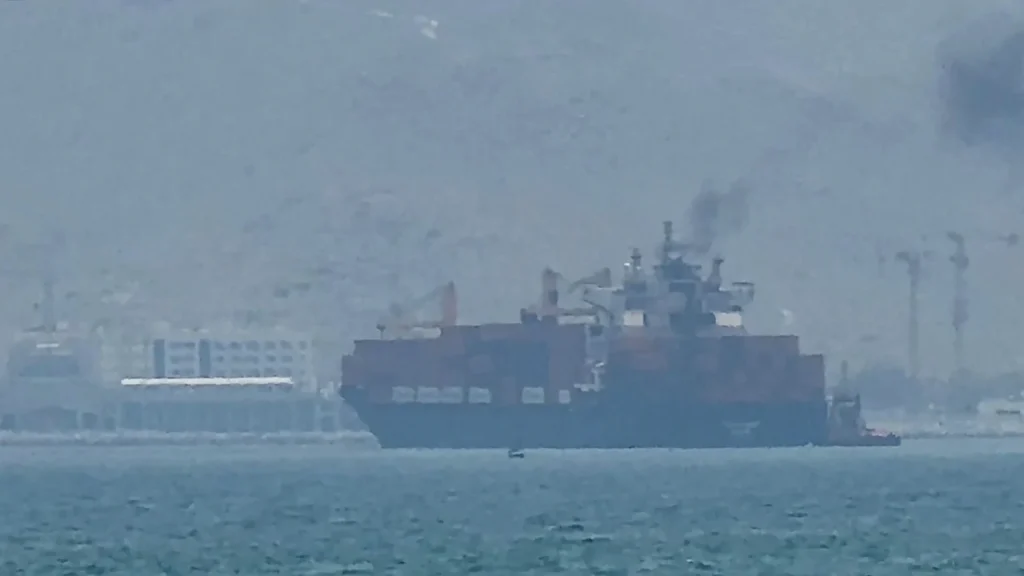
With the Strait of Hormuz once again at the center of a widening conflict, Iran says it is pressing ahead with mediator-led talks to keep its war with the United States from spiraling further — even as strikes and counterstrikes batter the Gulf and rattle global oil markets.
“The role of the mediators is to continue their efforts to prevent an escalation of tensions,” said Iranian foreign ministry spokesman Esmaeil Baqaei.
- Advertisement -
His comments came after the United States hit Iran for a second straight day, a fresh round of attacks that Tehran answered by striking at US allies across the Gulf while both sides clash over the status of the strategic Strait of Hormuz.
The new violence, coupled with Iran’s weekend announcement of another closure of Hormuz — a vital artery for the world’s oil trade — pushed crude prices higher and piled fresh strain on an already-fragile interim peace deal.
The US Central Command (CENTCOMM) said its forces had completed their latest barrage, which began overnight yesterday, on dozens of Iranian targets.
In a statement, it said US aircraft, naval vessels and drones had “completed a new wave of offensive strikes against Iran … hitting dozens of targets at multiple locations with precision munitions to degrade Iran’s ability to continue attacking international shipping flowing through the Strait of Hormuz”.
Over the past week, the fighting has increasingly narrowed onto competing claims over the critical energy corridor, after Iran’s Guards declared the route is now “closed” while the United States insists the strait remains open to maritime traffic and is not controlled by Iran.
Markets reacted quickly. Oil prices — which had fallen after the announcement of the June agreement — rose 4.5% when futures trading opened today in Asia, with the US benchmark WTI climbing above $74 (€64) a barrel amid fears that supplies to global markets could be disrupted.
Diplomatic channels have stayed active, with mediators attempting to revive a path out of the war after President Donald Trump this week declared a ceasefire over.
Pakistan, described as a key intermediary in negotiations between the rival countries, said it was watching developments with “deep concern at escalation in regional tensions”, according to its foreign office.
Iran’s foreign ministry accused Washington of reigniting danger along the waterway, saying the US attacks yesterday had “caused the return of insecurity in the Strait of Hormuz” and “have rendered futile all efforts” at establishing peace in the region.
Iranian state media reported two deaths in US strikes that it said targeted large areas across southern and western Iran, including Qeshm island and Bandar Abbas near the Strait of Hormuz, and in Khuzestan province bordering Iraq.
Iran’s Revolutionary Guards said they had struck US military targets and bases in Jordan, Bahrain and Kuwait, state media reported.
In Bahrain, air raid alerts sounded and the interior ministry issued warnings, while Kuwait’s army said the country’s forces were intercepting “hostile aerial targets”.
Jordan’s army said it intercepted four Iranian missiles.
Back and forth strikes
The latest escalation followed an Iranian attack yesterday on a commercial ship in the Strait of Hormuz, an incident that forced the crew to abandon the vessel after it caught fire.
Afterward, Iran’s Revolutionary Guards warned that “the Strait of Hormuz will be closed until further notice and until the end of American interventions in this region,” according to state news agency IRNA.
Iran has increasingly treated control of the waterway as a central pressure point, with an adviser to the country’s supreme leader saying yesterday it mattered more than “dozens of atomic bombs”.
US CENTCOM pushed back on X, saying the strait was “open to all vessels seeking to lawfully transit”.
As evening fell yesterday, Iranian state media reported at least 10 “enemy projectiles” hitting Qeshm Island, which sits on the Strait of Hormuz.
It said additional strikes hit the island of Farur, east of Qeshm in the Gulf, killing a telecommunications worker and wounding two others.
IRNA reported early this morning that US strikes killed one person and wounded four at a water pumping station in the southwest city of Mahshahr.
Iran’s Guards said they also hit Oman, a country that has rarely come under attack.
Muscat summoned the Iranian ambassador and delivered a formal protest — a rare step for the sultanate, which has sought to balance competing pressures from Washington and Tehran.
The strike came just hours after Oman hosted Iran’s foreign minister for talks focused on the Strait of Hormuz.
Trade of rhetoric
Yesterday’s attack on a Cyprus-flagged container ship in the waterway left one Indian sailor missing, New Delhi said.
Oman, meanwhile, said it had rescued 23 crew members from a commercial ship.
The crew abandoned ship and transferred to a lifeboat, around 17 kilometres east of Oman, British maritime agency UKMTO reported.
Separate Iranian strikes on ships in Hormuz earlier this week helped ignite the renewed fighting, accompanied by increasingly heated rhetoric from both sides.
Iran’s supreme leader, Mojtaba Khamenei, has vowed revenge for the killing of his father and predecessor on the first day of the war, and said Iran had compiled a list of individuals to be targeted.
Mr Trump on Saturday said any attempt to assassinate him would lead the United States to “completely decimate” Iran.