Gautam MalkaniMonday June 22, 2026
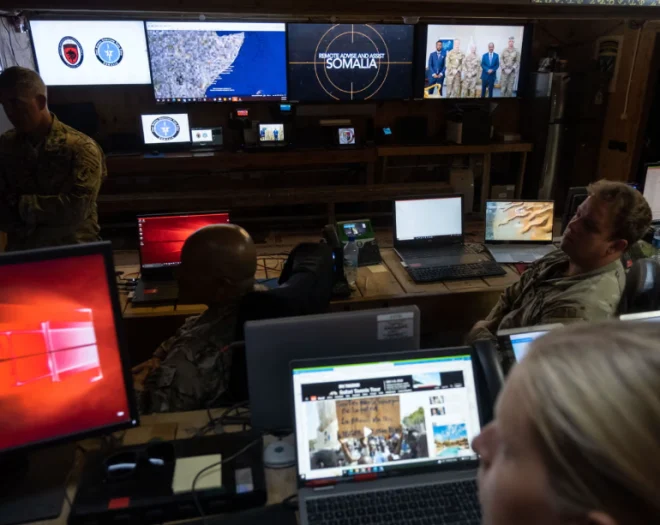
In Mogadishu, far from the scrutiny that often follows major wars, a US military special operations control centre oversees drone activity and operations against al-Shabaab. Photograph: Jonathan Torgovnik/Getty Images
- Advertisement -
Some conflicts remain in the shadows for reasons that are all too familiar: restrictions on press freedom, the danger reporters face on the ground, scarce resources, and the way geopolitics can eclipse civil wars. Add to that the sheer volume of armed conflict worldwide, and it becomes easier for civilian suffering, alleged abuses and attempts to hold armed forces to account to disappear from view.
That is why the Guardian this week published an investigation into the deaths of at least 12 civilians, including eight children, killed in a US airstrike in Somalia last year as Washington continues its covert military campaign against the Islamist militant group al-Shabaab. The reporting, published as part of our Rights and Freedom series, reflects a broader effort to shine a light on conflicts that might otherwise be overlooked.
“We’re reporting on this in the hope that the information and the Guardian’s reach will cut through,” says Mark Townsend, a senior global development reporter who worked on the investigation with Mohamed Gabobe, a freelance journalist and producer based in Mogadishu. “But it’s a very hard conflict to actually report on. Even excellent reporters like Mohamed can’t travel to areas controlled by al-Shabaab where this war is being conducted. And civilians in those areas aren’t allowed internet access or smartphones, so getting footage of strikes or images of the aftermath and victims and all the things you’d want to corroborate testimony is very difficult. On top of that, the US doesn’t release anything about what’s going on – it’s a very opaque campaign.”
The strike at the centre of the reporting took place in November in the town of Jamaame. It was the deadliest US operation for civilians in Somalia during either Trump administration, and the pattern of bombing has grown more aggressive.
Mohamed says western coverage too often fails to capture the scale of the human cost in Somalia. “I sometimes get the sense that many western media outlets view civilian casualties from US airstrikes in Somalia as a norm and part of everyday life,” he says. “But death shouldn’t be normalised, especially when the most powerful nation in the world is doing it on communities that have nothing to do with the armed parties involved in the Somalia conflict.”
The reporting by Mohamed and Mark shows that even secretive military operations can be examined rigorously rather than left to fade into the background. Their work depended on close coordination between the Guardian and a journalist with deep local knowledge, as well as careful cross-checking of scattered evidence in the absence of official records and documents, followed by questions put directly to the relevant authorities.
“When it comes to this model of working, I think it varies depending on the particular news organisation,” says Mohamed, who has been a journalist for 10 years and first reported for the Guardian in 2022. “For instance, some western media outlets allow the local journalist in the field to take the lead, and once the work is done they’ll continue to coordinate with that local journalist to make sure the story is told in an accurate and authentic way. Meanwhile with others, once you do the work, they will overlook the knowledge and context of the local journalist and will release the story in a manner that fits their narrative – which isn’t always accurate and, in some cases, is biased, sometimes without them even knowing.”
Mark, who has reported for the Guardian and its former sister newspaper, the Observer, for 24 years, has carried out similar collaborations with local journalists in other countries. “Obviously, it requires trust on both sides,” he explains. “It’s a collaboration in the most complete sense. But Mohamed did the hard yards here in terms of the on-the-ground reporting, so whatever feedback he had – for instance if something needed to be changed or slightly nuanced – then he got the final say, as far as I was concerned because it’s his lived experience, he’s the expert.”
Mark first contacted Mohamed after Tess McClure, an editor for the Guardian’s Rights and Freedom series, first spotted reports of a high number of children killed in last November’s airstrike.
With little access and a real risk of prosecution for reporting from al-Shabaab-controlled areas, Mohamed had to find another way in. “I reached out to clan elders in Mogadishu,” he explains. “Clan elders are the leaders and decision-makers when it comes to the affairs of each respective clan and sub-clan in Somalia. By negotiating with them and explaining my intentions and the importance of survivors speaking out, they helped put me in touch with some of the victims.”
Their testimonies capture the brutality of the strike and the civilian lives caught in its path. “One of the biggest challenges was asking the victims who’d lost loved ones in the attack certain questions that went into details about the bodies of their loved ones, or the screams they heard once the aerial bombardment ceased,” says Mohamed. “I don’t like asking people those kinds of questions – it feels like you’re making them relive horrors that no human being should endure. When asking these questions, if the victim pauses, I get the sense that they’re having a flashback. And if they weep or whisper a prayer, or even make a reference to a verse of the Qur’an, then I know they’re hurting a lot. But these details are crucial for putting together what actually happened.”
Alongside witness accounts, Mohamed and Mark assembled the story through photographs, video footage, X-rays of children’s shrapnel injuries, and interviews with drone specialists and military analysts. Mark also sent about 30 detailed questions to the recently renamed US Department of War. The department did not respond. The White House was approached as well, and its eventual response, quoted in one of the articles published this week, underscores the kind of hostile environment journalists can face from the current US administration.
“It’s very important that their response was included in the article because it shows how they’re doing these things without any kind of transparency or proper legal course,” says Mark. “They didn’t know, didn’t care, or wouldn’t say. Either way, it’s pretty dire if you’ve killed innocent people – you’d think you’d feel a responsibility to work out why.”
The articles leave readers with a set of urgent questions that remain unanswered: who approved the attack on a densely populated family neighbourhood, and why? Who, if anyone, was meant to be hit? Those questions sharpen the impact of the witness testimony. “Their refusal to share anything about what happened is in itself a galvanising factor,” says Mark.
Mark’s widely praised coverage of the wars in Sudan and the Democratic Republic of the Congo has also shown that audiences will engage with difficult, underreported conflicts. “Readers have responded brilliantly to our reporting about Sudan and the DRC, which are knotty conflicts that are quite complex. Readers do really care, which is very reassuring. Whether or not the wider world does, I’m not sure, but our readers do.”