Benjamin Netanyahu arrived at the White House on 11 February and, away from the press pack, was ushered into the Situation Room — a privilege granted to only a handful of foreign leaders.
Inside, the Israeli Prime Minister pressed his case for war with Iran.
The New York Times reported that his proposal pursued four aims: removing the country’s leadership, crippling its missile programme, sparking a popular uprising, and ultimately forcing regime change.
The CIA director dismissed that last prospect as “farcical”.
Secretary of State Marco Rubio offered the nearest thing to a sober assessment. A popular uprising, he said, was never a realistic outcome.
But the destruction of Iran’s missile programme? That, at least, was presented as possible.
The Supreme Leader may have been killed. Yet his son stepped in, the regime endured, and no public revolt materialised. Iran shut the Strait of Hormuz, cutting through a fifth of global oil supply and sending shockwaves through the world economy.
And even the narrower objective outlined by Mr Rubio remains unmet.
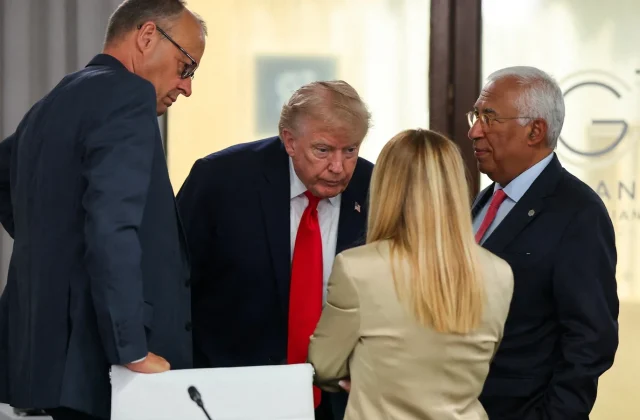
Donald Trump meets Benjamin Netanyahu at the White House on 11 February (Pic: ‘AVI OHAYON/GPO/HANDOUT’)
US intelligence assessments say Iran still holds about 70% of its missile stockpile — and retains the ability to fire them across long distances.
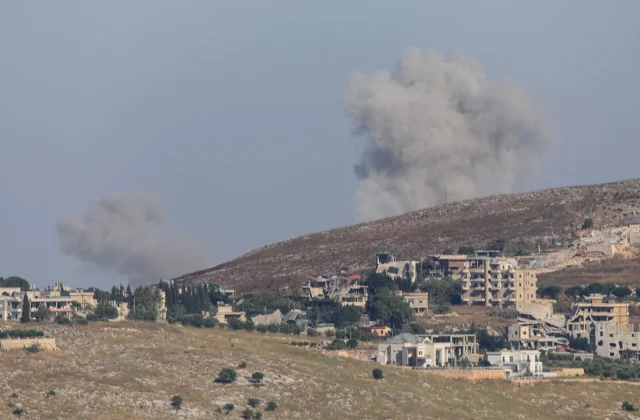
Last week alone, it launched roughly 10 ballistic missiles at northern Israel and struck at US military assets in Kuwait, Bahrain and Jordan.
Throughout the conflict, the damage done by Iran to American military infrastructure appears to have gone well beyond what Washington has publicly admitted.
Across US bases in the region, more than 200 structures were damaged or destroyed, including runways, hangars, radar systems and command headquarters, with repair costs estimated at as much as $5 billion.
At the same time, Iran has come out of the war in a stronger economic position than it held at the start. The rise in oil prices — driven by its own move to close the strait — has allowed Tehran to earn more from oil sales during the war than it did before, despite exporting fewer barrels.
And what emerged this week, after more than 100 days of war, was only a memorandum of understanding — 14 paragraphs of mostly provisional commitments that give both sides 60 days to try to hammer out a permanent settlement.
The central disputes were left unresolved. The memorandum says nothing about Iran’s missile programme and does not directly confront Hezbollah or Tehran’s wider network of regional proxies — unless, as Vice President JD Vance has argued, Paragraph 1’s pledge to pursue “peace and stability on all fronts” is taken to mean Iran must end support for them.
Tehran, of course, may not see that language the same way.
People ride motorcycles past a large billboard showing portraits of Iran’s late supreme leader, Ayatollah Ruhollah Khomeini (L) and slain supreme leader Ayatollah Ali Khamenei (R) in central Tehran
More striking still, the war not only failed to eliminate Iran’s missile programme — this week, Mr Trump openly backed Iran’s right to possess one.
“I’m saying that if other countries have them, it’s a little unfair for them not to have some,” Mr Trump said.
The memorandum is more specific on Iran’s nuclear programme. But if the war was supposed to force Tehran into deeper concessions, the result has been the reverse.
Back in February, during talks in Geneva, Iran had offered major limits on its nuclear activity — including a cap on enrichment, access for international inspectors, and a proposal to dilute, or blend down, its most dangerous stockpile of enriched uranium on site.
In this week’s memorandum, however, there is no agreed cap on enrichment at all. Paragraph 8 merely says both sides will “discuss the issue of enrichment” in a future final agreement.
And while the text appears to commit Tehran to “downblending” or diluting its uranium stockpile, the details — how, when and how much — have all been pushed into negotiations that have yet to begin.
A $300 billion reconstruction fund for Iran has also been endorsed in principle, but its financing, structure and timeline remain wholly undefined. For all the attention the number has drawn, it looks less like a firm commitment than a commitment to keep talking.
Mr Trump, true to form, was emphatic on that point. “There is no 300 Billion Dollar payment to Iran by the U.S.,” he posted on his Truth Social platform.
He was equally emphatic in declaring victory: “All there is for the U.S. is Success, Lower Oil Prices, and Victory. Check out the Stock Market.”
Damage due to an airstrike in a neighbourhood in Tehran in March
The memorandum’s clearest concessions, though, are not theoretical. Iran received them the moment the agreement was signed.
Tehran can now sell its oil freely and collect the proceeds — with sanctions waivers on crude exports, banking, transport and insurance all taking effect immediately.
The US naval blockade has been lifted, and millions of barrels of oil have already moved through the Strait of Hormuz.
And the memorandum’s treatment of the strait does not restore open passage so much as recognise Iran’s control over it.
Paragraph 5 guarantees toll-free transit through the vital waterway for only 60 days. Beyond that, the text says nothing, and Iran is explicitly assigned a role in negotiating the “future administration” of the strait with Oman and other Gulf states.
In practical terms, Iran appears to have gained a permanent new source of leverage — one it lacked before this war, which showed Tehran that it could shut the world’s most important oil chokepoint whenever it chose.
For Washington, that is a strange shape of victory.
For Israel, it is no better.
Benjamin Netanyahu was the chief architect of the war — the leader who entered the Situation Room and persuaded Donald Trump to wage it.
But when the negotiations that ended the conflict took place, he was absent. He was not in the room, not on the phone, and not consulted.
And the memorandum produced by those talks commits Israel, in its opening paragraph, to an immediate and permanent halt to military operations on every front, including Lebanon.
For Mr Netanyahu, the political humiliation is severe. With elections expected this autumn, his survival depends in part on convincing voters that he will not pull Israeli forces out of Lebanon.His own cabinet has already turned openly mutinous.
“Trump’s agreement does not bind us,” said the far-right National Security Minister Itamar Ben-Gvir.
Finance Minister Bezalel Smotrich has been urging Mr Netanyahu to go further still.
US Vice President JD Vance speaking to reporters at the White House
That, in turn, prompted a remarkable public rebuke from the US Vice President.
“If I was in the cabinet of the Israeli government,” he said on Thursday, “I might not be attacking the only powerful ally that I have anywhere left in the entire world.”
His warning points to more than routine diplomatic frustration.
US intelligence agencies have warned that Israel is likely to try to sabotage efforts to secure a lasting peace agreement.
The technical talks that were meant to start in Switzerland yesterday have already been delayed because of Israel’s actions in Lebanon.
And although a ceasefire between Israel and Hezbollah has since been announced, Mr Netanyahu has shown time and again that he is willing to push against the outer edge of what Washington will accept.
Still, none of that alters the central fact. Iran held out long enough to make the political and economic costs of continuing the war intolerable.
This agreement was not signed because it was good. It was signed because, in the end, there was no other option.
Read more Middle East stories