Thursday July 16, 2026
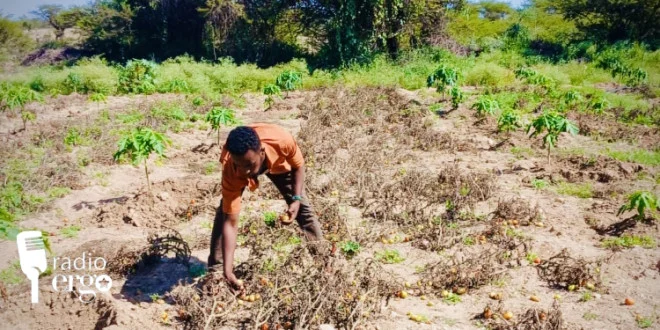
Farmer tends his land after crop losses/File Photo/Ergo
A locust invasion compounded by a crippling water shortage has shattered harvests in Hero-Dhagahley village, in Somalia’s central Mudug region, leaving farmers without crops, income or enough water for their families.
On his two-hectare farm, Abdimaciin Ahmed Mahmoud had grown tomatoes, onions, carrots, peppers and lemons, along with other produce. Nearly all of it was destroyed by locusts and lack of irrigation, costing him an estimated $1,300.
“The locusts laid eggs in the fields and covered every plant. Nothing has been left for us,” he told Radio Ergo. “Water is the main problem on my farm. The well has no functioning pump, tank or pipes, and we cannot afford fuel. We have lost the crops and many trees have dried up too.”
Residents of Hero-Dhagahley, in eastern Mudug, depend heavily on agriculture, taking vegetables and fruit to markets in Hobyo, Wisil and surrounding towns.
But the village well, which provides water for both irrigation and household use, has been broken for four months and has not been repaired. Farmers say water from a private well 10 kilometres away is beyond their means.
Abdimaciin said his household now prepares only one meal a day, while shopkeepers have become reluctant to extend further credit. He once earned at least $700 a month from the farm, which he began in 2023 using a $500 loan after drought killed more than 200 goats and camels that had supported his family’s pastoralist livelihood.
He can no longer pay the $5 charged for each barrel of water needed by his family of 10 and their five goats. Instead, they rely on neighbours for one jerrycan of water, an amount that falls far short of their needs.
The hardship has spread to his children’s schooling. Two children have dropped out of Koranic classes and primary school, while two older children live with his brother in Galkayo. Their uncle pays $10 per month for each child to remain in secondary school.
In recent months, Abdimaciin has accumulated about $600 in debt for food and water bought on credit. He said he had never faced such hardship, either during his years as a livestock herder or in his three years of farming.
Fellow farmer Hafid Abdi Siyad said the collapse of his one-and-a-half-hectare farm had upended life for his family of seven. Crops of grain and vegetables planted in February were wiped out, resulting in losses of roughly $1,200, including $800 he had borrowed to fund the farm.
“My main worry is now how to feed my family. Life was much better when the farm was producing. Today, our greatest struggle is simply surviving. The place that once gave us income is no longer producing anything. Our needs are increasing, and drought has left us without water,” he said.
Hafid said relatives in Galkayo and Hobyo occasionally help the family with one or two dollars, enough for a single meal. He also owes local shops more than $300, but they have stopped providing food on credit. Those who financed his farming continue to demand repayment.
For over eight years, the farm had been the family’s sole source of income. He said locusts, other pests and the shortage of water had combined to wipe out all production.
“The locusts caused huge losses. They destroyed plants that had been growing for three months. They covered our lemon and mango trees, as well as other young plants, until they dried out. There are too many to drive away, whether it is day or night,” he said.
Eggs were left across his fields, and he said he lacked the money and resources needed to remove them. Even with access to water, resuming cultivation would be difficult without broader rehabilitation support.
Hafid has sought casual work loading stones at nearby quarries, though he earns no more than a meagre $3 a week.
The financial strain also forced three of his children out of primary school in May after he was unable to pay $160 in fees covering four months. He said watching them lose their education was deeply painful. Raised in a pastoralist community where he never had the chance to attend school, he had wanted a different future for his children.
Liban Said Siyad, deputy chairman of the Hero-Dhagahley farmers’ cooperative, said the steep drop in production had affected more than 80 small-scale farmers in the area.
“Poor farmers have suffered the most. They used to go to their fields each morning and make a living from what they harvested and sold. Now they have nothing to bring to market,” he said. “This has brought hardship, financial losses and displacement. Families have lost the daily income they relied on.”