Missiles and drones tore across Gulf skies as US and Iranian forces traded their heaviest blows yet, with Tehran striking at American facilities across the region and declaring once again that it had shut the Strait of Hormuz — a lifeline for global energy shipments.
The exchanges marked the latest turn in a grinding cycle of attack and retaliation, as Iran pushes to cement its influence over traffic through the narrow waterway.
But this time, the tempo and reach of the assault signalled a sharper escalation.
For the first time since April, strikes reached Qatar — a key mediator in ceasefire efforts — and the United Arab Emirates, which said its air defences had engaged Iranian missiles and drones after a lull in attacks since early May.
Over the past week, US President Donald Trump has said he considers the ceasefire finished, though he has also left open the possibility of renewed talks.
The conflict, triggered by US and Israeli strikes on Iran on 28 February, has rattled the Gulf. Iran’s effective blockade of Hormuz has pushed energy prices higher, stoking inflation pressures around the world.
Those increases, particularly at the petrol pump, carry political weight for Mr Trump as November’s congressional elections draw closer.
Iran has moved to formalise a lasting system of fees in the strait — which carried one-fifth of the world’s oil and liquefied natural gas shipments before the war — and has warned ships to stay out unless they have its approval.
Late yesterday, Tehran said it had closed the waterway after firing a warning shot that struck a vessel travelling on an unauthorised route.
Today, it said it had disabled a second vessel.
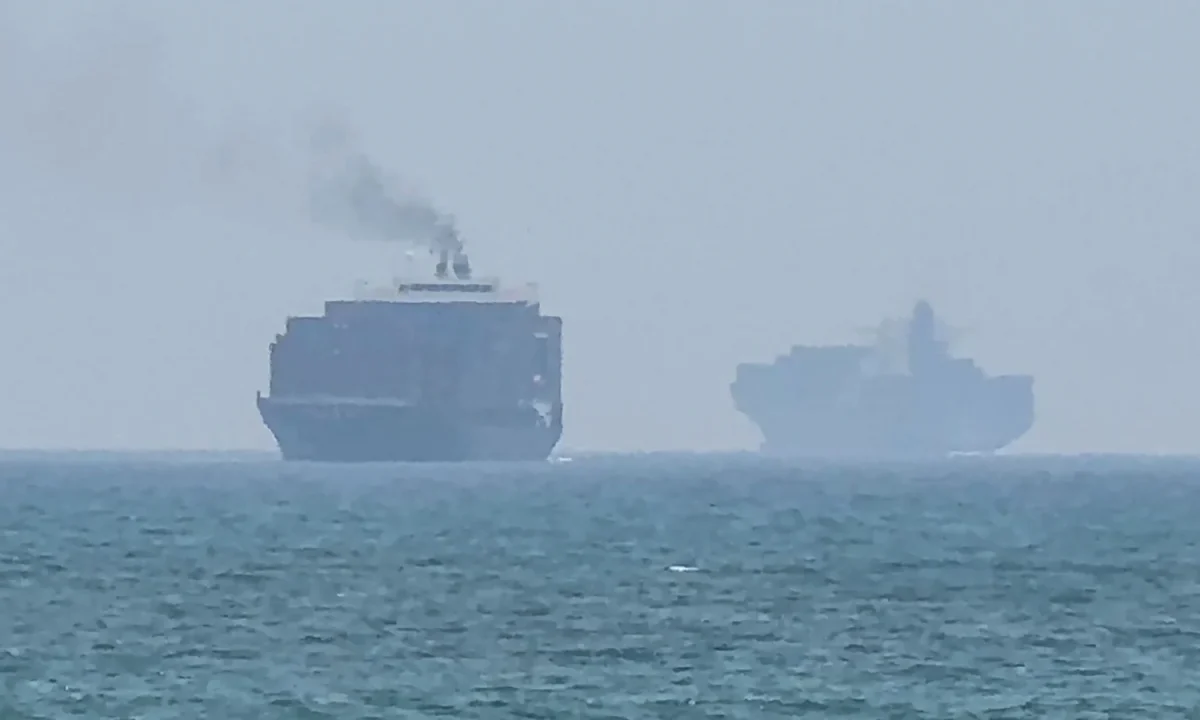
India said one of its nationals was missing after an attack on the container ship GFS Galaxy off the coast of Oman.
Oman said 23 crew members had been rescued.
Air defence interceptions are seen in the sky above Doha
Qatar urged all vessels — from pleasure craft to fishing boats and jet skis — to halt activities.
Iran’s newly established Persian Gulf Strait Authority said transit through the strait was currently impossible because of what it called “recent illegal movements of the United States military forces in the region”.
It said permits would be issued “as soon as stability and calm are restored”.
US Central Command disputed that account, saying American forces were in position to protect freedom of navigation in the face of what it described as Iranian “aggression, harassment, threats, and arbitrary declarations”.
“Iran does not control the strait. Traffic is flowing,” it said.
The US Navy-led Joint Maritime Information Center repeated guidance that, despite what it called a severe security threat, an “expanded” southern route near Oman remained open for two-way passage.
Central Command said US forces struck 140 Iranian military targets yesterday and more than 300 over three nights this week, describing the operation as an effort “to degrade Iran’s ability to attack civilian mariners and commercial vessels freely transiting the strait.”
Iranian state media reported blasts in multiple port cities and said an Iranian army officer had been killed in “US-Israeli” attacks on Iran.
Latest Middle East stories
Iran’s Guards responded by claiming strikes on a command-and-control centre and drone hangars in US ally Jordan, a US radar site in Kuwait, aircraft carrier support and refuelling platforms in Oman, and a jet maintenance centre and command facility in Qatar.
Qatar — which has previously said it would not mediate while under attack — said falling shrapnel injured three people, including a child.
It said Iran was “fully legally responsible” for the attack.
Across the region, governments reported fresh threats and interceptions: the UAE said it detected missile dangers outside its borders, Bahrain said it intercepted several Iranian aerial attacks, Jordan reported missile strikes, and Oman said it had been targeted by drones.
Oman said it had summoned Iran’s ambassador to protest drone attacks in two regions, and the US embassy in Oman told its nationals in Duqm and Musandam to shelter in place.
The surge in violence followed talks in Oman yesterday between Iran’s Foreign Minister Abbas Araqchi and Omani Foreign Minister Badr Albusaidi.
Footage posted to the IRGC’s social media channels showed missiles being launched
Iran said those discussions focused on coordinating arrangements in the Strait of Hormuz, and that they were due to continue with a Qatari presence.
Mr Araqchi later spoke by phone with Pakistani Foreign Minister Ishaq Dar about regional developments, Iran’s semi-official Tasnim news agency reported, underscoring Pakistan’s role as a key intermediary between Washington and Tehran.
On Tuesday, the US revoked the licence authorising the sale of Iranian crude after Qatari and Saudi commercial tankers came under fire.
Iran has not claimed responsibility for earlier attacks on ships, but analysts say Tehran uses such pressure points to strengthen its hand at the negotiating table.
Iran’s top negotiator Mohammad Baqer Qalibaf today posted on X: “The era of one-sided deals is OVER. We told you: keep your word or pay the price. Reality is knocking.”