By: Mohamed Mukhtar IbrahimSunday July 12, 2026
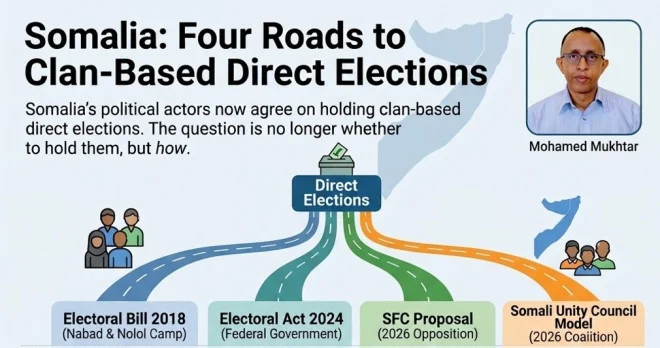
Somalia’s long-running argument over whether to hold clan-based direct elections has shifted: political leaders now broadly agree on direct voting, and the debate has moved to how those elections should be designed and administered.
For the first time in years, the Federal Government of Somalia (FGS) and opposition forces concur on the principle that citizens should directly elect their representatives. The remaining contention centers on the institutional arrangements — who runs the elections, how power is shared with Federal Member States, whether parties or independents will dominate, and what administrative capacity is necessary.
In practical terms, Somalia now faces four distinct institutional blueprints that all aim for the same endpoint — clan-based direct elections — but each prescribes a different route to get there.
The Four Electoral Models
This article compares four competing electoral models currently shaping Somalia’s political debate.
Four Questions That Separate the Models
Although all four models support clan-based direct elections, they answer four critical questions differently.
Who should manage elections?
How much authority should Federal Member States have?
Should political parties or individual candidates dominate elections?
How much institutional capacity is required before elections can be held?
The answers to these questions explain almost all the differences between the four models.
At a Glance
The Biggest Difference: Who Controls Elections?
Perhaps the most significant difference concerns who administers elections.
The Electoral Bill 2018, Electoral Act 2024, and Unity Council models place primary electoral authority at the national level. Proponents of the Electoral Bill 2018 additionally propose an independent oversight committee to supervise logistics, troubleshoot operational problems, and protect the integrity of the process.
The SFC proposal, by contrast, envisions a shared scheme with responsibilities split between the Federal Government and Federal Member States.
Centralization versus Shared Federal Management
The models also differ in the extent of responsibility assigned to Federal Member States.
This reflects different understandings of Somalia’s federal system.
The Electoral Bill 2018, the Electoral Act 2024, and the Unity Council assume that elections should be led principally by national institutions.
The SFC proposal argues that successful implementation depends on active state-level participation.
Political Parties or Individual Candidates? Will the citizen elect a party or an individual candidate?
Another major difference concerns political competition.
The SFC proposal stands out by allowing independent candidates to compete without party membership.
The other three models depend mainly on political parties as the route to office.
What electoral system is being proposed?
The models also propose different ways of translating votes into federal parliamentary seats.
The practical implications are significant.
Closed List PR gives political parties substantial control over which candidates are elected.
Open List PR allows voters to influence which candidates from a party are elected.
First-Past-the-Post (FPTP) allows voters to elect individual candidates directly from their constituencies.
How Much Influence Do Voters Have?
The level of voter influence differs considerably.
Under the 2018 model, party leadership largely determines which candidates obtain parliamentary seats.
The 2024 Act gives voters greater influence by allowing them to select individual candidates within party lists.
Both the SFC and Unity Council models allow voters to choose directly between competing individual candidates.
Registration and Voting
The four models also differ in how voters are registered.
The Electoral Act 2024 introduces Somalia’s most technologically advanced voter registration system but also requires substantially greater administrative capacity.
The SFC proposal deliberately favors simpler procedures to facilitate faster implementation.
State and Local Elections
Not all models cover every level of government.
The Electoral Act 2024 is the only model that comprehensively regulates elections at the federal, state, and local levels.
Institutional Requirements
One of the clearest differences is the level of institutional capacity each model assumes.
The Electoral Act 2024 is the most administratively demanding model. The SFC proposal takes the opposite approach. It relies more heavily on political agreement and simpler administrative procedures.
Strengths and Weaknesses
The Emerging Areas of Consensus
Despite their differences, the four models reveal several important areas of agreement.
All four support:
Clan-based direct elections.
Parliamentary election of the President rather than direct presidential elections.
Nationwide electoral administration through a national institution.
Regular electoral competition as the basis of democratic governance.
These shared principles represent a significant narrowing of Somalia’s political divide.
The Remaining Political Choices
The differences that remain are less about democratic principles than about institutional design and implementation. Policymakers will need to decide:
Should election administration be concentrated in a national commission or shared with Federal Member States?
Should parties remain the primary vehicle for representation, or should independent candidates have a greater role?
Should seats reflect party vote shares nationwide, or should representatives be directly accountable to defined geographic constituencies?
Should Somalia adopt a comprehensive long-term system immediately, or use a temporary model to build confidence and capacity?
Should the electoral framework prioritize comprehensive nationwide administration, or a simpler model that can be implemented with current institutional capacity?
Conclusion
The comparison demonstrates that Somalia’s electoral debate has entered a new phase. The central question is no longer whether the country should embrace clan-based direct elections; that principle is now broadly accepted across the political spectrum. The challenge is selecting an institutional model that can balance democratic legitimacy, federalism, political trust, administrative capacity, and long-term stability.
_______________________________
Mohamed Mukhtar IbrahimEmail: [email protected]