
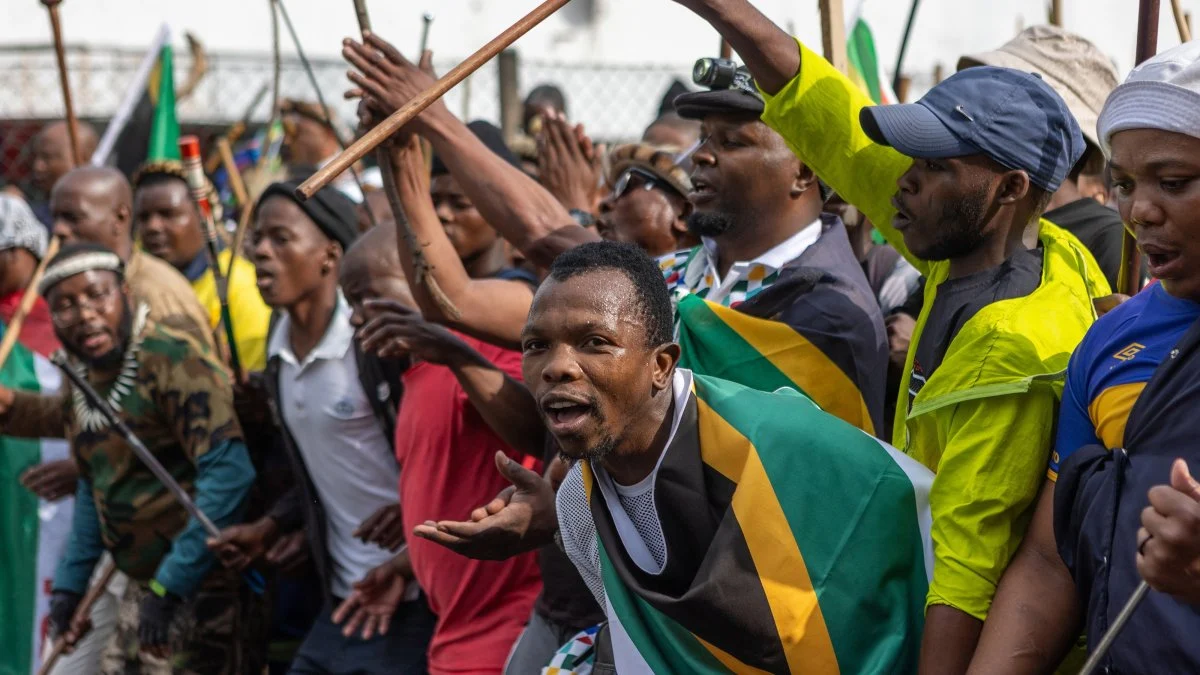
In an eruption of civil discontent, thousands marched across South African cities on Tuesday, urging the expulsion of undocumented foreign nationals. The demonstrations culminated after a sustained campaign of unrest that resulted in four fatalities and forced thousands to flee.
These protests were orchestrated by a coalition of minor political parties and citizen vigilantes, who set a June 30 ultimatum for undocumented immigrants to leave the country.
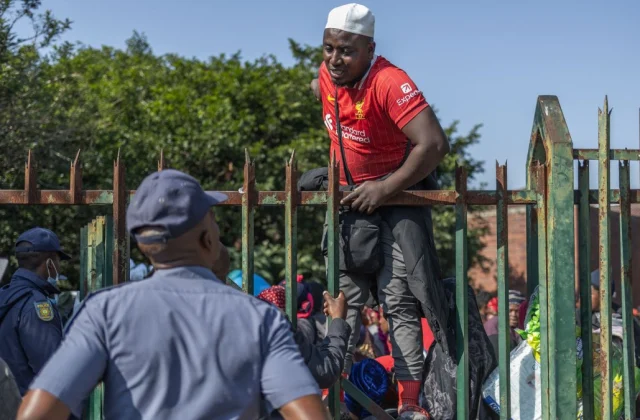
In Johannesburg, the financial heart of South Africa, thousands participated in the protests, creating a scene of desolation as shops remained closed, workers stayed home, and public transport stations lay silent. Under the watchful eye of police in riot gear, the demonstrators carried flags and placards, emphasizing their demands.
Meanwhile, in Durban—known as the Zulu heartland—protesters donned traditional warrior clothing and carried weapons, presenting a powerful spectacle. Security was heightened, with armoured vehicles and helicopters visible across the city. Brightness Gumbi, a kitchen business owner, expressed her frustrations, alleging that illegal immigrants benefited from the drug trade, which enabled them to afford rental properties better than locals.
In contrast, Cape Town’s demonstration was sparse, with approximately 100 people marching through the city center while passing a counterprotest against xenophobia and Afrophobia. Despite the peaceful nature of most protests, authorities did respond to “isolated incidents of looting.”
South Africa, a major magnet for migrant labor, finds itself amid a political storm as unemployment soars above 30%, compounded by rampant crime and failing public services. With local elections approaching, labor analyst Dale McKinley highlighted how the anti-migrant sentiment is becoming a political tool.
In recent weeks, anti-immigrant violence claimed the lives of an Ethiopian, two Mozambicans, and a Malawian. Various African governments, including Nigeria and Zimbabwe, have organized repatriation transport for their citizens, with over 25,000 individuals processed for departure recently.
As demonstrations progressed, hundreds of migrants—mainly from Malawi and Zimbabwe—gathered in Cape Town and Johannesburg, seeking assistance to return home as many faced eviction and job loss amid fears of fines and attacks.
A 23-year-old Zimbabwean woman, seeking anonymity in Cape Town, shared her fears, stating she wished to leave because of the brewing hostility. “I’m scared,” she admitted softly.
The anti-immigrant movement, branded “March and March,” is spearheaded by Jacinta Ngobese-Zuma, who emphasized a non-violent approach, pledging no violence or looting would occur in their name. The memory of unrest from five years ago, which claimed around 350 lives, prompted calls for calm and security reinforcements.
Ahead of June 30, President Cyril Ramaphosa detailed enhanced efforts to address illegal immigration, urging local leaders to quell rising tensions.
KwaZulu-Natal’s premier, Thami Ntuli, underscored the necessity of preventing any recurrence of past violence, driven by either criminality or xenophobia. This coordinated repatriation effort marks a significant shift, being the first instance where multiple governments organized returns of their nationals in unison.