
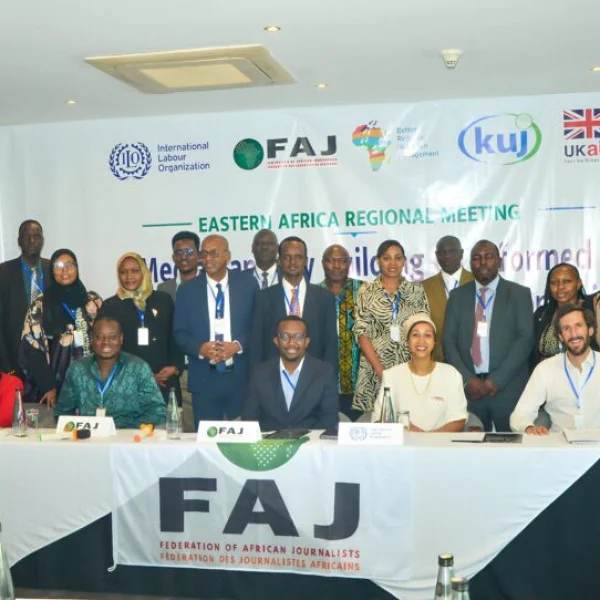
Media Leaders Commit to Fact-Based Migration Reporting Across Eastern Africa
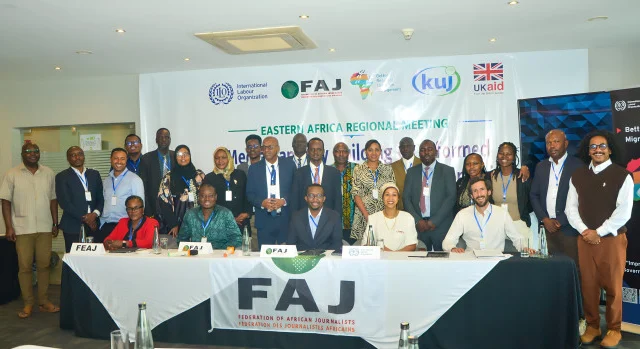
MOMBASA, Kenya – Media leaders and journalists from ten Eastern African countries have agreed on a common approach to strengthen fact-based reporting on migration, as the region grapples with misinformation, human trafficking and the dangers of unsafe migration.
The pledge came at the end of a three-day regional forum in Mombasa, Kenya, where delegates endorsed the Mombasa Statement on Responsible Migration Reporting, a declaration urging ethical, balanced and evidence-driven coverage of migration and labour mobility.
The forum, organised by the Federation of African Journalists (FAJ) and the Federation of Eastern Africa Journalists (FEAJ), brought together journalists’ union leaders and media practitioners from Comoros, Djibouti, Ethiopia, Kenya, Rwanda, Somalia, South Sudan, Sudan, Tanzania and Uganda. It was backed by the International Labour Organization (ILO) through the Better Regional Migration Management (BRMM) Programme, which is funded by the United Kingdom’s Foreign, Commonwealth and Development Office (FCDO).
Somalia was represented by three leaders from the National Union of Somali Journalists (NUSOJ), who joined the regional discussions on migration coverage, information integrity and the journalist’s role in helping communities make informed choices about migration and job opportunities.
The meeting came at a time when migration flows across Eastern Africa are rising, with countries in the region continuing to function as points of origin, transit and destination for migrant workers. Participants said migration has become a major public-interest issue, with consequences for employment, economic growth and social stability.
Speaking at the forum, ILO Better Regional Migration Management Chief Technical Advisor Aida Awel said accurate journalism plays a central role in shaping public understanding of migration.
“This regional media training marks an important step in strengthening informed, balanced, and evidence-based reporting on labour migration and employment issues across Eastern Africa. By equipping journalists with the knowledge and tools to report accurately and responsibly, we are contributing to greater public awareness, accountability, and regional cooperation on issues that affect millions,” she said.
FAJ President Omar Faruk Osman called on journalists to push back against misinformation and deliver reporting grounded in facts.
“Migration is one of the most significant public interest issues facing Africa today. Journalists have a responsibility to report it accurately and responsibly by exposing the risks of irregular migration, horrendous abuses and exploitations while highlighting opportunities available within our countries and across the region,” Osman said.
He warned that misleading content continues to shape migration decisions and public attitudes.
“In an age of rampant misinformation and disinformation, public interest journalism, where information integrity is consciously preserved, is essential to ensuring that migration narratives are guided by facts rather than false promises and unrealistic expectations,” he added.
Among the forum’s major outcomes was the regional launch of the ILO Toolkit on Migration Reporting, a practical guide intended to help journalists cover migration and labour mobility with accuracy, ethics and broader context. Participants also received training in verification methods, fact-checking and responsible reporting.
Discussions examined the risks associated with irregular migration, including human trafficking, forced labour and exploitation. Journalists were urged to report these threats clearly while avoiding sensationalism that could deepen stigma against migrants or vulnerable communities.
At the same time, participants called for more coverage of opportunities within the region, such as fair recruitment systems, vocational training, entrepreneurship and legal pathways for labour migration. Balanced reporting, they said, should reflect both the dangers and the possibilities tied to migration.
Beyond migration coverage, the forum also opened space for conversations about media freedom, journalist safety and regional solidarity. Delegates explored cross-border reporting initiatives and coordinated advocacy efforts aimed at protecting press freedom and freedom of expression across Eastern Africa.
The meeting closed with a renewed commitment from journalists and media organisations to deepen cooperation across borders and ensure that migration reporting advances the public interest through accuracy, fairness and accountability.