Russia signaled it is prepared to speak with European capitals, but the Kremlin made clear it will not negotiate under pressure, as tentative signs emerge that the EU may be exploring renewed contact with Moscow after largely freezing ties following the war in Ukraine.
Kremlin spokesman Dmitry Peskov said the sheer scale of unresolved issues made some level of engagement inevitable, arguing that practical realities now demanded communication. But, he added, Europe would first need to rethink the way it approaches Russia.
“The Europeans have a very serious misconception: They assume that negotiations with Russia must be conducted from a position of strength and based on Russia’s weakness. This is the biggest mistake … Such talk will lead nowhere,” he told reporters.
“Does this stem from European incompetence, misinformation, or stupidity? We don’t know for sure, but it’s a fact.”
The EU has imposed 20 rounds of sanctions on Russia over its invasion of Ukraine.
Shift in European stance
EU ambassadors agreed last week to advance membership talks with both Ukraine and ex-Soviet Moldova (stock image)
After spending much of the past year and more on the sidelines — while US President Donald Trump pursued efforts to broker an end to the war — the EU has begun edging, cautiously, toward direct outreach to Russia.
The office of European Council President Antonio Costa has had “brief contacts at diplomatic level” with the Kremlin in recent weeks in an effort “to open communication channels”, an EU official said on Wednesday.
In an interview with the Financial Times, Austrian Chancellor Christian Stocker said the bloc should use the current “momentum” around Ukraine peace efforts to press ahead with attempts to restart negotiations with Mr Putin.
Mr Peskov said Moscow was ready to engage, provided there was genuine willingness on the other side for substantive talks, “not to engage in moralising or, especially, to issue ultimatums”.
Still, Mr Costa’s move laid bare differences among EU leaders meeting in Brussels, with some arguing the outreach had not been coordinated and that the bloc’s priority should remain increasing pressure on Russia.
French President Emmanuel Macron said Europe must have a seat at the table whenever peace talks on Ukraine begin.
“We have always backed the idea that when the talks take place, Europeans must be at the table, because this concerns the interests of Europe,” said Mr Macron, speaking in Brussels.
Mr Macron said Mr Costa could take part in such negotiations, so long as his role was clearly defined.
Ukraine hits Moscow with drone strikes
Ukraine said an intensified campaign of long-range drone attacks deep inside Russia is helping shift the course of the war, with strikes aimed at ports, refineries and other strategic infrastructure.
Moscow rejects that assessment and says it will continue fighting until it secures its aims if diplomacy fails to deliver a settlement.
The governor of the Moscow region said an eight-year-old girl was killed in a large-scale Ukrainian assault on the capital and nearby areas the previous day.
That attack, involving hundreds of drones, sparked another fire at a major oil refinery in southeast Moscow — the second such blaze there in three days.
“Indeed, drone attacks continue. Appropriate measures are being taken to mitigate the consequences,” Mr Peskov said.
Asked whether Mr Putin had watched footage of the refinery burning, Mr Peskov told reporters they should instead look at images from Ukrainian cities hit by Russian forces.
“These strikes will continue,” he said.
Two killed in northeastern Ukraine
Two people were killed and two others wounded after Russia struck the northeastern Ukrainian region of Sumy with bombs, drones and missiles, according to Ukraine’s police.
In Kharkiv, Ukraine’s second-largest city, another nine people — including four children — required medical help after Russian bombing, Mayor Ihor Terekhov said on Telegram.
A Russian drone strike also killed one crew member aboard a Panama-flagged ship in Black Sea waters and injured two others, Ukraine’s deputy prime minister said.
Oleksiy Kuleba said on Telegram that a second vessel, sailing under the Saint Kitts and Nevis flag, was also hit, leaving its three crew members with light injuries.
Zelensky urges EU to fast-track Ukraine membership
EU leaders gathering in Brussels expect the Trump administration to turn more of its focus back to the war in Ukraine.
On Thursday night, however, they stopped short of demanding stronger trade action against China, despite a growing trade imbalance and accusations that Beijing is inundating European markets with heavily subsidised goods.
Leaders talked late into the night about mounting geopolitical pressures, while noting at least one brighter development in the form of the US-Iran peace agreement.
Ukraine’s President Volodymyr Zelenskyy urged European partners to help Kyiv defend against Russian ballistic missiles and to accelerate purchases of US Patriot air defence systems.
He said Ukraine was helping shape Europe’s wider defence posture and argued that the strongest possible security guarantee would be a fast-tracked path into the EU.
Leaders also weighed how to respond to what many see as Chinese dumping of electric vehicles and other industrial products into Europe, and how to reduce reliance on China for rare earths and other critical minerals.
Even so, they held back from urging the European Commission, for now, to impose tough new trade measures on Beijing.
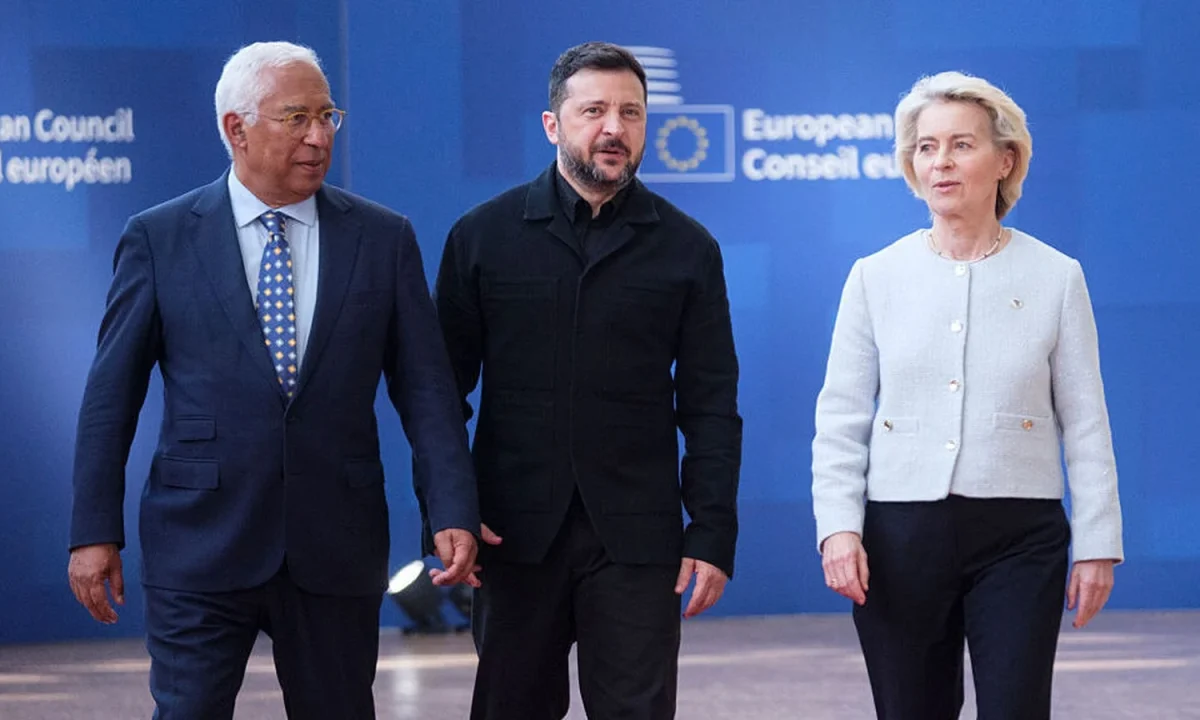
Volodymyr Zelensky told the EU summit that every democratic nation in Europe deserved to be in the EU (file pic)
Mr Zelensky, in comments posted in a video on X, told the summit that every democratic nation in Europe belonged in the EU and that “Ukraine merits this because it has paid more than any other country for its right to be free, independent and … European”.
European Union ambassadors agreed last week to move forward with membership talks for both Ukraine and ex-Soviet Moldova, with discussions set to begin on the first of six “clusters” designed to align laws and standards with those of the bloc.
“The future of Europe – free, united and of course in peace – is being decided in our defence. That shows how unique our situation is,” Mr Zelensky said.
He acknowledged that support for a faster accession process was not universal across the bloc.
“The most important such step – I know that not everyone loves this – could be a fast-track path for Ukraine to join the EU.”
Mr Zelensky also said Europe’s security depended on guaranteeing funding for Ukraine’s military, and that the EU together with the “coalition of willing” countries backing Kyiv could build the financial tools needed to make that happen.
A statement issued by the European Council after the summit welcomed the start of accession talks for Ukraine and said it “looks forward to the opening of the other clusters, in line with the merit-based approach”.
In an audio message released after the summit and an earlier meeting of the Ramstein group on military aid for Ukraine, Mr Zelensky again said Ukraine was ready for talks with Russian President Vladimir Putin on ending the war, now more than four years old.
But he also warned Europe against easing up, calling on leaders to keep pressure on Moscow.
“Europe has to be engaged for us to have a strong position, to commit fully on sanctions without loopholes, on confiscation without exceptions and on funding Ukraine,” he said.
Additional reporting: Reuters