
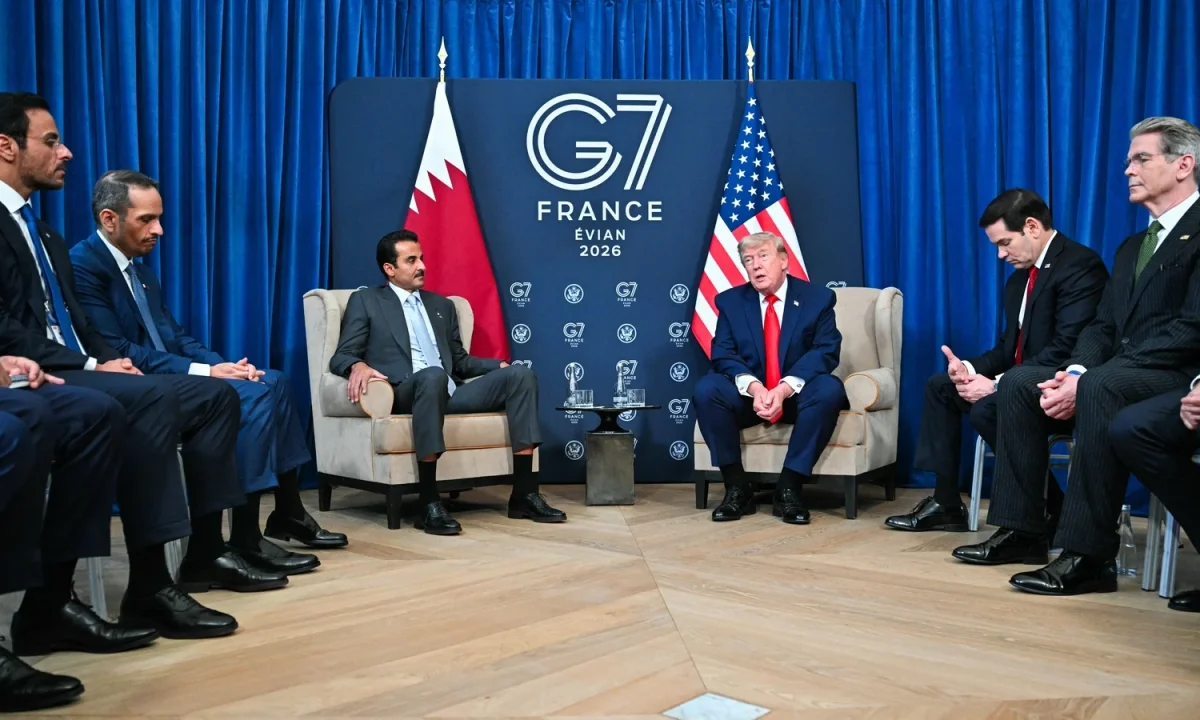
President Donald Trump declared that what he described as a US deal with Iran had moved into a new phase, insisting Washington would not put any money into the country as talks pressed ahead.
“We have our deal done with Iran, and it should be successful. It goes to a second stage, which I think would actually be easier,” he said during a press briefing at the G7 summit in France.
- Advertisement -
He said the agreement would ensure Iran never obtains a nuclear weapon, adding a stark warning that “all hell” would break out if Tehran sought to do so.
Earlier, Iran’s foreign minister said Iran and the US would begin another round of negotiations on Friday in Switzerland aimed at securing a final peace agreement after the formal launch of an interim deal.
“In our view, the two parties to this memorandum are the US and Israel on one side, and Iran and Hezbollah on the other,” he said.
“This is perhaps the most important issue in the memorandum – the declaration of an immediate and permanent end to the war on all fronts, including in Lebanon.”
A lasting truce between the US and Iran has yet to be sealed
Questions were still hanging over the interim deal meant to halt the war in the Middle East, with shippers warning that confidence may take weeks to recover even if the Strait of Hormuz reopens, while major issues remain unresolved.
The interim agreement would prolong a fragile ceasefire announced in April by another 60 days and reopen the Strait of Hormuz, which Iran has effectively blocked since the US and Israel attacked Iran in February.
Negotiators are expected to confront thorny matters in the next stage of talks, including the future of Iran’s nuclear programme.
Two other issues cited by Mr Trump and Israeli Prime Minister Benjamin Netanyahu to justify the war – ending Iran’s backing for regional armed proxies and restricting its missile programme – are not believed to be part of that negotiating agenda.
‘Very general document’
Oil prices dropped yesterday to their lowest point since 10 March, after the blockade of the Strait of Hormuz, the narrow channel between Iran and Oman, disrupted one-fifth of global oil trade.
By this morning, however, prices had steadied, signalling a more cautious mood, with Brent crude futures LCOc1 down 0.3% at $82.96 a barrel during Asian trading.
Iranian President Masoud Pezeshkian said in a social media post that the interim agreement was an “important step” toward ending the fighting, but stressed that a final accord for a durable truce “has yet to take shape.”
US Vice President JD Vance told CNN that the signed memorandum was a “very general document.” US officials said further details would be made public within the next two days.
Mr Vance said it contained “a very significant sanctions relief package” for Iran. He later told Fox News that Mr Trump could choose to release the agreement before Friday.
US and Iranian officials say the deal could eventually bring major economic gains for Iran through sanctions relief, the release of frozen foreign assets and the creation of a $300 billion reconstruction fund financed by neighbouring Gulf states that host US military bases.
US officials, speaking on condition of anonymity, said Iran would need to meet US demands that it never build a nuclear weapon and end support for militias such as Hezbollah in Lebanon to secure those benefits.
Iranian officials, who have consistently denied any intention to build a nuclear weapon, say they have conceded little by agreeing to resume diplomatic talks on Iran’s uranium enrichment programme, which were interrupted by the war.
Restoring trust
Even if the latest agreement loosens Iran’s grip on the Strait of Hormuz, that would amount only to a return to the prewar situation, and shippers say vessels will not resume normal traffic until they are convinced passage is safe.
Iran has indicated it intends to retain joint control of the strait with Oman. The US said the waterway would remain open toll-free for 60 days and that it expects that provision to carry into any final agreement.
Models of missiles and drones stand before a photograph of Iran’s late supreme leader
In a Truth Social post, Mr Trump said oil tankers were beginning to move out of the strait, “going along the Southern ‘Highway,’ which is totally safe, secure, and pristine”.
Fighting involving US ally Israel and the Iran-backed Hezbollah militia in Lebanon, which has displaced 1.2 million people, remains another major obstacle.
Iran has said the deal requires a complete halt to hostilities there, but Mr Netanyahu said Israel would maintain its forces in southern Lebanon and keep the right to respond to Hezbollah attacks.
“Iran wanted us to withdraw from it, but I stood firm,” he said. Israel has not taken part directly in the peace talks with Iran.
A US official said an Israeli pullout from Lebanon, which it invaded in March after Hezbollah entered the war, was not a condition of the deal.
Iranian Foreign Minister Abbas Araqchi said Israeli attacks must end immediately.